
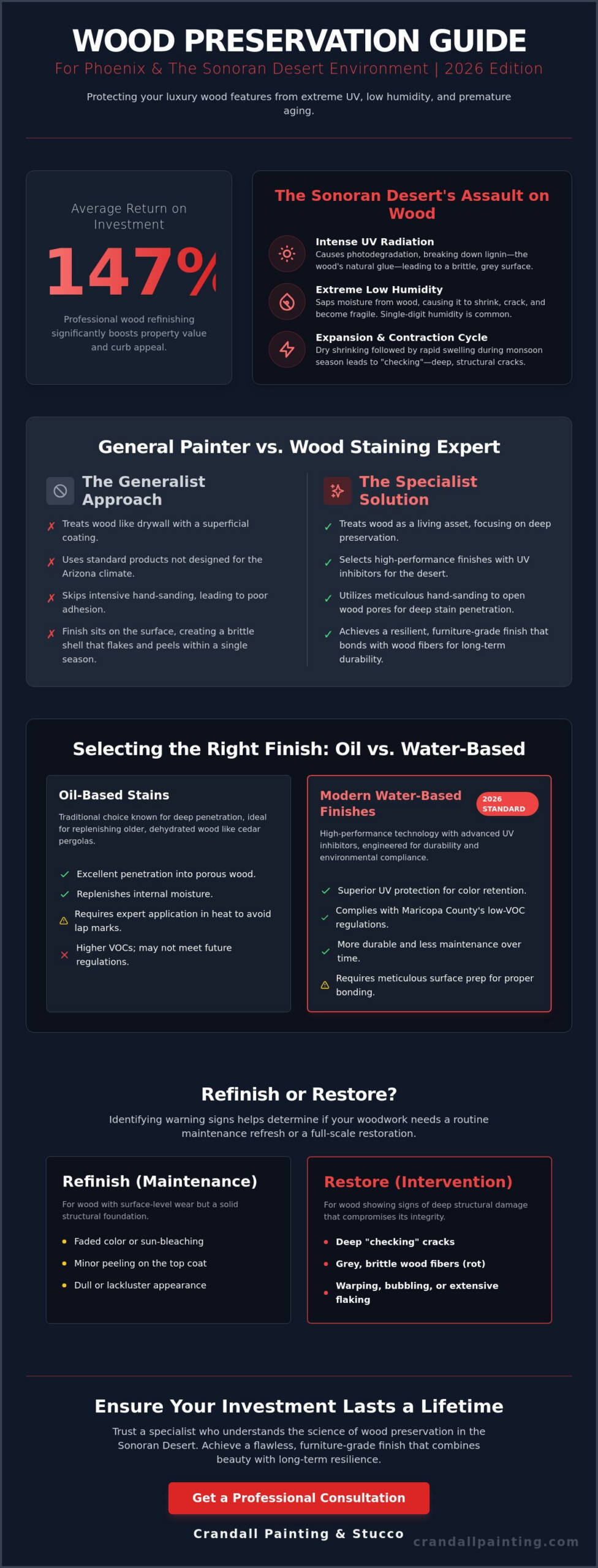
Did you know that refinishing your home’s wood features offers an average return on investment of 147%? In the unforgiving Sonoran Desert, your finest architectural details face a constant battle against intense UV radiation and extreme low humidity. You’ve likely seen the results: sun-bleached entry doors that peel or fine cabinetry that begins to crack under the atmospheric strain. It’s frustrating to invest in luxury wood only to watch it degrade because of the climate or inconsistent work from previous contractors who didn’t understand the local environment.
Partnering with a dedicated wood staining expert phoenix homeowners trust ensures your investment is preserved with the precision it deserves. We understand that in Arizona, wood restoration is a preservation science as much as an art form. This 2026 guide explores the latest techniques for achieving a rich, furniture-grade finish that thrives in the heat. We will preview the new AWI Standards 2026, explain Maricopa County’s strict low-VOC regulations, and look at the shift toward the warmer, desert-inspired palettes that define modern luxury living.
Key Takeaways
- Understand how the extreme Sonoran Desert UV levels and single-digit humidity degrade architectural wood and why specialized protection is required for longevity.
- Learn the critical differences between oil-based and high-performance water-based finishes to ensure your project complies with Maricopa County’s 2026 VOC regulations.
- Discover why a wood staining expert phoenix trusts utilizes hand-sanding and meticulous surface preparation to achieve a flawless, furniture-grade result.
- Identify the warning signs of deep structural damage, such as grey rot, to decide if your woodwork requires a routine maintenance refresh or a full-scale restoration.
- Elevate your property’s curb appeal and asset value by implementing professional standards that combine aesthetic beauty with long-term environmental resilience.
Why Phoenix Homeowners Require a Specialized Wood Staining Expert
Phoenix is beautiful but brutal. Organic wood fibers aren’t built for 115-degree summers without intentional, expert intervention. A general painter might treat your mahogany door like a piece of drywall, applying a superficial layer of pigment that quickly bubbles under the sun. In contrast, a wood staining expert phoenix homeowners trust treats wood as a living asset. The objective is never just a cosmetic change. It is about deep-penetrating structural preservation that stops the desert from reclaiming your high-end architectural features.
General contractors often fail in the Valley because they rely on standard products designed for temperate climates. In Scottsdale’s luxury estates, a “one size fits all” approach leads to inconsistent finishes and rapid degradation. These painters frequently skip the intensive hand-sanding required to open the wood’s pores, resulting in a stain that sits on the surface rather than bonding with the fibers. This creates a brittle shell that flakes off within a single season, leaving the underlying wood vulnerable to the elements.
The Science of Wood Dehydration in Arizona
UV radiation is a constant abrasive force in the Sonoran Desert. It triggers a process called photodegradation, where the sun’s rays dismantle lignin, the natural glue holding wood fibers together. Once lignin fails, the wood becomes brittle and grey. Combined with humidity levels that often drop into the single digits, the wood loses its internal moisture and shrinks. When the monsoon season arrives, the rapid intake of water causes the wood to swell violently. This cycle of expansion and contraction leads to “checking,” those deep, unsightly cracks that compromise the wood’s integrity. Wood weathering is the primary enemy of Phoenix estates, acting as a relentless countdown against your home’s exterior beauty.
Preserving Value in Luxury Residential Architecture
In high-end neighborhoods like Scottsdale and Paradise Valley, the entry door is more than a point of access; it’s a statement of quality. Professional staining ensures these custom features maintain their appraisal value by preventing the warping and peeling that suggest neglect. A master craftsman understands how to coordinate wood tones with local architectural elements, such as specific terracotta stucco finishes or desert stone accents. By choosing the right Wood stain, you create a seamless transition between the organic warmth of the wood and the surrounding landscape.
Investing in professional care extends the life of your pergolas, decks, and cabinetry significantly. Our approach focuses on long-term resilience rather than temporary fixes. You can explore the full range of our expertise by visiting our services page to see how we protect luxury properties throughout the Valley with meticulous attention to detail.
Selecting the Perfect Finish: Oil-Based vs. Water-Based Stains
The choice between oil and water-based finishes determines how gracefully your woodwork ages in the Arizona sun. It’s a strategic decision that balances chemical compatibility with environmental resilience. A seasoned wood staining expert phoenix professional understands that surface aesthetics are secondary to the underlying science of preservation. In the Sonoran Desert, your selection must account for extreme thermal expansion and the relentless breakdown of organic fibers.
Oil-Based Stains: The Traditional Choice for Deep Penetration
Oil-based stains remain a preferred option for older, porous wood that has suffered from years of dehydration. These products utilize natural oils that dive deep into the grain, replenishing the wood’s internal moisture and providing a flexible barrier against the elements. You’ll find that oil-based finishes are particularly forgiving on “thirsty” surfaces like aged cedar pergolas or structural beams. However, the Phoenix summer presents a unique challenge: heat accelerates drying times significantly. This requires a master’s touch to prevent lap marks and ensure an even, furniture-grade appearance. Regular maintenance is essential for oil finishes, as they naturally erode over time and require a refresh every few years to maintain their protective qualities.
Modern Water-Based Finishes and UV Inhibitors
In 2026, water-borne technology has reached a level of sophistication that rivals traditional oils. High-performance water-based stains now feature advanced UV-blocking resins specifically engineered to resist the intense radiation found in the Valley. These finishes often provide superior color retention, preventing the “silvering” effect common in sun-bleached wood. For interior projects, water-based options are nearly mandatory due to Maricopa County’s strict low-VOC regulations. They offer a cleaner application process with minimal odor, making them ideal for refined living spaces where air quality is a priority. For a deeper look at the technical aspects of wood finishing, research from the Forest Products Laboratory highlights how these modern resins create a durable shield against moisture loss.
Beyond the base chemistry, you must consider the opacity of the stain. Transparent stains are perfect for new, high-grade woods like mahogany or walnut where the grain is the star. Semi-transparent options offer a balance, adding rich desert tones like terracotta or ochre while still allowing the wood’s character to shine. For wood that shows signs of previous inconsistent work or deep weathering, a solid stain provides the most comprehensive protection. Regardless of your choice, a high-quality top-coat sealant is the final, essential step. It acts as a sacrificial layer that absorbs the brunt of environmental stress. If you’re ready to define a protection plan for your home’s architectural assets, a professional consultation can help you navigate these complex choices with confidence.
You can see how these various finishes perform across different architectural styles by visiting our services page, where we detail our approach to both interior and exterior wood preservation.
Refinishing vs. Restoration: Determining the Right Path for Your Wood
Discerning homeowners often use the terms “refinishing” and “restoration” interchangeably, yet they represent two distinct levels of care. Refinishing is a maintenance-level refresh designed for wood that is structurally sound but has lost its luster. It involves a light sanding and a fresh application of stain or sealant to maintain the protective barrier. In contrast, restoration is an intensive intervention required when the wood has suffered from grey rot, deep checking, or structural damage. A wood staining expert phoenix specialist must determine which path is necessary to ensure your home’s architectural features remain an asset rather than a liability.
The cost-benefit analysis of restoration is particularly compelling for custom features. While a high-end entry door in Scottsdale can be a significant investment, restoring it to its original glory often costs a fraction of a full replacement. Beyond the immediate aesthetic improvement, professional wood care offers a substantial return on investment. According to industry data, refinishing wood features can provide an average return on investment of 147%, making it one of the most effective ways to preserve property value in a competitive market like Phoenix or Paradise Valley. This type of value preservation is central to the work of specialists like Cascade Outdoor Services, who focus on high-quality deck restoration and structural outdoor construction. A master craftsman assesses the structural integrity of the grain to ensure the wood can still support a furniture-grade finish before beginning the work.
Signs Your Wood Needs Immediate Professional Attention
You can perform a simple “water drop test” to check the integrity of your current sealant. Place a few drops of water on the wood surface. If the water beads up, the protection is still active. If it soaks in within seconds, the wood is vulnerable to moisture loss and UV damage. Look for these visual cues that indicate a need for professional care:
- Silvering: A grey, weathered appearance that signals the breakdown of lignin.
- Peeling: Previous low-quality coatings that are no longer adhering to the fibers.
- Dark Water Stains: Indications that moisture has penetrated deep into the grain.
- Dead Fibers: Wood that feels soft or pulpy and no longer holds a consistent color.
These symptoms suggest that the Professional Standards for Wood Finishing must be applied to save the piece. When fibers become “dead,” they lose their ability to bond with new stains, requiring a master’s touch to revive the surface.
The Restoration Process: From Stripping to Final Polish
Restoration begins with removing failed previous finishes. We choose between chemical stripping and mechanical sanding based on the wood species and the severity of the damage. Chemical stripping is often safer for intricate custom details, while mechanical sanding is more effective for flat, weathered surfaces. A critical, often overlooked step is neutralizing the wood’s pH after stripping. If the surface remains too acidic or alkaline, the new stain will not bond correctly, leading to premature failure.
Once the wood is neutralized and hand-sanded to a smooth finish, it is ready for the “white-glove” staining process. This level of detail ensures the finish is consistent and durable enough to withstand the Arizona heat. For homes requiring a comprehensive exterior update, we often coordinate wood restoration with Exterior Painting Scottsdale services to ensure every surface of the estate is protected and visually harmonious. You can explore our full range of preservation techniques on our services page.
Professional Standards for Wood Staining in Luxury Phoenix Estates
Achieving a furniture-grade finish on an exterior surface requires more than just a brush and a bucket. It demands a meticulous adherence to professional standards that many general painters overlook. A true wood staining expert phoenix professional knows that surface preparation accounts for roughly 80% of the final result. Without proper mechanical and hand-sanding, the wood cannot absorb the stain uniformly. This is especially true for custom architectural details where machine sanders cannot reach. Hand-sanding ensures that every curve of a corbel or recessed panel of an entry door is properly opened to receive the pigment.
Application timing is critical in the Arizona heat. If you apply stain when the wood surface temperature is too high, the solvent evaporates too quickly. This results in “lap marks,” where overlapping brush strokes create dark, inconsistent streaks. To avoid this, we follow a strict climate-controlled schedule. This often means working in the early morning hours or in shaded sections of the estate to ensure the stain has adequate time to level and penetrate. The goal is a seamless, translucent glow that highlights the wood’s natural architecture rather than masking it.
The Importance of Grain Management
When liquid stain hits raw wood, it often causes the microscopic fibers to stand up, a process known as “raising the grain.” If left unmanaged, the final surface will feel like fine-grit sandpaper. Different species react uniquely to this moisture. For example, porous Red Oak might require more intensive management than the dense, oily fibers of Mesquite. Alder, a common choice for Phoenix luxury homes, can often take stain blotchily if not pre-conditioned. To achieve a perfectly smooth finish, an expert sands lightly with a high-grit paper between every coat to knock down raised fibers and ensure the subsequent layer bonds perfectly. This methodical approach is the hallmark of a master craftsman.
Final Sealants and Long-Term Maintenance Plans
The final sheen you choose should act as a bridge between your woodwork and the surrounding stone or stucco. While high-gloss finishes offer a traditional “piano” look, many 2026 luxury trends favor matte or satin sheens that feel more organic and desert-modern. These sealants aren’t just for show; they’re your primary defense against moisture loss. We recommend a scheduled maintenance program that includes annual inspections. Catching a small area of UV degradation early allows for a quick touch-up, preventing the need for a full-scale restoration later. Protecting your investment starts with a professional assessment of your home’s wood features to establish a baseline for care.
You can explore how we integrate these standards into our broader restoration projects by visiting our services page, where we detail our commitment to quality across every surface of your home.
The Crandall Difference: Bespoke Wood Restoration and Staining
Selecting a wood staining expert phoenix homeowners can trust means choosing a partner who views your property as a significant investment. At Crandall Painting & Stucco, our 20-year legacy in Scottsdale, Paradise Valley, and the greater Phoenix area is built on a foundation of uncompromising quality. We don’t believe in “standard” applications. Every project begins with an architectural assessment to ensure our custom finishes align with the specific grain patterns and environmental exposure of your estate. Our “Master Craftsman” approach ensures that your wood features don’t just survive the desert heat; they thrive within it.
What sets us apart is our ability to provide a holistic restoration experience. Because we also specialize in expert stucco repair and interior painting, we understand how different materials interact. We ensure that the rich mahogany tones of your entry door perfectly complement the specialized textures of your exterior walls. This integrated perspective allows us to maintain a unified aesthetic across your entire property, ensuring that every transition between wood, stone, and stucco is seamless and sophisticated. For homeowners with custom decorative garage doors, our expertise in wood garage door refinishing Scottsdale residents trust extends this same level of artisanal care to one of your home’s most prominent exterior features.
Our Meticulous Process for Discerning Clients
We recognize that our presence in your luxury home is a privilege. Our workflow is designed to be as unobtrusive as possible while maintaining a “white-glove” standard of cleanliness. This process includes:
- Protective Masking: We utilize surgical-grade masking techniques to protect your custom stone flooring, hardware, and surrounding landscaping.
- Artisanal Preparation: Every surface is hand-sanded and conditioned to ensure the wood fibers are perfectly prepared for deep pigment absorption.
- Precision Application: We apply stains and sealants in climate-controlled windows to prevent lap marks and ensure a flawless, furniture-grade finish.
- Final Artisanal Polish: Our team performs a detailed final inspection and polish to ensure the sheen and color are consistent across all architectural details.
Our commitment to respect and cleanliness is just as important as the final finish. You can view the full scope of our dedication to quality by exploring our services for a detailed look at our restoration capabilities.
Ready to Transform Your Woodwork?
In the Phoenix climate, local expertise is the best insurance for your home’s longevity. High-end wood restoration is a delicate balance of chemistry and craftsmanship that requires a deep understanding of how Sonoran UV levels affect organic materials. A professional consultation allows us to identify potential vulnerabilities before they become costly structural issues. By investing in a bespoke maintenance plan now, you protect the long-term appraisal value and curb appeal of your estate. When you are ready to elevate your home’s finest features, Contact Crandall Painting & Stucco for your custom wood staining quote and experience the difference that 20 years of local mastery provides.
Elevate Your Home’s Architectural Legacy
Protecting your home’s wood features requires more than a cosmetic update; it’s a commitment to long-term preservation. By understanding the science of desert dehydration and selecting advanced UV-blocking finishes, you ensure your investment remains resilient against the relentless Arizona sun. Whether you’re addressing sun-bleached entry doors, restoring a custom garage door through professional wood garage door refinishing in Scottsdale, or restoring intricate interior cabinetry—similar to the high-end custom work produced by Instacabinets—the right technical approach safeguards both the beauty and the structural integrity of your property. Quality work doesn’t just look better; it lasts longer.
Partnering with a wood staining expert phoenix specialist ensures your property receives the artisanal care it deserves. Since 2004, our family-owned business has provided Scottsdale and Paradise Valley homeowners with specialized wood restoration techniques that exceed standard painting practices. We take pride in our master craftsman approach, treating every grain of wood as a vital part of your home’s story. For homeowners whose kitchens and living spaces have suffered under the Arizona sun, our dedicated wood cabinet restoration service offers a sophisticated alternative to full replacement, preserving the structural integrity and character of your original woodwork. It’s time to restore the warmth and sophistication that only high-quality woodwork can provide.
Schedule your expert wood staining consultation with Crandall Painting & Stucco today and discover how we can transform your home’s exterior and interior features with precision and care.
Frequently Asked Questions
How often should I restain my exterior wood doors in Phoenix?
Restaining exterior doors typically occurs every 2 to 3 years for surfaces with direct southern exposure. The intense Sonoran sun degrades the protective top coat much faster than in more temperate regions. If your door is sheltered by a deep portico, you might extend this interval to 5 years. Regular inspections help you catch thinning sealants before the underlying wood fibers suffer permanent UV damage.
Can you change the color of my existing dark wood stain to something lighter?
Transitioning from a dark stain to a lighter tone is possible, though it requires a comprehensive restoration process. We must chemically strip the existing dark pigments and perform deep mechanical sanding to reach the raw, untainted wood. This reset allows us to apply a lighter, desert-inspired palette like sand or pale ochre. It’s a labor-intensive transformation that restores the wood’s natural luminosity and character.
What is the best time of year to stain exterior wood in Arizona?
The ideal windows for exterior staining in Arizona are the spring and autumn months, specifically from March through May and October through November. During these periods, temperatures remain moderate, which prevents the stain from drying prematurely. Applying finishes in the 110-degree summer heat often causes the product to flash-dry on the surface. This creates unsightly lap marks and prevents the deep penetration necessary for protection.
Why is my wood stain peeling or bubbling after only a year?
Peeling or bubbling is almost always the result of inadequate surface preparation or trapped moisture. If the wood wasn’t properly sanded to open the pores, the stain merely sits on the surface like a film. High heat then causes the air or moisture beneath that film to expand, leading to bubbles. Using a high-quality product over an old, incompatible finish can also trigger this type of premature failure.
Is it better to use a solid stain or a semi-transparent stain for sun protection?
Solid stains provide the highest level of UV protection because they contain more opaque pigments that block the sun’s rays. However, they mask the natural beauty of the wood grain. If you prefer to showcase the wood’s character, a high-performance semi-transparent stain with added UV inhibitors is a sophisticated alternative. The choice depends on whether you prioritize maximum environmental shielding or the organic aesthetic of the grain.
How do I know if my wood is too far gone for restoration?
Wood is likely beyond restoration if it displays deep structural rot or if the fibers have become soft and pulpy. You can test this by pressing a small tool into a suspicious area. If the wood crumbles or the tool sinks in without resistance, the integrity of the grain is compromised. In these cases, replacement is the more secure option to maintain the high architectural standards of your estate.
Do you offer custom color matching for existing cabinetry and beams?
We provide precise custom color matching to ensure new wood features blend seamlessly with your existing cabinetry and structural beams. Our master craftsmen utilize artisanal touch-up and decorative painting techniques to replicate the patina of aged wood. This is essential for luxury homes where additions must look like original architectural elements. We carefully balance undertones to achieve perfect visual harmony across all surfaces.
What is the difference between a general painter and a wood staining expert?
A general painter typically treats wood as a flat surface to be covered, whereas a wood staining expert phoenix specialist focuses on the cellular preservation of the material. Our process involves deep grain management, pH neutralization, and the use of specialized resins designed for the Arizona climate. We view staining as a technical science that ensures your high-value architectural assets remain protected and beautiful for years.