
Is that small flake of paint on your exterior a simple cosmetic touch-up, or is it the first warning sign of a structural failure? In the unforgiving heat of the Sonoran Desert, ignoring a minor blemish can quickly evolve into a significant restoration project. You’ve likely spent years curating your home’s architectural beauty, so seeing the texture begin to bubble or shed is understandably unsettling. Understanding what to do about peeling stucco Phoenix properties often face is the first step in protecting your luxury asset from escalating repair costs.
This master craftsman’s guide provides the clarity you need to restore your home’s exterior before the 2026 monsoon season arrives. We’ll explore the specific environmental causes of stucco failure in our region and provide a clear path toward a seamless, invisible repair. You will discover how a methodical restoration process moves beyond a temporary patch to ensure your home’s architectural integrity and curb appeal remain fully restored for years to come.
Key Takeaways
- Understand how extreme Sonoran Desert temperatures create an “Oven Effect” that compromises the bond of your home’s exterior finish.
- Learn to identify the difference between cosmetic paint issues and structural delamination by using the professional “Tap Test” method.
- Discover exactly what to do about peeling stucco Phoenix properties require to maintain a flawless architectural appearance and prevent moisture intrusion.
- Explore the benefits of a methodical, five-step restoration approach that ensures repairs remain invisible and durable through the 2026 monsoon season.
- Recognize why specialized restoration expertise is essential for luxury estates to avoid the common “patchwork quilt” aesthetic of low-quality repairs.
The Science of the Sonoran: Why Phoenix Stucco Peels
Peeling stucco is far more than an aesthetic nuisance. It represents a fundamental loss of adhesion between the decorative finish coat and the underlying cementitious layers. To truly grasp why your home’s exterior is failing, it helps to understand what stucco is and how its traditional mix of cement, sand, and lime reacts to the unique stresses of the Arizona climate. In our region, the environment acts as a relentless testing ground for building materials. When homeowners ask what to do about peeling stucco Phoenix experts look first at the bond integrity. This separation often begins at a microscopic level before manifesting as visible flakes or bubbles on your estate’s facade.
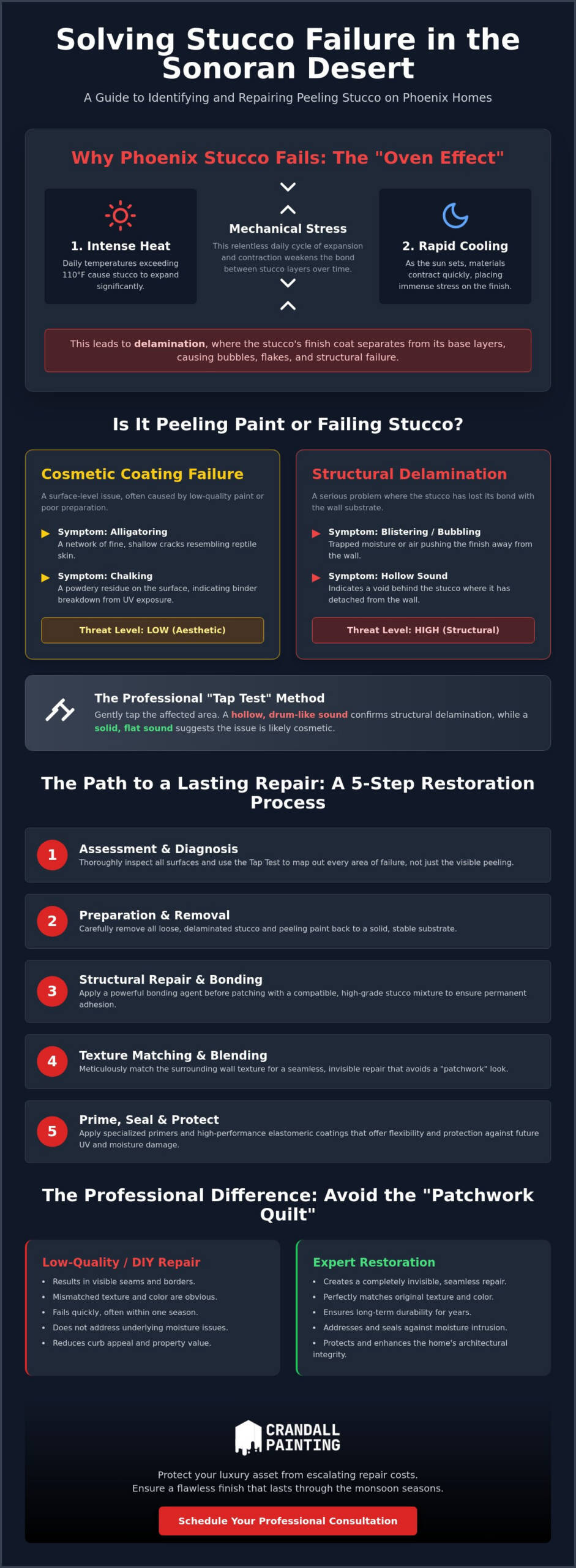
The “Oven Effect” serves as the primary catalyst for this deterioration. Phoenix regularly experiences temperatures exceeding 110°F, which creates intense thermal expansion within the wall system. As the sun sets, the rapid cooling causes the materials to contract. This daily cycle of stretching and shrinking places immense mechanical stress on the stucco. Over time, the finish loses its elasticity and can no longer bridge the movement, leading to delamination. Modern coatings often contain polymers designed to provide flexibility, but the sheer intensity of the Sonoran heat can exceed the performance limits of standard retail products.
The Impact of Extreme Heat and UV Intensity
Sustained exposure to Arizona’s high UV index does more than just fade colors; it chemically degrades the binders that hold the coating together. You may notice a fine, powdery residue on your hand after touching the wall. This “chalking” phase is a clear indicator that the protective resins have broken down, leaving the surface brittle and porous. South and west-facing walls typically fail first because they endure the most direct, punishing afternoon sun. Without the right exterior painting or restoration strategy, these surfaces become highly susceptible to shedding.
Monsoon Moisture and Efflorescence
Moisture is the silent killer of desert stucco, particularly during the humid monsoon months. When rain hits a brittle surface, water seeps into hairline cracks and travels behind the finish. As the wall dries, it triggers efflorescence, a process where mineral salts migrate to the surface. These salts crystallize behind the paint or finish coat, exerting enough pressure to physically push the material away from the wall. With the 2026 weather outlook suggesting a robust monsoon season, ensuring your moisture barriers are intact is essential for long-term protection. Understanding what to do about peeling stucco Phoenix requires addressing these hidden salt deposits before applying any new finish.
Peeling Paint vs. Delaminating Stucco: Identifying the Failure
Identifying the specific nature of your home’s exterior wear is the first step in determining what to do about peeling stucco Phoenix homeowners find most concerning. While surface-level paint flakes may appear similar to deep-seated delamination, the underlying causes and required solutions differ significantly. A cosmetic failure is often limited to the aesthetic coating. True delamination, however, indicates that the stucco itself has lost its structural bond with the building’s lath or substrate. Distinguishing between these two requires a trained eye and a methodical approach.
To differentiate between these scenarios, we often utilize the “Tap Test.” By gently tapping the affected area with a wooden tool or your knuckles, you can listen for a hollow, drum-like sound. This resonance indicates a void where the stucco has physically detached from the wall. If the sound remains solid and flat, the issue is likely confined to the paint layers. Guidelines for professional restoration suggest that ignoring these hollow spots allows moisture to accumulate, eventually compromising the entire wall system. This trapped vapor creates “blistering,” where the finish bubbles outward as it struggles to breathe.
Signs of Cosmetic Coating Failure
Cosmetic issues often manifest as “alligatoring,” which looks like a network of fine, shallow cracks resembling a reptile’s skin. This usually stems from poor prep work during a previous painting project or the use of low-quality materials that cannot withstand the desert sun. While unsightly, these surface-level flakes don’t always indicate a structural threat. However, simply power washing and repainting over these areas is a temporary fix. Without proper mechanical abrasion and bonding agents, the new layer will inevitably fail within a few seasons.
Warning Signs of Structural Stucco Damage
Structural failure is more aggressive and requires immediate attention to prevent systemic decay. You might notice “spalling,” where actual chunks of the cementitious material fall away from the wall, exposing the layers beneath. If you see reddish-brown stains, it’s a sign that moisture has reached the metal lath, causing corrosion that expands and pushes the stucco off. Understanding the technical nuances of these failures is the key to Mastering Stucco Repair in Phoenix. Addressing these issues early protects your estate from the high costs of a full-scale replacement. If you suspect your home is showing signs of deep-seated wear, a professional exterior assessment can provide the clarity needed to preserve your investment.
The Risk of DIY: Why Professional Restoration Is Essential
It’s tempting to view a small area of delamination as a simple weekend project. However, for a high-value estate, the risks of a localized patch far outweigh the perceived savings. When determining what to do about peeling stucco Phoenix residents often find that store-bought “stucco in a tube” or generic patch kits create a jarring visual discrepancy known as the “patchwork quilt” effect. These quick fixes rarely match the density or chemical composition of the original wall, leading to uneven drying and eventual cracking at the repair site.
One of the most significant dangers involves the use of improper materials, such as non-breathable sealants that trap moisture within the substrate. As detailed by building experts regarding the causes of stucco failure, trapping water behind the finish coat accelerates the decay of the underlying wood framing or metal lath. Professional restoration involves moisture detection technology that identifies hidden dampness before it can compromise your home’s structural skeleton. Without this diagnostic step, you aren’t fixing the problem; you’re merely hiding it.
The Challenge of Texture Matching
Replicating the nuanced “Santa Fe” or “Lace” finishes found in Scottsdale and Paradise Valley is a disciplined art form. These textures are hand-applied and carry the unique signature of the original craftsman. Blending a new repair into a 20-year-old weathered surface requires an artisanal touch that standard painters simply don’t possess. Crandall’s stucco repair process focuses on hand-tooling every edge to ensure a seamless transition that disappears into the surrounding wall.
Long-term Value vs. Short-term Savings
A poorly executed repair is often more damaging to an estate’s value than the original peel itself. Discerning buyers and inspectors immediately flag inconsistent exterior textures as a sign of deferred maintenance. When deciding what to do about peeling stucco Phoenix homeowners should weigh the immediate cost against the long-term protection of their investment. Opting for a “white-glove” restoration service preserves your property’s status as a premium asset while providing peace of mind against future failures. Professional restoration preserves the architectural intent of a home by maintaining a cohesive, uninterrupted aesthetic that honors the original design.
The Crandall Method: A 5-Step Stucco Restoration Process
Restoring a luxury exterior requires more than a bucket of patch compound and a paintbrush. It demands a disciplined, methodical protocol that addresses both structural stability and aesthetic perfection. When considering what to do about peeling stucco Phoenix homeowners deserve a solution that lasts a decade, not just until the next summer heatwave. Our “Master Craftsman” approach relies on desert-tested materials and a multi-layered technique designed to integrate seamlessly with your home’s original architecture. By combining these steps with our comprehensive Our Services, we ensure your estate’s exterior is not only repaired but fully renewed.
Step 1 & 2: Evaluation and Strategic Removal
Precision begins with a thorough diagnostic phase. We utilize professional moisture testing to confirm the substrate is dry and structurally sound before any new material is applied. Once the assessment is complete, we meticulously remove all loose or failing material. This process continues until we reach a “hard edge.” A hard edge is defined as the precise point where the existing stucco remains perfectly bonded to the substrate, providing a stable and immovable foundation for the restoration.
Step 3 & 4: Bonding and Artisanal Texturing
To ensure the new patch becomes one with the original wall, we apply high-grade bonding agents that act as a chemical bridge between the old and new layers. This is followed by the “Art of the Match,” where our craftsmen hand-tool the new stucco to mirror your home’s unique texture. Whether your estate features a subtle Santa Fe finish or a complex Lace texture, our goal is a repair that is invisible to the naked eye. We respect the necessary curing times even in the intense Phoenix heat, as rushing this stage is the most common cause of immediate repair failure.
Step 5: High-End Finishing and Protection
The final stage involves preparing the new surface for its protective coating. We perform pH testing on the fresh stucco to ensure it has neutralized, preventing the “burning” of the finish coat that often plagues amateur repairs. For the 2026 climate, we select premium elastomeric or high-build acrylic coatings that offer superior UV resistance and flexibility. These final touches make the repair indistinguishable from the rest of the facade while providing a robust shield against the elements.
If you are ready to move beyond temporary patches and invest in a permanent solution for your home, we invite you to schedule a professional restoration consultation today.
Choosing a Specialist for Your Phoenix Estate
Selecting the right partner for your home’s exterior is a decision that impacts both immediate curb appeal and long-term asset value. While many general contractors offer broad services, they often lack the specialized masonry knowledge required to address the chemical and structural nuances of desert finishes. When considering what to do about peeling stucco Phoenix luxury homeowners must prioritize specialists who treat restoration as a disciplined craft rather than a simple maintenance task. A general painter might apply a fresh coat of color over a failing surface, but a master craftsman identifies the root cause of delamination to ensure the repair remains stable for years.
The Crandall difference lies in our unique ability to bridge the gap between structural durability and the decorative arts. We understand that your home is a significant investment in your lifestyle, and every repair must honor its original architectural intent. When evaluating a contractor’s portfolio, look beyond the “before and after” photos of vibrant paint. Instead, look for evidence of seamless texture matching where the repair site is indistinguishable from the surrounding wall. True mastery is found in the details that you cannot see, ensuring your home retains its prestigious character.
Exclusivity and Reliability in Scottsdale
Local expertise is indispensable when working in prestigious enclaves like Paradise Valley, DC Ranch, and Silverleaf. These communities feature specific desert-modern and Mediterranean architectures that require a bespoke service model. A partner who understands the distinct environmental pressures of these micro-climates can provide tailored solutions that standard residential painters often overlook. Our approach is designed for the discerning client who values meticulousness, reliability, and a white-glove experience throughout the entire restoration process.
Next Steps for Your Property Restoration
Taking action before the next extreme weather cycle is the most effective way to protect your estate. Scheduling a professional consultation allows for a comprehensive “Master Craftsman” assessment of your home’s exterior. During this initial visit, we evaluate moisture levels, substrate integrity, and texture complexity to develop a precise restoration plan. This proactive approach ensures that your home remains a beautiful, protected sanctuary regardless of the intensity of the Sonoran heat. We invite you to consult with Crandall Painting & Stucco for your restoration needs and discover the transformative power of quality workmanship.
Securing the Architectural Future of Your Estate
Your home’s exterior is the first line of defense against the unforgiving Sonoran climate. We’ve explored how daily thermal cycles and intense UV radiation degrade standard finishes; and why identifying the difference between cosmetic flaking and structural delamination is vital for your property’s health. By understanding these environmental factors, you’ve gained the clarity needed to decide what to do about peeling stucco Phoenix properties face before minor issues become systemic failures. Choosing a methodical restoration over a temporary patch ensures your architectural vision remains uninterrupted.
Since 2004, our team has focused on restoring high-end Scottsdale estates with a commitment to artisanal texture matching and decorative excellence. Our specialized expertise in climate-resilient coatings ensures that your restoration survives the 2026 monsoon season and beyond. Don’t leave your architectural investment to chance or amateur patches that compromise curb appeal. We invite you to Request a Professional Stucco Restoration Consultation to begin the process of renewing your home’s facade with the precision it deserves. Your property’s beauty is a reflection of your lifestyle, and we’re here to protect that vision with quiet confidence and disciplined mastery.
Frequently Asked Questions
Is peeling stucco a sign of water damage?
Peeling stucco is frequently a primary indicator of water damage beneath the surface. When moisture penetrates the finish, it can lead to efflorescence or the corrosion of the internal metal lath. Addressing these underlying moisture issues is a critical part of knowing what to do about peeling stucco Phoenix homes experience during high-humidity cycles. It’s essential to identify the source of the intrusion before applying new materials.
Can I just paint over peeling stucco to fix it?
Painting over peeling stucco won’t resolve the issue and often accelerates the damage. The new paint only adheres to the failing layer, causing the entire section to shed even more quickly. A successful restoration requires the complete removal of loose material and the application of a proper bonding agent. This ensures the new finish becomes a permanent part of the wall rather than a temporary mask.
How much does it cost to repair peeling stucco in Phoenix?
The investment required for restoration depends on the degree of delamination and the complexity of your home’s architectural texture. While surface-level repairs are less intensive, systemic failures involving lath corrosion require a more comprehensive scope of work. Because every luxury estate has unique requirements, a professional assessment is the only way to ensure an accurate and fair plan for your specific property.
How long does a professional stucco repair last in the Arizona sun?
A professional restoration performed with premium, UV-resistant materials typically lasts a decade or longer. Its longevity depends on the quality of the bonding agents and the flexibility of the final protective coating. Our desert-tested methods are designed to withstand the extreme thermal expansion that occurs during the height of the Arizona summer. Using the right materials ensures the repair remains stable and beautiful.
What is the difference between a hairline crack and peeling stucco?
A hairline crack is a narrow separation in the surface, while peeling indicates a total loss of adhesion between the stucco layers. While a crack may seem minor, it acts as a gateway for moisture to enter the substrate. If you leave these small openings unsealed, they eventually lead to the large-scale delamination and peeling that compromises your home’s exterior integrity.
Why is my stucco peeling specifically on the bottom of my walls?
Peeling at the base of a wall is usually caused by rising damp or moisture wicking from the ground. This occurs when soil, mulch, or irrigation spray consistently saturates the stucco, allowing water to migrate upward through the porous cement. Ensuring your home has proper drainage and a clear weep screed helps prevent this specific type of failure. It’s a common issue in desert landscapes with high irrigation needs.
How do you match the texture of old stucco?
Matching aged stucco requires an artisanal approach that involves hand-tooling and custom blending of the finish coat. We analyze the original sweep, trowel depth, and aggregate size to replicate the unique signature of the initial craftsman. This meticulous process is essential for maintaining the seamless aesthetic required for high-end residential architecture. When done correctly, the transition between the old and new surfaces is completely invisible.
Should I repair my stucco before or after monsoon season?
Repairing your exterior before the monsoon season is the most strategic choice for long-term property protection. Securing the moisture barrier before the heavy rains of July and August prevents water from entering existing cracks and causing deeper structural decay. Proactive maintenance is a key part of what to do about peeling stucco Phoenix estates need to remain resilient. It’s better to seal the home when the substrate is dry.