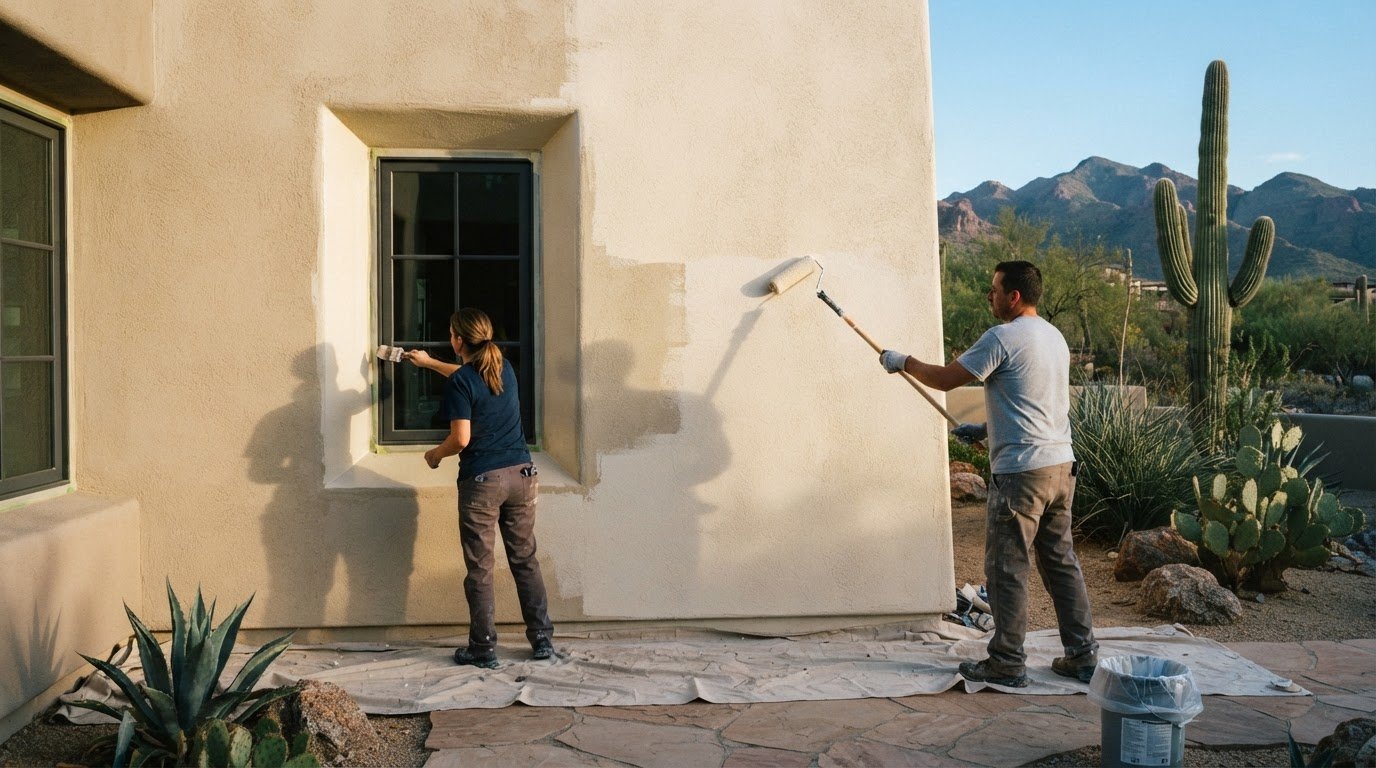

A successful Spanish-style stucco repair restores more than the visible surface: the backing, finish coat, and surrounding texture all matter. In Carefree, the right approach depends on whether the damaged area sits over framing, adobe brick, or stone, and how closely the repair needs to match the original finish.
It’s easy to focus on a crack or discolored patch, but Spanish-style walls bring together materials and details that need to be considered as a whole. This guide explains what to look for in stucco repair for Spanish style homes in Carefree, from metal lath and wire to finish-coat repairs and texture matching.
You’ll also learn how sand, lace, raised, and smoother finishes differ, and why the underlying adobe brick or stone can affect the repair. This context can help you understand what a careful restoration involves and how it can preserve your home’s character.
Key Takeaways
- Stucco repair should account for the support beneath the finish, especially around architectural details such as eyebrow hoods, where weatherproofing, expanded metal, and wire support the first coat.
- Exposed base coat and discoloration call for a finish repair that considers the surrounding surface; on white stucco, a clean, rust-free trowel helps prevent a dirty appearance.
- Medium- or fine-grain sand textures can conceal cracking more effectively than smoother finishes, while lace and raised textures create distinct surface patterns.
- Texture choices affect both appearance and application: a Santa Barbara smooth finish uses two coats, while pebble-dash finishes use small pebbles.
- Identifying whether stucco covers adobe brick, stone, or another substrate helps clarify what the repair needs to address beneath the visible surface.
Applying expanded metal and wire to support stucco
In Carefree, permit and code review depend on the work’s scope. A finish-coat patch differs from work that changes framing, openings, or structural support, and those distinctions shape what review may apply. For a Spanish Colonial Revival eyebrow hood, the support assembly also matters: weatherproofing covers the structure, while expanded metal and chicken wire support the first stucco coat.
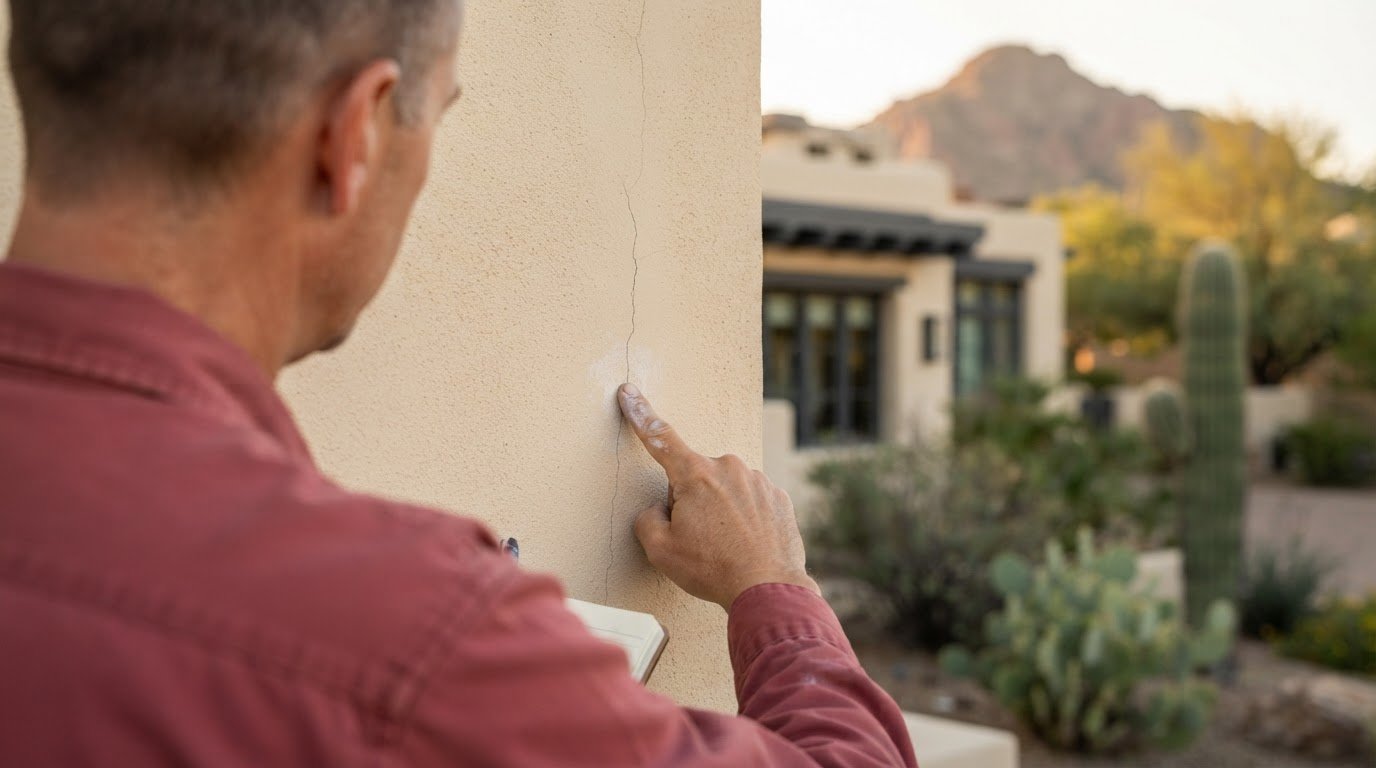
Diagnosis starts by tracing a visible crack or discoloration to its likely source. Examine the stucco around the damaged area, nearby openings, and transitions between materials. A crack near a window eyebrow, for example, warrants a close look at the hood’s attachment and the surrounding wall. Moisture staining or loose plaster can signal damage beyond the surface. The repair scope should reflect the observed condition of both the finish and its backing.
There’s no reliable per-square-foot price that applies to every Spanish-style repair in Carefree. The project price depends on the damaged area, access, backing condition, and finish detail required. A free, no-obligation estimate establishes the cost for that scope. A small finish-coat repair and one involving failed support are different jobs, even if their visible patches appear similar in size.
A supported architectural feature is built in layers. Structural plywood on the framing provides backing for decorative elements such as window eyebrow hoods and iron grilles. The hood is wrapped in weatherproofing, then expanded metal and chicken wire are applied to support the first stucco coat. This sequence helps the fresh plaster adhere to a stable base rather than relying on the finish layer alone.
Detail placement matters. On a Spanish Revival eyebrow hood, the decorative window grille is bolted to the underside before stucco is applied. This order integrates the grille’s attachment with the feature instead of requiring fasteners through a completed finish. Expanded metal and wire have different forms, but both support the first coat across shaped details.
Crack and water-damage repairs should reflect the wall’s condition. First, identify loose or failed stucco and assess the backing. Then address the moisture source before rebuilding the finish. Where support is damaged, restore the backing and lath assembly before applying the stucco coats and reproducing the surrounding texture. A surface cover alone leaves the damaged layer in place.
When considering a repair, look for a clear explanation of the observed damage, the support involved, and the proposed finish. For example, a scope for an eyebrow hood should account for its weatherproofing, framing support, metal, wire, and grille attachment. A precise description makes it easier to understand what the repair includes and how the new surface will meet existing Spanish-style details.
Delaying a repair can allow moisture or movement to affect more than the visible finish. Covering failed stucco without addressing its backing can conceal the condition instead of resolving it. The extent of removal should reflect what is loose or damaged, not just the area that looks discolored from outside.
Repair time depends on the affected area, support work, detail complexity, and the time needed between plaster coats. Crandall Painting & Stucco provides a two-year warranty on its work. Confirm that the written project agreement clearly defines the repair scope, whether it addresses the finish coat or the support beneath it.
Permit and code review depend on the repair’s scope. A finish-coat patch differs from work that changes framing, openings, or structural support, and those distinctions determine what review may apply.
Repairing finish-coat discoloration and exposed base coat
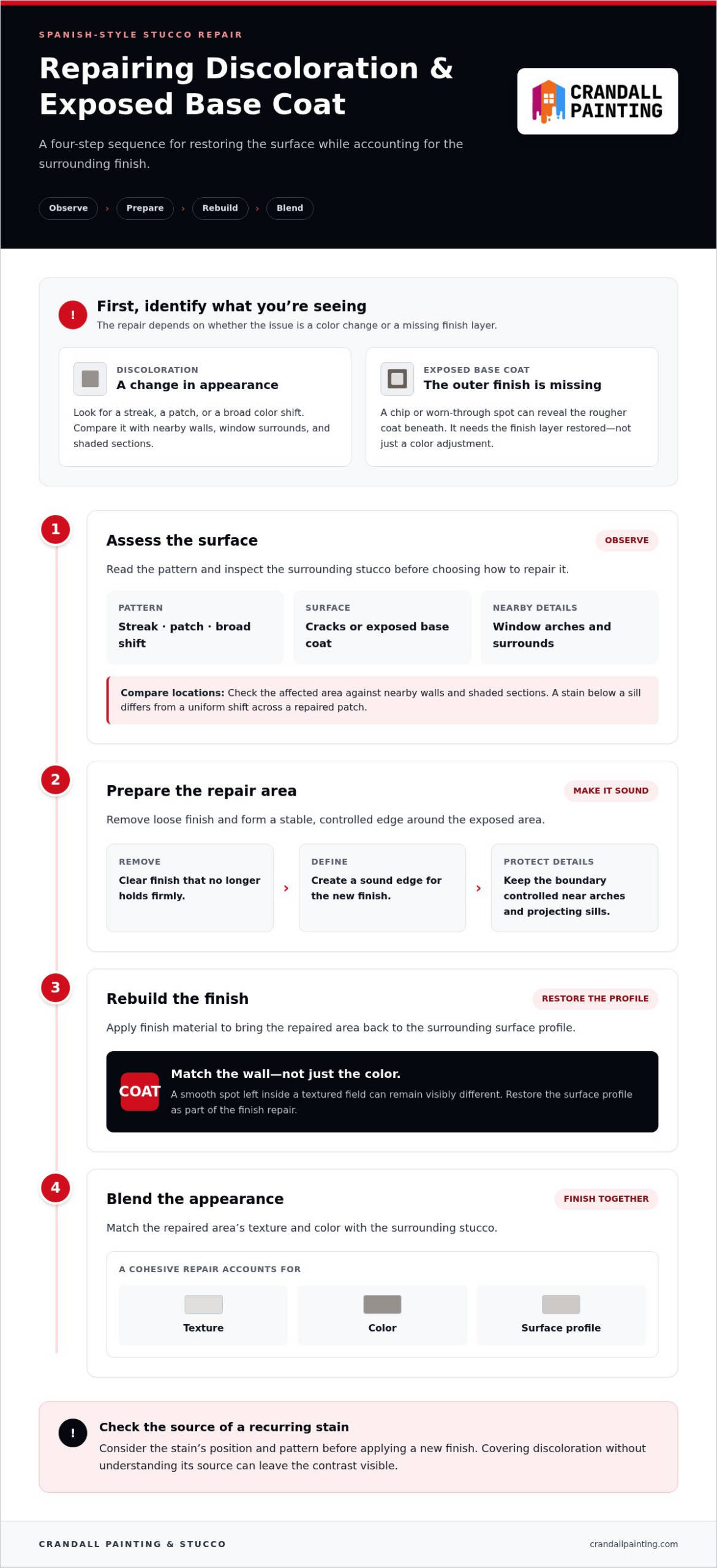
Discoloration on an exterior stucco wall can make a Spanish-style facade look uneven, especially across broad white or off-white surfaces. Compare the affected area with nearby walls, window surrounds, and shaded sections. A stain concentrated below a sill differs from a uniform color shift across a repaired patch. The location and pattern can help distinguish surface soiling from a mismatch in finish material or application.
An exposed base coat needs more than a color adjustment. It means the outer finish layer is missing or worn through, revealing a different surface. For example, a small chip beside an arch may expose the rougher coat beneath. Restoring the finish means bringing the area back to the surrounding surface profile, then matching its color and texture.
Preparation shapes the result. Identify loose edges around the exposed area and remove material that no longer holds firmly. Keep the repair boundary controlled, especially where stucco meets an arched opening or projecting sill. If the damage is near a recurring stain, consider its position and pattern before applying a new finish. Covering discoloration without understanding its source can leave the contrast visible.
- Assess the surface. Note whether discoloration appears as a streak, a patch, or a broad shift. Check the surrounding finish for cracks, exposed base coat, and changes around details such as window arches.
- Prepare the repair area. Clear loose finish and create a sound edge around exposed base coat. A stable edge gives the new finish a defined transition rather than a fragile overlap.
- Rebuild the finish. Apply the finish material to restore the wall’s surface profile. Keep the repair consistent with the surrounding stucco instead of leaving a smooth spot within a textured field.
- Blend the appearance. Match the texture and color across the repaired area. On white stucco, a clean, rust-free trowel helps prevent a dirty appearance during finishing.
Tool cleanliness matters on pale finishes. A rust mark from a trowel can leave a dark streak that stands out against white stucco, even when the repair itself is sound. Around a Spanish-style doorway, that contrast may draw attention to the patch instead of the arch. A clean, rust-free tool helps preserve the intended appearance.
Color matching also depends on the repair’s size and placement. A small patch beside a shaded courtyard wall may look different from a larger section exposed to direct light. Compare the finish in the conditions where it will be seen, and assess transitions at corners, recesses, and openings. These edges can make slight variations especially noticeable.
A careful finish-coat repair restores continuity without disguising a deeper problem. If discoloration comes with loose stucco or exposed base coat, address the damage before treating the wall as a paint-only issue. The final surface should follow the existing texture and architectural lines so the repair sits naturally within the home’s exterior rather than appearing as an isolated patch.
Sand, lace, and raised textures
Texture determines how light moves across a Spanish-style wall and how visible small surface variations become. A medium- or fine-grain sand finish creates a granular surface that can make cracking less noticeable than a smoother finish. Lace texture adds patterned relief, while a raised finish creates more pronounced peaks and recesses. These differences matter when a repair must blend into an existing home style.
Sand finishes use visible grains to create an even, stippled surface. The grain can be subtle or more apparent, depending on the material and finishing technique. On a broad wall, fine-grain sand may look restrained from a distance, while medium grain creates a stronger texture up close. Neither finish repairs an underlying crack; it changes how the surface looks and how noticeable minor cracking may be.
Lace finishes create repeated, irregular patterns across the stucco. A patch can stand out if its pattern differs from the surrounding wall. For example, a repair beside an arched entry should follow the nearby lace pattern, not just match its color. Texture matching includes the height, spacing, and direction of the raised marks.
Raised finishes have more pronounced surface variation than sand textures. Their shadows shift with the sun, making differences easier to see across corners, recessed windows, and curved walls. Before repairing a raised surface, identify how the existing marks overlap and where their peaks sit. Reproducing those elements helps prevent a patch from looking like a flat insert on a textured facade.
- Sand: Medium- or fine-grain texture offers more visual concealment of cracking than a smoother finish.
- Lace: Reproduce the surrounding pattern and relief, especially beside arches and window recesses.
- Raised: Match the high and low points so changing light does not exaggerate a patch.
A useful comparison starts with an intact area beside the damage. Look at the wall straight on, then from an angle where grazing light reveals surface depth. For instance, a patch under a window may appear close in color but still look smooth beside a lace finish. Assessing both texture and profile helps identify what needs blending.
Texture should follow the home’s existing architectural character rather than introduce a competing pattern. A sand-finished courtyard wall may need a different match from a raised surface around an exterior arch. The repair also needs a sound base: added texture can soften the appearance of minor cracking, but it cannot replace repairing damaged stucco. Distinguishing concealment from repair helps preserve the wall’s finish and underlying condition.
Stucco texture options
Texture shapes how a Spanish-style facade catches light and frames architectural details. Around arched windows, smooth stucco emphasizes the curve, while a textured finish creates stronger shadows. In Carefree, matching the existing finish helps a repair sit naturally beside the original wall. The right choice depends on the surrounding surface, desired appearance, and how much texture already defines the home.
A Santa Barbara mission finish has subtle undulation created with steel-trowel methods. Its restrained movement gives a wall more depth than a uniformly smooth surface without creating a pronounced pattern. Because the texture comes from hand-applied variation, a repair must echo the nearby surface’s gentle rises and dips. A uniform, flat patch can stand out beside this finish, especially near a curved window opening.
Smooth stucco offers a clean, refined appearance, but it tends to crack more than other stucco textures. A smooth white finish can use finer aggregates and a pool trowel or steel-trowel float. A Santa Barbara smooth finish requires two coats. The base coat should be roughly 3/8 inches thick before the finish coat, helping prevent concrete or cinder blocks from showing through. These details influence both the finish’s appearance and the layers beneath it.
Pebble-dash and drydash finishes bring visible aggregate into the surface. Pebbles used for these finishes are about 1/8 to 1/4 inch in size. Their size creates a distinct, granular appearance, so a repair needs to match the existing aggregate character. A patch with a different pebble scale can stand apart from the wall, including around window recesses and entry details.
Spatterdash is another aggregate-rich option. Its mortar may contain small pebbles or crushed stone replacing half of the normal sand content. That composition creates a surface distinct from smooth stucco or fine-grain sand finishes. Before selecting a texture, compare the damaged section with an intact wall, noting aggregate size and how the finish looks in changing light.
- For subtle movement: Consider a Santa Barbara mission finish with steel-troweled undulation.
- For a clean plane: Smooth white stucco uses finer aggregates, but its finish can be more prone to cracking.
- For visible aggregate: Pebble-dash and spatterdash create different granular effects.
Texture selection is also a repair decision. A new finish should relate to adjoining walls, window arches, and exterior transitions rather than introduce a contrasting surface. For example, a smooth patch in a pebble-dash wall changes both light reflection and tactile pattern. Matching the established finish preserves visual continuity while keeping the home’s Spanish-style details prominent.
Stucco, adobe brick, and stone
For Carefree’s hot, dry climate, a suitable finish starts with the wall beneath it. Traditional Spanish-style homes often pair white or off-white stucco with adobe brick or stone, exposed beams, and a warm palette. Off-white stucco reflects sunlight and highlights the texture of brick or stonework. A cohesive repair respects both the substrate and the home’s architectural character.
Adobe brick and stone are different backings. Thick walls finished with white stucco over either material helped Spanish-style homes stay cool in hot weather. If a crack exposes masonry, note whether the visible material is brick or stone before planning the surface repair. The work should restore the stucco layer while preserving transitions around the masonry and nearby details.
Traditional Spanish-style architecture also features archways, curves, and ceramic terracotta roofs. These forms create edges where stucco meets other materials, so a repair around an arch should follow its curve rather than flatten the transition. Matching the existing finish and color helps the restored area sit naturally beside the home’s other architectural elements.
Historic scored stucco requires particular care. In the eighteenth and nineteenth centuries, scored finishes were often marbleized or painted to imitate marble or granite. Repairing that surface involves more than filling a damaged section: the scoring and decorative appearance contribute to the wall’s character. Preserving those details helps distinguish a historic finish from plain, unscored stucco, reflecting the same attention to heritage surfaces seen in the masonry and facade work of Progressive Contracting NY Corp.
The extent of lost bond helps determine whether localized repair is suitable. Complete replacement of historic stucco will probably be necessary only when more than 40-50% of the stucco surface has lost its bond. That threshold makes the condition of the existing finish important; widespread detachment calls for a different scope than isolated damage over sound material.
- Identify the backing: Distinguish adobe brick from stone where damage exposes the substrate.
- Respect the finish: Preserve scoring or marbleized details on historic stucco.
- Match the architecture: Follow curves and material transitions around arches and masonry.
Exterior plaster has a practical constraint: once mixed, stucco sets like cement and must be worked promptly. Preparation and continuity are therefore important, especially across curved edges or scored surfaces. In a Spanish-style home, the repair needs to unite the substrate, plaster, and finish without obscuring the details that give the facade its character.
If damaged stucco has loosened over adobe brick or stone, consider a repair that addresses both the surface and its architectural context. Restoration professionals such as Royal Renos Stucco emphasize evaluating both the underlying masonry and the topcoat to ensure a seamless, durable result.
Crandall Painting & Stucco: Exterior Painting
Crandall Painting & Stucco repairs stucco damage, exposed base coat, and mismatched finishes that interrupt a Spanish-style facade. Exterior painting can complete the refreshed appearance when the project calls for a coordinated finish.
When you’ve identified the surface condition and want the repair to respect the home’s texture, arches, and masonry details, discuss the project with Crandall Painting & Stucco. A free, no-obligation estimate can connect the visible concern with the finish work needed to bring the exterior back into visual balance.
For considered stucco repair and exterior painting, contact Crandall Painting & Stucco to discuss your home.
Plan the Next Stage of Your Home’s Renewal
A considered restoration begins with deciding what matters most: preserving the home’s original character, creating a more consistent exterior, or coordinating improvements across connected spaces. For stucco repair for Spanish style homes in Carefree, that priority can guide the scope, finish choices, and timing of the work, keeping decisions aligned with the way you want the home to look and feel.
Crandall Painting & Stucco offers stucco repair and exterior painting for homeowners improving exterior surfaces, as well as interior painting when a broader refresh reaches inside. Discussing those needs together can help clarify how each part of the property should relate without losing sight of the home’s distinctive style.
When you’re ready to discuss the next step for your home, contact Crandall Painting & Stucco. A thoughtful plan can help you move forward with confidence and preserve the character that makes your home feel distinctly yours.
Frequently Asked Questions
What stucco repair methods suit Spanish-style homes in Carefree, Arizona?
The right approach to stucco repair for Spanish style homes in Carefree depends on the damage and what supports the wall. For a narrow crack in firmly bonded stucco, a localized repair can preserve the surrounding finish. If damage crosses a corner or material transition, defining the repair along that architectural break can make its boundary less conspicuous. An assessment should distinguish surface defects from movement or separation beneath the finish.
How can homeowners match new stucco texture and color to existing Spanish-style finishes?
Compare the repair with the same wall plane, not just a detached color sample. Existing stucco may have weathered unevenly, so a fresh finish can look different even when its initial shade seems close. Ask for a small sample beside the repair area and assess it in sun and shade before deciding. Also view it from the courtyard or entry approach, where the wall’s larger pattern and nearby architectural details are visible.
What Arizona building permits or codes apply to exterior stucco repair in Carefree?
Permit and code review depend on the repair’s scope. A finish-coat patch differs from work that changes framing, openings, or structural support, and those distinctions determine what review may apply.