
A single hairline crack in your desert home is rarely just a cosmetic flaw; it’s a structural vulnerability waiting for the first monsoon of the season to strike. You’ve likely felt that sinking feeling when spotting a jagged line across your facade, especially if you’ve suffered through mismatched, amateur patches in the past. It’s frustrating to see your property’s curb appeal diminished by repairs that look like an afterthought. We believe your home deserves a master craftsman’s touch to maintain its sophisticated presence in the Phoenix landscape.
In this article, you’ll discover how to achieve a seamless restoration that disappears into your home’s original architecture while providing a fortified shield against the 2026 summer heat. Our guide ensures your home remains both beautiful and protected through the most intense Arizona seasons. We’ll explore the nuances of professional stucco repair phoenix, the importance of adhering to the 2024 Phoenix Building Construction Code, and the specific restoration methods that preserve your property’s long-term value.
Key Takeaways
- Identify the specific environmental stressors that compromise Southwest architecture and why a breathable exterior is essential for your home’s longevity.
- Recognize the critical difference between superficial surface wear and deep-seated issues like efflorescence or lath failure before they escalate.
- Explore the sophisticated methods of stucco repair phoenix that ensure a seamless texture match and preserve your property’s aesthetic value.
- Learn why meticulous surface preparation and substrate restoration are the essential foundations of a repair designed to last for decades.
- Understand the long-term financial benefits of investing in artisanal workmanship versus the hidden costs and visual flaws of temporary patches.
The Science of Stucco in the Arizona Desert
Stucco serves as a sophisticated, breathable barrier designed to protect Southwest architecture from the elements. To understand the complexity of its composition, one might ask, What is Stucco? Traditionally, it’s a cement-based mixture that allows moisture vapor to escape while shielding the interior from external heat. In the Phoenix valley, this breathability isn’t a luxury; it’s a requirement for home health. The intense desert climate demands an exterior that functions as a living skin rather than a static shell.
While many homeowners view their exterior as a permanent fixture, it’s actually a material in constant motion. The Phoenix environment is uniquely hostile because of the extreme range of conditions it presents. Your home must withstand blistering heat, desiccating winds, and sudden, violent moisture. Without the correct chemical balance and application, traditional finishes quickly succumb to the desert’s volatility.
Thermal Stress and Structural Movement
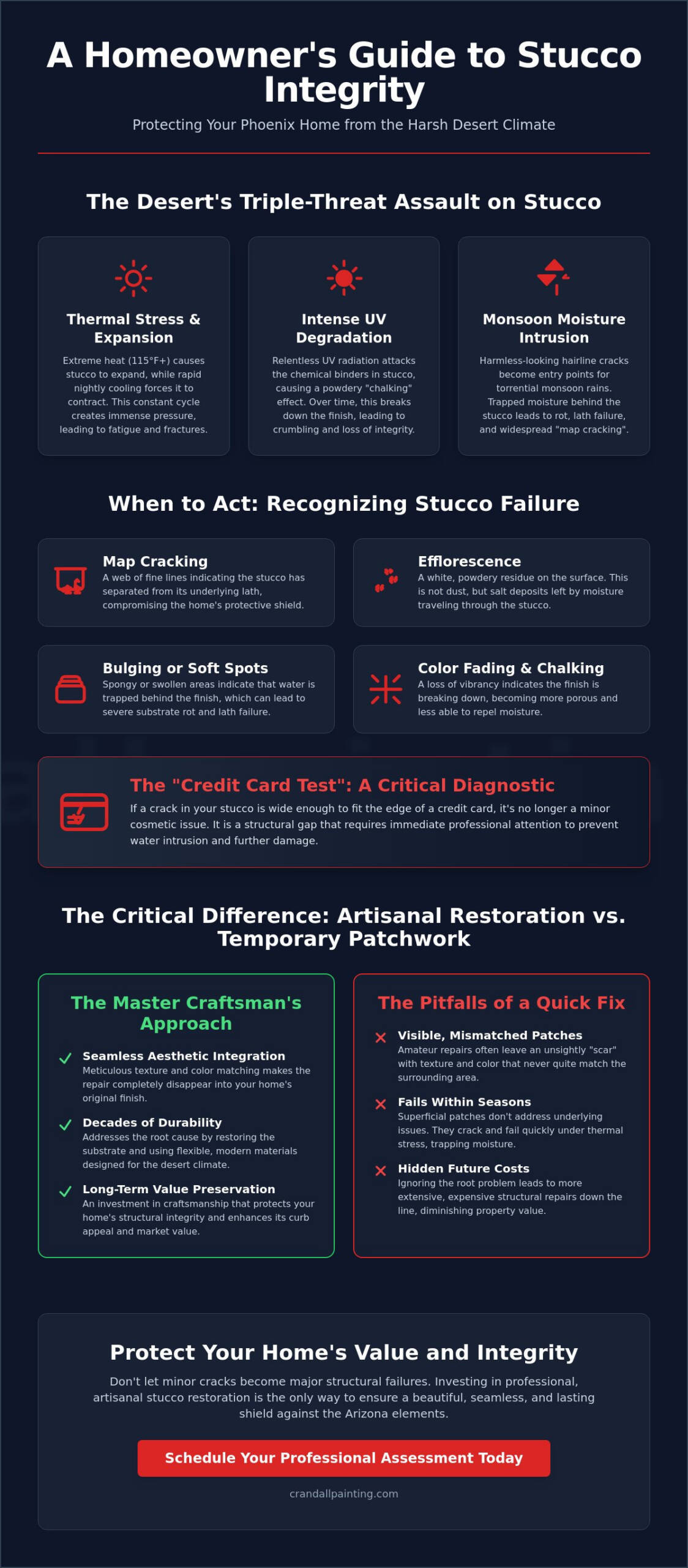
Phoenix summers reach punishing heights. When the mercury hits 115°F, your home’s exterior expands significantly. As the sun sets and the desert air cools rapidly, that material must contract. This relentless cycle creates immense pressure on the substrate. Rigid, inferior materials often fail where flexible, high-quality restoration succeeds. Thermal shock occurs when rapid temperature fluctuations cause the stucco to expand and contract too quickly, leading to structural fatigue and visible fracturing.
The Impact of Intense UV Exposure
The Arizona sun is a relentless force. Intense UV radiation doesn’t just fade your paint; it attacks the chemical binders holding the stucco together. You’ll first notice “chalking,” a powdery residue on the surface that indicates the finish is breaking down. If left unaddressed, this progresses to structural crumbling as the binder fails entirely. Modern restoration utilizes 2026 coating technologies that act as a high-performance sunscreen for your home, providing a level of protection that older materials simply can’t match.
While heat is the primary catalyst for damage, the monsoon season presents the most immediate threat. Hairline cracks that seem harmless in June become dangerous conduits for moisture in July. When water enters these micro-fissures, it can trap moisture behind the substrate, leading to internal rot or “map cracking.” This pattern signals that the underlying lath is beginning to fail. Expert stucco repair phoenix involves more than just filling a gap; it requires sealing the home’s envelope against these seasonal deluges to ensure long-term structural integrity and peace of mind.
Common Signs of Stucco Failure: When to Act
Your home communicates its health through its facade. Recognizing the early whispers of deterioration is the difference between a simple restoration and an extensive structural overhaul. While the desert sun provides a beautiful backdrop for Southwest architecture, it also accelerates the need for professional stucco repair phoenix when early warning signs are ignored. A meticulous eye can distinguish between natural aging and the red flags that suggest deep-seated vulnerability.
One of the most telling indicators is “map cracking.” This intricate web of fine lines resembles a topographical map and suggests that the bond between the cementitious layers and the underlying lath has been compromised. This pattern often indicates that the original work may have deviated from the industry-standard stucco application, leading to a loss of adhesion. When the layers separate, they no longer act as a unified shield, allowing the intense Arizona heat to penetrate deeper into the home’s structure.
You should also be wary of efflorescence, which appears as a white, powdery salt deposit on the surface. It isn’t merely dust; it’s a sign that moisture is moving through the stucco and pulling minerals to the surface. If you notice bulging or soft spots, the situation has likely progressed. These areas indicate that water is trapped behind the finish, which can lead to substrate rot if not addressed by a master craftsman. Color fading is another subtle clue. When a finish loses its vibrancy, it often becomes more porous, losing its ability to repel the sudden deluges of monsoon season.
Hairline Cracks vs. Structural Gaps
Distinguishing between cosmetic blemishes and structural threats is essential. A simple “credit card test” serves as a reliable guide. If a crack is wide enough to insert the edge of a credit card, it has moved beyond a hairline issue and requires immediate attention. While small surface cracks can result from natural drying, larger gaps often point to foundation settling or significant thermal stress. If these exterior gaps mirror cracks appearing on your interior walls, you may also need to consider professional drywall repair phoenix az to restore your home’s internal sanctuary.
Staining and Discoloration Indicators
Discoloration often tells a story of poor drainage or environmental impact. Vertical dark streaks usually point to roof drainage issues where water is allowed to cascade directly down the wall rather than being diverted. It’s important to differentiate between organic growth, which is rare in our arid climate, and mineral deposits from hard water exposure. Early detection of these stains allows for targeted remediation before the moisture causes the stucco to crumble. For those seeking a professional assessment of these vulnerabilities, a consultation with a restoration specialist can provide clarity and a path forward.
The Art of Texture Matching and Finishes
The true test of any restoration lies in its invisibility. Achieving a perfect match requires a deep understanding of the original applicator’s technique, from the angle of the trowel to the specific aggregate size used in the mix. Matching a twenty-year-old hand-applied texture requires more than just technical knowledge; it demands an artist’s intuition. Whether your property features the rugged charm of a lace finish or the sleek profile of a modern sand texture, the goal of stucco repair phoenix is a seamless transition that defies detection.
Traditional three-coat systems, consisting of a scratch coat, brown coat, and finish coat, offer a depth and resilience that modern one-coat applications often struggle to replicate. The choice of system often depends on the age of the structure and the desired aesthetic. Adhering to historic stucco repair guidelines ensures that the structural integrity of the home is maintained while honoring its architectural heritage. Each application is a deliberate step toward renewing the home’s original character.
High-end estates in the valley are seeing a resurgence of artisanal finishes that prioritize both texture and longevity. These bespoke surfaces do more than just look beautiful; they provide a superior substrate for final protective layers. The quality of this finish directly dictates the success and lifespan of your exterior painting scottsdale project. A well-executed texture ensures that your protective coatings bond correctly, preventing premature peeling or fading in the intense Arizona sun.
Popular Phoenix Stucco Textures
- The Santa Barbara Finish: This smooth, high-end aesthetic mimics the look of traditional adobe. It requires a master’s touch to avoid visible trowel marks and is highly sought after for Mediterranean-style luxury homes.
- Skip Trowel and Lace: These represent the classic Southwest look. While they are excellent at hiding minor surface imperfections, they present unique challenges during repair because the “random” pattern must be meticulously replicated by hand.
- Sand Finish: Often found on contemporary desert homes, this texture requires precision application to ensure a uniform, grainy appearance across large wall surfaces.
Synthetic vs. Traditional Stucco
Modern homeowners often weigh the benefits of acrylic (EIFS) against traditional Portland cement. Acrylic finishes offer exceptional color retention and flexibility, which helps them resist the hairline cracking caused by thermal expansion. However, traditional Portland cement remains a staple for its unmatched durability and breathability in the desert heat. Choosing the right material involves balancing your neighborhood’s architectural standards with the specific environmental exposure of your home’s orientation. Homeowners who want to explore the full scope of exterior cladding options can benefit from a deeper look at stucco siding repair techniques that address both material selection and long-term desert performance.
The Professional Restoration Process
The professional restoration process is a methodical journey that transforms a compromised facade into a resilient masterpiece. While many view it as a simple patch job, true stucco repair phoenix requires a disciplined adherence to chemical and structural protocols. Every stage, from the initial cleaning to the final seal, must be executed with a focus on longevity and aesthetic cohesion. We view each project as a significant investment in your property’s future, requiring a steady hand and a deep understanding of desert-specific materials.
Meticulous Surface Preparation
Success begins with a pristine foundation. We remove loose debris and use professional pressure washing to eliminate contaminants that hinder adhesion. This stage involves inspecting the “key,” which is the physical space behind the metal mesh where the new stucco must lock into place. We also address rusted corner beads and damaged weep screeds to ensure the structural metal remains intact. Mechanical bonding is superior to chemical-only patches because it creates a physical interlocking of materials that resists the extreme thermal expansion common in the Valley.
Artisanal Application and Blending
Blending new material with an existing surface is where true craftsmanship shines. We utilize a “feathering” technique, gradually thinning the edges of the repair to create an invisible transition between the old and new sections. Because the Arizona sun causes significant pigment shift over time, we perform custom color matching to account for existing sun-fade rather than relying on original manufacturer codes. This ensures the restoration is indistinguishable from the rest of the home. For those seeking a comprehensive solution for their home’s exterior, exploring our services reveals the depth of our commitment to quality.
Once the application is complete, we respect the mandatory curing period. Cement requires a specific hydration cycle to reach its full strength. Rushing this process leads to immediate failure, as the intense heat will pull moisture out too quickly, causing the new material to become brittle. The final phase involves priming and sealing the surface with high-performance products designed for the harsh desert environment. These sealants act as a barrier against monsoon moisture while allowing the substrate to breathe. If you’re ready to invest in a restoration that stands the test of time, schedule a professional consultation with our master craftsmen.
Investing in Longevity: Choosing a Master Craftsman
Selecting a partner for your home’s restoration is an exercise in discerning long-term value over an initial price point. In the Valley, the “lowest bid” frequently translates to a visible patch that fails to breathe or expand with the structure. These amateur fixes often lead to moisture traps and future leaks that compromise your property’s internal sanctuary. A master craftsman understands that stucco repair phoenix is a preservation effort, requiring a disciplined approach to both chemistry and regional architecture.
When interviewing potential contractors, technical questions are your best defense. You should verify their standing with the Arizona Registrar of Contractors, specifically looking for a CR-36 Plastering license for any project exceeding $1,000. Ask about their familiarity with the 2024 Phoenix Building Construction Code and their specific experience with the local climate’s impact on material curing. A reliable expert will provide a detailed plan that addresses the root cause of the damage rather than simply masking the symptoms. This holistic perspective ensures that your stucco, exterior painting, and wood restoration phoenix work together to create a fortified building envelope. For a thorough understanding of what separates a lasting repair from a temporary fix, reviewing a comprehensive stucco siding repair guide for desert home restoration can help you ask the right questions and set the right expectations.
Evaluating Technical Expertise
Artisanal restoration requires a deep understanding of modern coating chemistry. You should review a contractor’s portfolio specifically for their ability to execute invisible transitions in varied lighting conditions. A professional who masters texture matching can often provide a level of detail that borders on the decorative. There’s a significant synergy between high-end architectural textures and faux finishing arizona, where the goal is to create a bespoke, hand-crafted surface that elevates the entire property. This level of expertise ensures your home remains an aspirational landmark in your neighborhood. Owners of luxury estates in the area will find particular value in understanding the specialized standards required for paradise valley stucco repair, where the caliber of artisanal workmanship must match the architectural significance of the property.
Long-Term Maintenance Strategies
Maintaining your home’s pristine condition in 2026 requires a proactive strategy. We recommend conducting a thorough annual inspection immediately following the first major monsoon of the season. Look for new micro-fissures or signs of mineral deposits that suggest water is not shedding correctly. Your landscaping also plays a vital role in stucco health. Ensure that irrigation emitters don’t spray directly onto the wall surface, as constant moisture exposure is the primary catalyst for substrate failure. If you notice widespread chalking or significant fading, it’s likely time for a full exterior refresh to restore the protective binders in your finish. For a comprehensive evaluation of your home’s needs, we invite you to explore our services and consult with a specialist who views your home as a masterpiece.
Preserving Your Home’s Architectural Legacy
Protecting your home from the intense Arizona climate requires more than a temporary patch; it demands a deep respect for the science of desert restoration. By recognizing the early indicators of failure and prioritizing artisanal texture matching, you ensure your property remains a resilient and beautiful asset. A commitment to meticulous preparation and seasonal maintenance will safeguard your investment against the 2026 summer heat and beyond.
Since 2004, our family-owned team has specialized in the unique needs of high-end estates throughout Scottsdale and Paradise Valley. We bring a Master Craftsman approach to every project, ensuring that your stucco repair phoenix is both structurally sound and aesthetically invisible. We invite you to Request a Professional Stucco Consultation with Crandall Painting & Stucco to begin your home’s transformation. Your property is a significant investment; let us help you preserve its original splendor for decades to come.
Frequently Asked Questions
How much does stucco repair cost in Phoenix?
The investment for professional restoration varies based on the scale of the damage and the complexity of the texture matching required. Minor patches for isolated issues require less labor than extensive substrate remediation that involves lath replacement and multiple cementitious layers. Because labor accounts for the majority of the project cost, a detailed assessment is necessary to provide an accurate reflection of the craftsmanship required for a seamless result.
Can I repair hairline cracks in stucco myself?
Homeowners can often seal very fine surface fissures with high-quality masonry sealants, but this often addresses only the symptom rather than the cause. Without a professional evaluation, you might inadvertently trap moisture behind the finish, leading to internal rot or lath corrosion. A specialist can determine if these lines indicate natural settling or more significant structural movement that requires a master’s touch to resolve permanently.
How long does a professional stucco repair last in the Arizona sun?
A meticulous stucco repair phoenix project can last ten years or longer when executed with climate-specific materials and proper curing techniques. The longevity of the restoration depends heavily on the quality of the bond and the application of high-performance protective coatings. These modern finishes are engineered to withstand the intense UV radiation and relentless thermal expansion cycles that define our desert environment.
Will the repair be visible once the job is finished?
An artisanal restoration should be virtually indistinguishable from the surrounding surface once the project is complete. Achieving an invisible transition requires a combination of precise aggregate blending, hand-applied texture matching, and custom color titration to account for existing sun-fade. When we feather the edges of new material into the old, we ensure the home’s sophisticated aesthetic remains uninterrupted and polished.
What happens if I ignore small cracks in my stucco?
Neglecting even minor fissures allows monsoon moisture and wind-driven rain to penetrate your home’s protective envelope. Over time, this water intrusion causes the underlying metal lath to rust and the wooden substrate to rot, leading to significant structural failure. What begins as a simple hairline crack can quickly evolve into “map cracking” or delamination, necessitating a much more expensive and invasive remediation process. Protecting your home’s wooden structural elements from this kind of moisture damage is equally critical, and a professional approach to wood restoration in Phoenix can prevent the decay that begins when water breaches your exterior envelope.
Is it better to patch stucco or recoat the entire wall?
The decision between a targeted patch and a full wall recoat depends on the age of your home and the extent of the surface degradation. Localized patches are ideal for isolated physical damage, but they may not address widespread porosity or binder failure. A full recoat provides a unified, high-performance shield for the entire elevation, ensuring consistent protection and a flawless, contemporary appearance for the whole structure.
Do I need to paint my stucco after it is repaired?
Applying a premium protective coating is an essential final step to seal the porous cementitious material against the elements. Raw stucco absorbs water and is vulnerable to the sun’s desiccating heat, which can lead to premature cracking and crumbling. A high-quality exterior finish acts as a resilient barrier, providing the UV resistance and water-shedding capabilities necessary to maintain the integrity of your stucco repair phoenix.
How does monsoon season affect my stucco?
Monsoon season introduces extreme humidity and violent deluges that put immense pressure on your home’s exterior seal. If your stucco has existing vulnerabilities, wind-driven rain can be forced into the substrate, causing the material to swell and eventually pull away from the wall. Ensuring your facade is properly sealed before the storms arrive is the most effective way to prevent moisture-related damage and maintain your property’s long-term value.