
Can your Desert Mountain patio cover be restored, or has desert exposure taken too great a toll? A faded finish doesn’t always mean the wood needs replacing, but intense sun and dry conditions can wear down its protective surface and change its appearance. Wood restoration for patio covers in Desert Mountain should start with the condition of the existing wood and the finish you want, not a one-size-fits-all treatment.
If you’re weighing restoration against a finish refresh, begin by noting what has changed and where. This guide explains how to assess visible wear, compare possible approaches, and prepare for a project discussion. Crandall Painting & Stucco provides wood restoration, staining, and varnishing, along with a free, no-obligation estimate to help define the project scope.
Key Takeaways
- Use fading, peeling, uneven colour, or worn finish as cues to examine the patio cover, not as a remote diagnosis of the wood’s condition.
- Wood restoration for patio covers in Desert Mountain starts with assessing and preparing the surface before selecting a finish.
- Compare restoration, a finish refresh, and a closer condition assessment against the wood’s appearance and your goals.
- Note which areas receive stronger sun or show more visible finish changes to help shape a project-specific scope.
- Crandall Painting & Stucco serves Desert Mountain and provides free, no-obligation estimates.
Wood Restoration for Patio Covers in Desert Mountain: Recognizing When the Finish Needs Attention
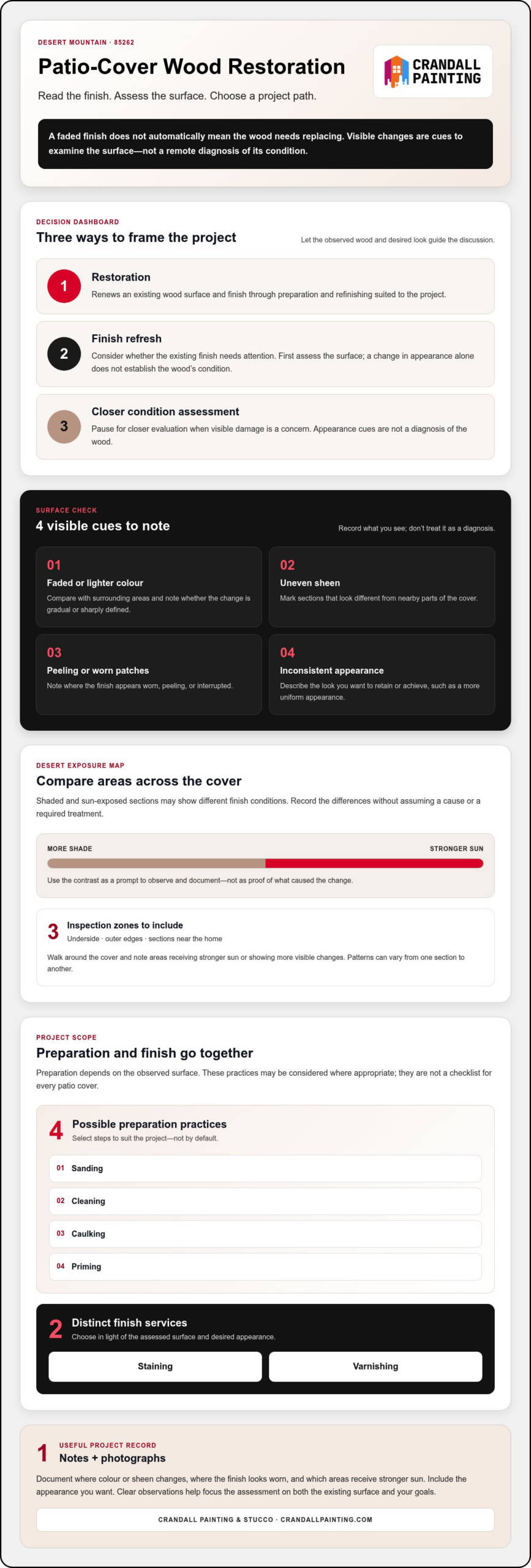
Should you refresh the existing finish, or first clarify the condition of the wood? That is a useful starting point for wood restoration for patio covers in Desert Mountain. A change in appearance can indicate that the finish needs attention, but it doesn’t reveal the full condition of the surface. Begin with a visual review and use what you observe to guide a project-specific assessment.
Wood restoration renews an existing wood surface and finish through preparation and refinishing suited to the project. The aim is to improve the wood’s appearance while addressing visible finish needs. General wood finishing techniques provide background on how finishes are applied, but the appropriate restoration approach depends on the patio cover’s condition and the appearance you want.
Outdoor finishes are exposed to sunlight, dust, and changing weather. Over time, these conditions may affect colour, sheen, and how evenly a finish appears. The pattern can vary across a single cover, so don’t assume every section needs the same treatment.
What changes in a patio-cover finish can signal wear?
Look for colour that seems lighter or less consistent than surrounding areas, sections with a different sheen, and places where the finish appears worn, peeling, or interrupted. These are visible cues to document, not a diagnosis of the wood. An uneven appearance may reflect cosmetic wear, while visible damage is a separate concern that calls for closer evaluation.
- Note where colour or sheen changes, and whether the difference is gradual or sharply defined.
- Record peeling, worn-looking patches, or areas where the finish appears incomplete.
- Describe the appearance you’d like to retain or achieve, such as a more uniform look or a different finish character.
Clear notes and photographs can help explain what you’re seeing during an estimate. They also keep the discussion focused on both the existing surface and your goals, rather than appearance alone.
Why assess a Desert Mountain patio cover by exposure area?
In Desert Mountain, ZIP code 85262, shaded and sun-exposed sections of a patio cover may show different finish conditions. One beam, for example, may appear more faded than a section that receives more shade, while dust may be more noticeable elsewhere. Record these differences, but don’t treat them as proof of a particular cause or required treatment.
Walk around the cover and note which areas receive stronger sun or show more visible changes. Include the underside, outer edges, and sections near the home, without assuming any one area always needs more attention. This exposure map gives the assessment useful context and helps tailor the scope to the wood’s observed condition and your preferred appearance. A careful review is the first step toward a considered restoration plan.
How Wood Restoration for Patio Covers Addresses Surface and Finish Needs
Once the surface has been assessed, restoration can be planned in stages: prepare the wood, then select a finish that suits the project and your preferences. The scope may vary across one patio cover. A surface with areas of worn finish may need different preparation from one where the main goal is a change in appearance.
Preparation and finish selection should reflect the wood’s condition and the appearance you want. This keeps the plan focused on the actual surface instead of assuming every cover needs identical treatment. Crandall Painting & Stucco provides wood restoration, staining, and varnishing, with the approach tailored to the work involved.
What does preparation contribute to a wood restoration project?
Careful preparation helps create a more consistent surface for finish work. Depending on the project, preparation may include sanding, cleaning, caulking, or priming. These are scope-appropriate practices, not a checklist applied in full to every patio cover. Assessment helps determine which steps suit the work, and the estimate outlines the planned scope.
For example, sanding may be considered where the surface needs attention before refinishing, while cleaning removes surface dirt before finish work begins. Caulking or priming may be included where appropriate. The goal is to match preparation to the observed conditions rather than prescribe treatment from a brief description. The USDA Forest Service’s wood durability and protection research offers broader context on wood protection and durability; a patio-cover plan still needs to reflect the specific project.
How do staining and varnishing fit into the finish decision?
Staining and varnishing are distinct finish services. The choice should reflect both the appearance you want and the assessed wood surface. You may want to preserve the character of the existing wood or pursue a different look. Discussing that goal alongside the surface condition helps shape a practical scope without assuming one finish will suit every cover.
Wood restoration for patio covers in Desert Mountain involves more than choosing a finish based on appearance alone. The preparation and finish are related decisions. For broader context on caring for wood, Crandall’s wood restoration guide for Phoenix discusses wood restoration in the region.
Crandall Painting & Stucco can prepare a free, no-obligation estimate for wood restoration. The project discussion can cover the surface, preparation scope, and finish goals before work is planned.
Restore, Refinish, or Reconsider: Choosing a Path for Your Desert Mountain Patio Cover
The right direction depends on the existing wood and how you want the patio cover to look. Restoration, a finish refresh, and pausing for a closer assessment are useful ways to frame the decision, not guaranteed outcomes. This guide covers wood surfaces and finishes; questions about the cover’s structure or construction are separate from finish work.
| Path | Visible condition | Desired appearance | Project-specific evaluation |
|---|---|---|---|
| Restoration | The finish appears broadly worn, uneven, or interrupted, and the surface needs a considered review. | You want to renew the existing wood surface and finish, with the scope shaped by its condition. | Assess the surface and preparation needs before defining the restoration work and finish selection. |
| Finish refresh | The main concern appears to be the finish’s look, such as a change in sheen or colour. | You’re seeking a refreshed appearance without assuming that a more extensive scope is necessary. | Review the existing surface to determine whether a refresh suits its condition and goals. |
| Closer condition assessment | Visible changes leave uncertainty about the surface, or the concern extends beyond appearance. | You’d rather clarify what you’re seeing before deciding on a finish direction. | Pause to define the concern and the appropriate scope before finish work is planned. |
This comparison is a starting point, not a diagnosis. A worn-looking finish in one area may not tell the full story, and a desired appearance doesn’t establish which preparation or finish is suitable. An estimate can define the proposed scope after the surface and your preferences have been discussed.
When might restoration or refinishing suit the homeowner’s goals?
Restoration or refinishing may be worth considering when the visible finish no longer matches the appearance you want and the existing surface is suitable for the proposed work. For example, you may want to address an uneven-looking finish while preserving the wood’s established character. The appropriate scope depends on an assessment, so don’t assume an aged or visibly damaged surface can be restored without project-specific evaluation.
When should the project scope be clarified before work begins?
Keep finish concerns distinct from questions about the cover’s structure or construction. A wood-restoration estimate should describe the proposed restoration work and relevant preparation, not imply structural repair or replacement. Crandall’s wood restoration services in Phoenix provide broader context for the service. For a Desert Mountain project, a free, no-obligation estimate can help establish a clear scope before work is scheduled.
Preparing for Patio-Cover Wood Restoration in Desert Mountain
A little preparation can make the first project conversation more useful. For wood restoration for patio covers in Desert Mountain, note visible finish changes, identify areas with stronger sun exposure, and decide what appearance you’d like to achieve. These details connect your goals with the patio cover’s condition, without requiring you to choose a finish before the surface is assessed.
Use this sequence to organize your next steps:
- Note your concerns. Record visible changes such as fading, peeling, or uneven finish.
- Map exposure areas. Identify surfaces with stronger sun exposure and those showing more noticeable finish changes.
- Define your appearance goals. Describe what you hope to preserve or change in plain language, without specifying a technical finish.
- Arrange a consultation. Share the property location, areas of concern, and your priorities.
- Review the estimate, then schedule. Consider the proposed scope and preparation before moving forward.
What information helps shape a useful estimate?
Share the property location, which parts of the patio cover are included, and what you’ve noticed about the finish. If one section gets stronger sun or looks more worn than another, include that observation. Describe your preferred appearance, such as wanting a more consistent look or retaining the wood’s existing character. This gives the project discussion context without committing you to a finish in advance.
Crandall Painting & Stucco provides a detailed estimate before scheduling and material ordering. The estimate outlines the proposed work and relevant preparation so you can understand the scope before deciding how to proceed. Estimates are free and no-obligation; price is upon request.
What should homeowners expect during project coordination?
The process moves from consultation to a detailed estimate, then to scheduling, job coordination, and quality control. Timing varies with the project scope and scheduling. Discuss access and household arrangements during coordination so expectations for the project are clear.
The estimate should describe the restoration work and preparation being planned, rather than leaving you to infer what is included from a general finish goal. Reviewing the scope lets you align the proposed preparation with the areas and appearance priorities you shared. If the project’s extent changes during planning, clarify the scope before scheduling.
With your observations and goals ready, request a free, no-obligation estimate for patio-cover wood restoration to discuss the project scope. Price is upon request.
Crandall Painting & Stucco: A Clear Next Step for Desert Mountain Wood Restoration
Choosing a restoration plan is easier when the process is clear from the first conversation through the final review. Crandall Painting & Stucco is based in Scottsdale and serves Desert Mountain, including ZIP code 85262. The company has served customers since 2002 and is fully licensed, bonded, and insured. Its work carries a two-year warranty.
What makes the project process reassuring?
A patio-cover project starts with a consultation about the wood, its visible finish condition, and the appearance you want. A detailed estimate then sets out the proposed scope, giving you a chance to understand the planned work before scheduling and material ordering.
After the estimate, scheduling and job coordination organize the agreed work. Preparation is planned for the project, and quality control is part of the process. Customer-service follow-up provides an opportunity to discuss the project after completion. These steps bring structure to wood restoration for patio covers in Desert Mountain while keeping the scope connected to the particular surface and your goals.
The estimate can describe restoration work and relevant preparation, so you can review the plan before moving ahead. Restoration, staining, and varnishing are considered in relation to the project rather than treated as a universal formula. The scope and schedule establish what work is planned and when.
How can a Desert Mountain homeowner get started?
Begin by describing the patio-cover wood and the concerns you’ve observed. Share which areas show visible finish changes, what you’d like the finished surface to look like, and any project priorities. You don’t need to select a finish in advance; the estimate process provides an opportunity to discuss your goals and the proposed work.
Crandall Painting & Stucco provides free, no-obligation estimates, with price upon request. Once you’ve reviewed the scope, you can decide whether the proposed restoration work fits your needs and proceed to scheduling.
For a patio cover in Desert Mountain, request a free, no-obligation estimate to discuss the wood’s condition and your restoration goals. Price is upon request.
Give Your Patio Cover a Thoughtful Next Step
Your patio cover is part of how you enjoy your home, and its finish deserves an approach shaped around its actual condition. Rather than choosing a treatment based on appearance alone, use your observations and goals to start a conversation about a suitable scope. That makes wood restoration for patio covers in Desert Mountain a considered project, not a rushed choice.
Crandall Painting & Stucco has served customers since 2002, is fully licensed, bonded, and insured, and provides a two-year warranty on work. A free, no-obligation estimate gives you an opportunity to discuss the patio cover and understand the proposed work. Price is upon request.
When you’re ready to take the next step, request a free, no-obligation estimate for your patio-cover wood restoration. Crandall Painting & Stucco serves Scottsdale, Paradise Valley, Carefree, DC Ranch, Desert Mountain, Scottsdale Mountain, and Phoenix.
Frequently Asked Questions
How often should a wood patio cover be restored in Desert Mountain?
There isn’t one fixed restoration interval that suits every patio cover. Consider an assessment when you notice a change in the finish, such as new fading or peeling, rather than relying on a calendar alone. For wood restoration for patio covers in Desert Mountain, dated photos can help you compare how the surface changes over time and describe your concerns clearly during a project discussion.
Can wood restoration change the colour or appearance of my patio cover?
Yes. Restoration and finish work can be planned around a desired change in appearance, but suitable options depend on the existing surface and project scope. Before work is planned, describe what you’d like to preserve or alter, such as the overall colour character or how the finish looks across different sections. A project-specific discussion can help establish an approach without promising an exact result in advance.
How long does patio-cover wood restoration take?
Project duration varies with the scope of work and scheduling. The amount of surface involved and the preparation included help shape the plan. Crandall Painting & Stucco discusses the work through a consultation and detailed estimate before scheduling, helping you plan around the project scope.
Do homeowners need to be present during a wood restoration project?
No, homeowners don’t need to be present during the project. Discuss access and any property-specific arrangements as part of coordination before work is scheduled. The crew protects furniture and flooring with drop cloths, tape, and coverings. Clear communication about the work area and access helps the project proceed in an organized way while you’re away.
How much does wood restoration for a patio cover cost?
The price depends on the project scope. Crandall Painting & Stucco provides free, no-obligation estimates, and price is upon request. To receive a project-specific estimate, share which areas are included and describe the work you’re considering. That gives the estimate a clear basis without relying on a generic price range that may not reflect your patio cover.
Does patio-cover wood restoration include a warranty?
Yes. Crandall Painting & Stucco provides a two-year warranty on work. For details relevant to the proposed project, review the estimate and project documents. Keeping those documents with your home records gives you a clear reference after the work is complete. The project scope and finish plan are separate from the warranty period.