
A hairline crack in your desert estate’s exterior isn’t just a cosmetic blemish; it’s a silent invitation for the next monsoon to compromise your home’s structural sanctuary. When you seek out professional stucco siding repair, you’re doing more than filling a gap. You’re defending the architectural elegance of your property against unsightly fissures and the poorly matched patches that often plague high-end residences. It’s natural to worry that a repair might look like a scar, especially if previous attempts haven’t met your standards for excellence.
This guide reveals the sophisticated standards that preserve both the structural integrity and aesthetic grace of Arizona’s finest estates. You’ll learn how a master craftsman achieves a seamless finish that stands up to the intense desert heat and seasonal rains. We’ll examine the meticulous techniques required for invisible texture matching, the necessity of following the 2024 Phoenix Building Construction Code, and how a disciplined approach to restoration enhances your property’s long-term valuation.
Key Takeaways
- Identify the critical differences between superficial hairline cracks and the deep-seated structural fissures that compromise your home’s integrity.
- Discover the meticulous three-coat system required for professional stucco siding repair to ensure your restoration withstands the intense desert elements.
- Understand why artisanal remediation offers a fifteen-year lifespan, providing a far superior return on investment than standard retail patching.
- Learn how architectural complexity and texture matching influence the restoration process for high-end Arizona properties.
- Recognize the vital role of pH neutralization and professional exterior painting in achieving an invisible, architecturally seamless finish.
Evaluating Stucco Siding Damage: Identifying Signs of Failure in Desert Estates
Professional stucco siding repair is far more than a cosmetic touch-up. It is the systematic restoration of Portland cement-based exterior finishes designed to preserve the architectural integrity of high-value properties. To truly appreciate the complexity of these surfaces, one might explore What is Stucco? in its historical and modern contexts. In the Phoenix area, this material acts as a protective shield, but it’s a shield that lives and breathes with the environment. When this shield fails, it often does so in subtle ways that require a master craftsman’s eye to diagnose.
Arizona’s extreme thermal cycles represent the primary driver of stucco fatigue. During the summer months, exterior walls can reach temperatures exceeding 160 degrees before cooling rapidly during a sudden monsoon downpour. This rapid fluctuation causes the Portland cement to expand and contract at a rate that eventually creates stress fractures. Beyond cracks, discerning homeowners should look for red flags such as efflorescence, which appears as a white, powdery salt deposit on the surface. This indicates that moisture is traveling through the wall and pulling minerals out with it. Bulging or localized staining often points to a failure in the bond between the layers, suggesting that the finish is no longer protecting the home’s structure. For a comprehensive overview of what these warning indicators mean for your property, our guide on common signs of stucco failure in the Arizona desert provides a professional framework for distinguishing routine aging from critical deterioration.
The Anatomy of a Crack: When to Worry
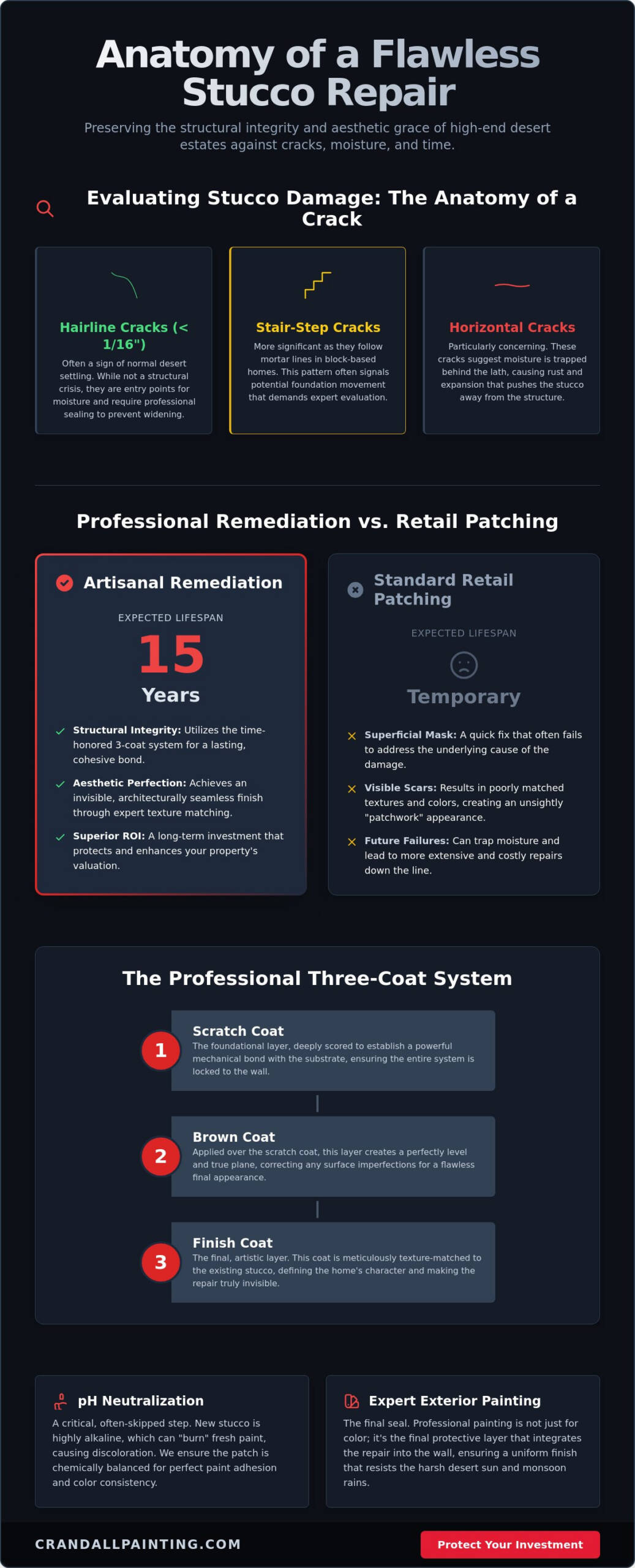
Understanding the geometry of a crack is the first step in determining the necessary level of intervention. Hairline cracks, those measuring less than 1/16 inch, are often typical signs of desert settling and don’t always indicate a structural crisis. However, they still require sealing to prevent them from widening. Stair-step cracks that follow the mortar lines in block-based homes are more significant, as they often signal foundation movement. Horizontal cracks are particularly concerning; they frequently suggest that moisture is trapped behind the metal lath, causing the metal to rust and expand, which eventually pushes the stucco away from the house.
Moisture and Monsoons: The Hidden Danger
The arrival of a Scottsdale monsoon brings intense, wind-driven rain that can find even the smallest entry point. Once rain penetrates unrepaired cracks, it can lead to internal wood rot and mold long before it’s visible on the interior drywall. This often results in “spalling,” where the stucco loses its grip and begins to flake or fall away from the substrate in large pieces. After any major storm event, we recommend a thorough inspection of your estate’s exterior to catch these issues early.
Use this brief checklist to assess your home’s condition after a storm:
- Examine window and door perimeters for new separation or sealant failure.
- Identify dark, damp “water maps” that persist long after the surface should have dried.
- Observe the roof-to-wall transitions to ensure kick-out flashing is directing water away from the siding.
- Look for signs of “wicking” moisture at the very base of the walls near the soil line.
If you notice any of these warning signs, it’s vital to consult with a specialist who understands the nuances of desert restoration. You can learn more about our approach to preservation by exploring our professional restoration services designed for Arizona’s unique architectural landscape.
The Professional Approach to Stucco Siding Repair: Techniques for Lasting Durability
Professional stucco siding repair requires a disciplined adherence to time-honored methods rather than the convenience of modern quick-fixes. While retail patches offer a temporary mask, a true restoration utilizes the traditional three-coat system to ensure structural harmony. This methodical approach begins with a scratch coat to establish a mechanical bond, followed by a brown coat to create a level plane, and concludes with a finish coat that defines the home’s character. Each layer must be applied with precision to ensure the new material functions as a single, cohesive unit with the existing wall.
The success of this system depends entirely on the preparation of the substrate. We meticulously remove all loose or compromised material and clean the underlying surface to ensure the new layers integrate perfectly. One critical step often ignored by less experienced contractors is the “wetting” process. By pre-hydrating the old stucco, we ensure it doesn’t rob essential moisture from the new application. This prevents the “dry-out” that leads to weak, brittle repairs. To further fortify high-stress areas around windows or architectural corners, we embed alkali-resistant fiberglass mesh. This reinforcement provides the tensile strength necessary to resist the thermal expansion that causes recurring cracks.
For homeowners who value the historical and structural integrity of their property, the National Park Service offers a detailed guide on historic stucco repair techniques that highlight the importance of material compatibility and proper application. These standards remain the benchmark for high-end residential restoration.
Artisanal Texture Matching
Arizona’s architectural landscape is defined by diverse finishes, ranging from the buttery smoothness of Santa Barbara to the intricate patterns of Lace and Dash. Achieving an invisible repair requires an artisanal touch. We utilize a “feathering” technique, where the repair edges are delicately thinned out to blend seamlessly into the original wall. By using custom-blended finish coats, we ensure the grain and aggregate size match the existing surface perfectly, preserving the aesthetic elegance of your estate.
Material Science: Why Standard Patches Fail
In the low-humidity environment of Phoenix, the chemical behavior of cement changes significantly. While traditional Portland cement is excellent, we often utilize polymer-modified stucco for its superior flexibility and adhesion in extreme heat. Curing is the chemical hydration process that ensures stucco reaches its maximum PSI strength. Without proper hydration during this phase, a patch will fail within a few seasons. If you want to ensure your home’s exterior remains resilient, you might consider the detailed craftsmanship found in our professional restoration services.
Professional Remediation vs. Retail Patching: Protecting Your Estate’s Value
The belief that stucco siding repair is a simple weekend project remains a persistent misconception among many homeowners. While it’s tempting to think a trowel and a bucket of pre-mix from a local hardware store can solve the problem, the results rarely meet the architectural standards of a luxury estate. A retail patch is merely a temporary bandage, typically failing within one to two years as it shrinks and pulls away from the original substrate. Conversely, a Master Craftsman restoration is engineered to endure for fifteen years or more, functioning as a permanent part of the home’s structure. In exclusive enclaves like Paradise Valley or DC Ranch, the presence of visible, mismatched patches acts as a warning sign to discerning buyers. It signals a piecemeal approach to maintenance that can negatively impact a property’s market valuation during a professional inspection. Homeowners in these elite communities can benefit from reviewing our dedicated guide on Paradise Valley stucco repair to understand the master craftsman standards required for flawless restoration in this high-value market.
Adhering to recognized industry standards for Stucco facade maintenance is essential for preserving a home’s long-term health and aesthetic grace. For a deeper look at the technical nuances of this restorative art, you may find our guide on Mastering Stucco Repair in Phoenix particularly insightful. This level of detail ensures that your home remains a sanctuary rather than a source of ongoing maintenance stress.
The Cost of Inexpert Repairs
Inexpert repairs often create hidden liabilities that far exceed the initial cost of professional service. When a patch is applied without proper vapor management, it can trap moisture against the internal wood framing. This leads to wood rot and mold growth that eventually requires expensive structural remediation. There is also the “halo effect” to consider. Because retail materials have a different chemical composition and porosity than the original Portland cement, they absorb exterior paint at a different rate. This creates a permanent, distracting outline that remains visible regardless of how many coats of paint are applied. Correcting these botched attempts later is a complex task that requires stripping large sections of the wall to restore a uniform appearance.
The Value of Precision: Why Scottsdale Homeowners Choose Pros
Scottsdale homeowners prioritize professional intervention because precision requires more than just skill; it requires the right infrastructure. Large-scale stucco siding repair necessitates industrial-grade mixers for consistent material batching and specialized scaffolding for safe, high-reach access. These tools allow for a uniform application that a DIY approach simply cannot replicate. Entrusting your estate to a specialist ensures that the restoration is both structurally sound and aesthetically perfect. You can view our full range of capabilities by visiting Crandall’s professional services to see how we maintain the highest standards of desert craftsmanship.
Calculating the Investment: Stucco Repair Costs and Longevity Factors in Phoenix
Investing in your estate’s exterior is a strategic decision that balances immediate preservation with long-term valuation. When calculating the necessary investment for stucco siding repair, several bespoke variables dictate the scope of the project. Accessibility is a primary factor; a home with multiple stories or complex architectural features requires specialized scaffolding and increased labor hours, which naturally influences the project’s complexity. The total linear feet of cracks and the intricate nature of the existing texture also play significant roles. A simple flat finish is less demanding than a bespoke, hand-applied Lace or Santa Barbara texture that requires an artisanal touch to replicate perfectly.
The age of your home’s original exterior further complicates the restoration process. Over decades, the chemical composition and color of Portland cement shift due to mineral leaching and environmental exposure. Matching the exact hue and porosity of a thirty-year-old wall requires a more disciplined approach to color blending than younger surfaces demand. Despite these technical challenges, the financial benefits remain compelling. Industry data indicates that a new or improved stucco exterior in the Phoenix market can yield a return on investment of 70% or more. This makes professional restoration a powerful tool for enhancing both the aesthetic appeal and the market value of your property.
Environmental Factors and Maintenance Cycles
Scottsdale estates face some of the most punishing UV exposure in the country, which necessitates a proactive and methodical maintenance cycle. We recommend a professional inspection every three to five years to identify micro-fissures before they evolve into structural liabilities. Simple preventative measures, such as adjusting landscaping to keep sprinklers from directly hitting the walls, can significantly extend the life of your repair. Utilizing high-quality elastomeric coatings can also provide a flexible barrier that bridges future micro-cracks, protecting your home’s substrate from moisture intrusion during the intense monsoon season.
The ‘Restoration’ vs. ‘Patch’ Price Gap
It is essential to distinguish between a superficial patch and a comprehensive architectural restoration. Professional restoration involves structural reinforcement and thorough substrate cleaning, ensuring the new material bonds permanently with your home’s original structure. High-end finishes, such as Venetian plaster or custom faux applications, require specialized labor rates due to the level of professional mastery involved. Architectural stucco restoration typically requires multiple site visits to allow for proper curing between coats. If you are ready to secure your property’s future, you can request a professional consultation to evaluate your estate’s specific restoration needs.
Seamless Integration: Why Precision Stucco Repair Requires Expert Painting
Achieving a flawless result requires viewing the structural fix and the final coating as a singular, unified evolution. A professional stucco siding repair doesn’t end when the cement dries; it concludes only when the new material is indistinguishable from the original facade. This synergy is vital because the chemical properties of fresh stucco differ significantly from the aged substrate. New Portland cement is naturally “hot,” possessing a high alkaline pH that can chemically degrade standard paint films if they’re applied too early. We prioritize neutralizing this alkalinity or utilizing specialized primers to ensure the finish remains vibrant and bonded for years to come.
Texture is only half the battle. To create a uniform canvas, we utilize high-build primers that fill microscopic voids and bridge the transition between the old wall and the new patch. This step is essential for preventing the “flashing” effect, where the repaired area reflects light differently than the rest of the home. For a deeper understanding of the coatings required to withstand our local climate, consult our Exterior Painting Scottsdale guide. It outlines the 2026 standards for desert-durable finishes that complement high-end masonry work.
The Crandall Method: A White-Glove Finish
Our approach to restoration is defined by a commitment to 100% invisible repairs. We understand that for estates in Scottsdale Mountain and Desert Mountain, “good enough” is never the standard. The Crandall Method involves an artisanal color-matching process that accounts for how desert light interacts with different pigments. Our final inspection occurs during the peak of the day. The sun is the ultimate judge, and we scrutinize every texture detail under the harsh Arizona light to ensure no shadows or inconsistencies remain. This level of professional mastery is why discerning homeowners trust us with their most significant architectural investments.
Next Steps for Your Property
Protecting your home’s structural sanctuary begins with a professional diagnostic consultation. During a Crandall on-site assessment, we don’t just look for cracks; we analyze the root cause of the failure to ensure our stucco siding repair provides a permanent solution. You can expect a thorough walkthrough where we identify thermal stress points, moisture risks, and texture matching requirements. We provide a clear, methodical plan for transformation that respects your schedule and your property’s elegance. If you’re ready to restore the prestige of your estate’s exterior, you may request a professional stucco and painting consultation today.
Secure the Architectural Legacy of Your Estate
Professional restoration is a vital investment in the longevity and aesthetic grace of your property. By prioritizing the disciplined three-coat system and ensuring precise pH neutralization, you defend your home against the relentless desert sun and seasonal monsoons. Master craftsmanship isn’t found in a quick patch; it lives in the artisanal texture matching that preserves your property’s prestige in elite enclaves like Scottsdale and Paradise Valley.
Crandall Painting & Stucco offers over 20 years of local experience, serving as specialists in the high-end architectural textures that define Arizona’s finest homes. Our integrated method ensures that every stucco siding repair is paired with expert painting for a finish that’s both structurally sound and visually seamless. We don’t just fix surfaces; we restore the architectural integrity of your most valued asset.
Take the first step toward a renewed and protected exterior today; your estate deserves nothing less than master-level care.
Frequently Asked Questions
How much does stucco siding repair cost for a typical Scottsdale home?
The investment for restoration is dictated by bespoke variables such as the total linear feet of fissures, the height of the architectural features, and the complexity of the existing texture. Because high-end estates often feature hand-applied finishes like Santa Barbara or Lace, a professional diagnostic is required to determine the exact labor and artisanal matching necessary for a seamless result. Every project is unique, focusing on long-term structural integrity rather than a temporary fix.
Can I repair stucco cracks myself with a retail patch kit?
While retail kits exist, they are generally unsuitable for the standards of a luxury estate. These products lack the structural reinforcement of a traditional three-coat system and frequently shrink over time, leaving a visible “halo” around the repair. Professional stucco siding repair ensures the new material bonds permanently with the substrate, preventing the mismatched textures that can detract from your property’s overall market valuation.
How long do I have to wait for new stucco to cure before painting it?
Traditional Portland cement typically requires a 28-day curing period to reach its maximum PSI strength and allow the alkaline pH levels to stabilize. Rushing this hydration process can cause the paint to “burn” or peel prematurely. While certain high-performance primers can facilitate a shorter window, a disciplined approach to curing is essential for ensuring the final coating remains vibrant and securely bonded to the new surface.
What is the difference between a hairline crack and a structural stucco failure?
Hairline cracks are narrow fissures, often less than 1/16 inch, typically caused by minor thermal expansion or natural desert settling. Structural failure is much more significant, presenting as “stair-step” patterns, horizontal gaps, or localized bulging. These red flags often indicate foundation movement or moisture that has caused the metal lath to rust and expand, requiring immediate professional intervention to prevent further degradation.
Why does my stucco have white, powdery stains (efflorescence) near the cracks?
Efflorescence occurs when moisture penetrates the stucco and dissolves internal mineral salts, carrying them to the surface as it evaporates. These white, powdery stains are a definitive signal that your home’s exterior envelope has been compromised. If left unaddressed, this active moisture migration can lead to the “spalling” or delamination of the stucco finish, eventually affecting the underlying structural framing. Understanding the full spectrum of signs of stucco failure can help you determine when professional intervention is necessary before minor issues escalate into costly structural repairs.
Will the repaired stucco match the existing color and texture of my home?
A master craftsman utilizes artisanal feathering techniques and custom-blended aggregates to ensure the texture is invisible to the eye. While the physical texture can be matched perfectly, the most effective way to ensure a flawless color match is to repaint the entire architectural plane. This prevents the “patchy” look often seen in lower-quality work and ensures a sophisticated, uniform finish across the entire facade.
How often should I inspect my stucco siding for damage in the Phoenix area?
We recommend a professional inspection every three to five years to stay ahead of the intense UV exposure and seasonal monsoon cycles. Regular assessments allow you to identify micro-fissures before they evolve into costly structural liabilities. This proactive maintenance cycle is essential for preserving the aesthetic elegance and structural sanctuary of high-value properties in the challenging Arizona climate.
Can professional stucco repair prevent future water damage and mold?
Expert stucco siding repair acts as a critical seal for your home’s exterior, preventing wind-driven rain from reaching the sensitive wood framing and lath. By restoring the moisture barrier and utilizing high-build primers, you eliminate the entry points that lead to internal rot and mold growth. This comprehensive approach provides long-term protection, ensuring your estate remains a resilient and healthy environment for years to come.