
What if the finish that looks most striking on a sample feels out of place in your kitchen? Choosing faux painting for kitchen islands Phoenix homeowners can feel confident about starts with the whole room: cabinetry, counters, flooring, lighting, and the island’s role as a focal point. A subtle color wash can add depth without competing for attention, while a more pronounced textured or aged effect can make the island a defining feature.
A successful decorative finish starts with a clear idea of how you want the island to look and how it should relate to the rest of the kitchen. This guide compares faux-finish directions and explains what shapes a project, from coordinating surrounding surfaces to preparing the island. Crandall Painting & Stucco offers Decorative Painting, including faux finishing and touch-up, for Phoenix-area homes. The project begins with a consultation and a free, no-obligation estimate.
Key Takeaways
- Explore faux painting for kitchen islands Phoenix homeowners can tailor to the room, from stone-like and wood-like effects to aged or textured finishes.
- Compare each finish’s visual impression with your cabinets, countertops, flooring, hardware, and lighting before settling on a direction.
- Preparation can include sanding, cleaning, caulking, and priming to create a more even foundation for decorative work.
- Crandall Painting & Stucco offers Decorative Painting, including faux finishing and touch-up, in Phoenix and surrounding areas, including zip code 85018.
- Established in 2002, Crandall Painting & Stucco is fully licensed, bonded, and insured, with a project process that includes coordination and quality control.
Faux Painting for a Phoenix Kitchen Island: What It Can Add
A kitchen island often sits between cooking and dining areas, anchors an open floor plan, or draws the eye from an adjoining living space. Its finish can help the island harmonize with the surrounding kitchen or make it a deliberate point of contrast.
Faux painting gives you a way to shape that visual role. The right direction depends on the existing room, the atmosphere you want, and your personal taste. Compare the island with nearby surfaces before choosing a finish, and consider how it looks from the kitchen entrance and adjoining rooms.
Why the island deserves its own finish decision
Look at the island in relation to the perimeter cabinets, countertops, flooring, hardware, and light. A restrained finish can echo a tone or texture already in the room, creating a coordinated impression. A more noticeable treatment can distinguish the island as a focal point. Neither approach is automatically better; the balance depends on how much visual emphasis feels right in your kitchen.
Assess the island from the room’s main sightlines, including the entrance and nearby seating areas. A finish that feels subtle up close may read more prominently across the room. Check it under both natural daylight and kitchen lighting, since the surrounding light affects how color and contrast appear.
What faux painting means for a kitchen surface
Faux painting for kitchen cabinetry is a decorative finish applied to create the visual impression of another material, texture, or aged surface. On an island, broad design directions might suggest stone-like variation, wood-like character, or a gently aged appearance. These are visual references, not exact material replicas.
Decorative painting changes a surface’s visual character through applied finishes rather than by replacing the island material. The result can introduce depth and distinction while keeping the island connected to the kitchen’s overall design. For a wider overview of the subject, see Faux Painting Techniques and History.
To begin shaping an idea, decide whether the island should blend in, complement the room, or stand apart. Then consider the kitchen’s existing colors and patterns. For example, a countertop with pronounced movement may already command attention, while a quieter surface may leave more room for the island finish to make an impression. Use these comparisons to guide the design, not as fixed formulas.
For homeowners exploring faux painting for kitchen islands Phoenix, the guiding principle is to treat the island as part of the entire room rather than an isolated canvas. Crandall Painting & Stucco provides decorative painting services, including faux finishing and touch-up. A considered finish direction begins with the character of your kitchen and the atmosphere you want the island to bring into it.
Faux Finish Directions for Kitchen Islands: Compare the Visual Effects
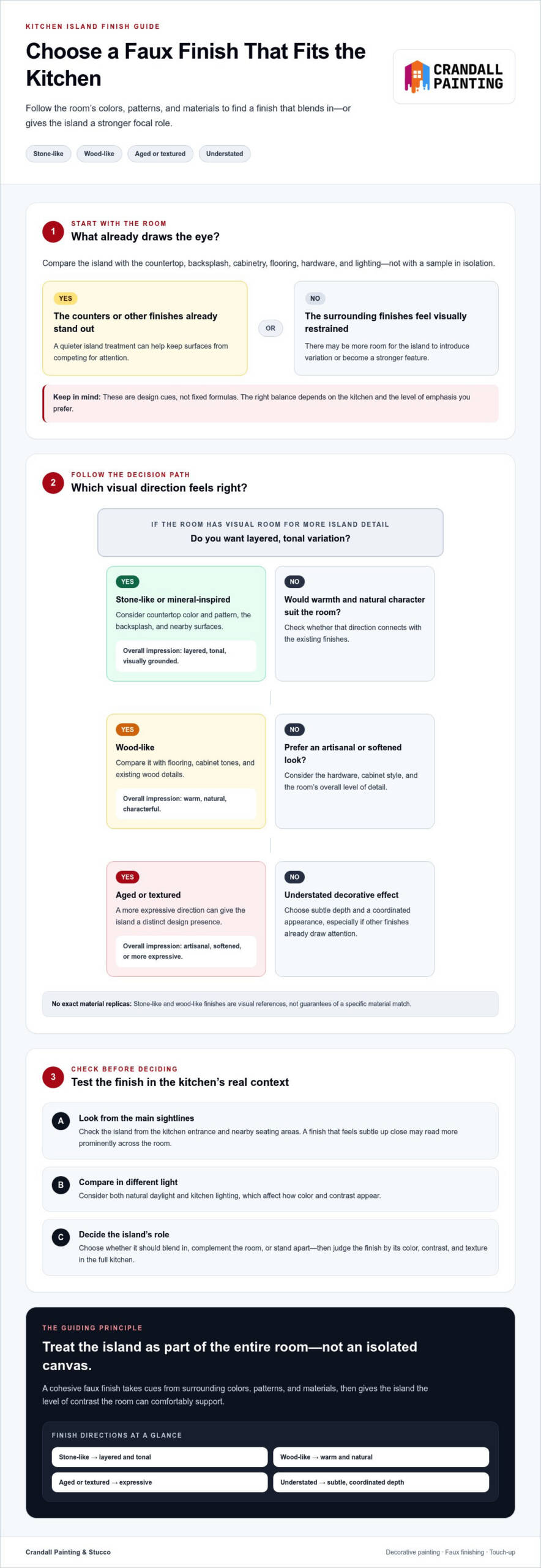
Finish direction influences whether an island feels quietly connected to the kitchen or becomes its defining accent. Rather than choosing by a sample alone, compare the effect with the countertop, cabinetry, flooring, and hardware already in the room. The options below are broad design references, not exact material replicas or promises of a particular result.
A cohesive faux finish takes its cues from the kitchen’s surrounding colors, patterns, and materials, then gives the island the level of contrast the room can comfortably support.
| Visual direction | Overall impression | Kitchen elements to consider |
|---|---|---|
| Stone-like or mineral-inspired | Layered, tonal, and visually grounded | Countertop color and pattern, backsplash, and nearby surfaces |
| Wood-like | Warm, natural, and characterful | Flooring, cabinet tones, and existing wood details |
| Aged or textured | Artisanal, softened, or more expressive | Hardware, cabinet style, and the room’s overall level of detail |
| Understated decorative effect | Subtle depth with a coordinated appearance | Whether the counters or other finishes already draw the eye |
Stone-like and mineral-inspired looks
A stone-like direction can bring tonal variation and visual depth to an island without claiming to reproduce a specific slab. Consider the countertop first. If its pattern is prominent, a quieter island effect may keep the surfaces from competing. If the counter is visually restrained, the island may have more room for variation. Treat names such as marble or granite as visual references, not guaranteed matches.
Wood-like, aged, and understated effects
A wood-like direction can suggest warmth and natural character, while an aged appearance may lend the island a softer, more established presence. A subdued treatment supports a coordinated room; a more pronounced decorative effect makes the island’s finish a stronger design feature. Compare either direction with cabinet color, hardware, and flooring so the island feels considered rather than disconnected.
Use the comparison as a starting point, then consider the preferred direction in the context of your actual kitchen. A finish that seems appealing on its own may feel too busy beside a patterned counter or too subtle under the room’s lighting. For faux painting for kitchen islands Phoenix, ask not only which look is attractive, but how its color, contrast, and texture contribute to the room’s overall balance.
Crandall Painting & Stucco’s decorative painting services include faux finishing and touch-up. A project discussion can help translate a visual preference into a finish direction suited to the island and its surroundings.
How to Choose a Faux-Painted Kitchen Island Finish in Phoenix
A clear decision path can help turn an appealing idea into a finish that belongs in your kitchen. Start with what you want the island to contribute, then compare that visual goal with the surfaces and lighting already in the room. For faux painting for kitchen islands Phoenix homeowners are considering, the most useful reference is the kitchen itself, not a finish viewed in isolation.
Start with the kitchen’s existing palette
Before choosing a direction, note the dominant cabinet colors, countertop pattern, flooring tones, hardware, and other prominent finishes. Decide whether the island should coordinate quietly or read as a distinct focal point. In an open layout, view it from adjoining rooms as well as from the kitchen’s main work and seating areas.
- Name the effect you want. Describe the mood or visual character you hope to create, such as a calm, coordinated presence or a more expressive accent. This keeps the discussion focused on the intended appearance rather than a technique name alone.
- Compare cabinet colors. Decide whether the island should echo the perimeter cabinets, relate through a shared undertone, or provide contrast. Compare the full cabinet color, not just a small detail or hardware accent.
- Read the countertop’s movement. Look at its pattern, color shifts, and visual prominence. If the counter already attracts attention, a quieter island treatment may help maintain balance. A simpler counter may leave room for a more noticeable effect.
- Bring in flooring and hardware. Check whether the floor introduces warm, cool, or varied tones, then consider how pulls, knobs, and fixtures contribute to the room’s overall character. Aim for a deliberate relationship, not an exact match across every surface.
- Review the light and sightlines. Observe the island in natural daylight and under artificial lighting, including from nearby rooms. Light can change how color and contrast are perceived, so consider the finish in the settings where you use the kitchen.
Review the finish before committing to a direction
During the initial consultation, describe the effect you’re drawn to and what you want to avoid, such as a finish that feels too busy beside the counter. Photos of the room and notes about its colors can help make those preferences concrete. Review the proposed finish direction in the context of the kitchen before settling on it.
Keep appearance separate from assumptions about performance. A stone-like or aged look describes visual character; it doesn’t, by itself, establish how a finish will wear or what care it requires. Discuss the project’s practical expectations as well as the look you’re seeking. Across Phoenix, Scottsdale, and nearby communities such as Paradise Valley, homes have varied interior styles, so evaluate the finish in the context of your particular kitchen.
For broader context on Crandall’s Decorative Painting, including faux finishing and touch-up, explore the service overview. Reviewing palette, lighting, and desired effect gives the island a finish direction shaped by your home and taste.
Kitchen Island Faux Painting: Preparation and Project Planning
A considered decorative finish begins before the first coat. Careful preparation helps create a more even foundation for the visual effect, while thoughtful planning keeps the work organized around your kitchen and household routine. For faux painting for kitchen islands Phoenix homeowners are planning, the island’s condition and project scope shape the preparation and schedule.
What preparation can involve
Crandall Painting & Stucco’s preparation includes sanding, cleaning, caulking, and priming. These steps prepare the surface for decorative work, with the plan based on the island’s condition and project scope. The company also uses clean work practices and protects nearby areas with drop cloths, tape, and coverings.
Before work begins, clear items from the island and nearby counters, and consider what needs to remain accessible. Think through how you’ll use the kitchen while the project is underway. During planning, discuss adjoining surfaces and access so the work can be coordinated with the room around the island. Project timing varies by scope, so scheduling reflects the work involved rather than a fixed duration.
Planning around a Phoenix-area home
Crandall Painting & Stucco serves Phoenix, including zip code 85018 and surrounding areas, as well as Scottsdale, Paradise Valley, Carefree, DC Ranch, Desert Mountain, and Scottsdale Mountain. Its process moves from consultation and a detailed estimate to scheduling, coordination, quality control, and follow-up. The estimate defines the project before scheduling, while coordination helps plan access and work around the household’s routine.
Homeowners don’t need to be present during the work, according to the company’s FAQ. You can prepare by arranging access, clearing the work area, and sharing household considerations during planning. If you’ll be away, establish the practical details for access and communication as part of coordination.
Crandall’s Interior Painting and Decorative Painting are relevant to kitchen-island projects, with faux finishing and touch-up included in its decorative work. Reviewing the scope and preparation together helps align expectations for the island and surrounding kitchen. Crandall provides a free, no-obligation estimate to begin planning the project. Details are available on Crandall Painting & Stucco’s website.
Plan Your Phoenix Kitchen Island Faux Painting Project with Crandall
A kitchen-island finish is a personal design decision, and a clear process can help you move from an initial idea to a well-coordinated project. Crandall Painting & Stucco provides Decorative Painting, including faux finishing and touch-up, for Phoenix-area homeowners. The company has operated since 2002 and is fully licensed, bonded, and insured.
Crandall serves Phoenix, including zip code 85018 and surrounding areas, as well as Scottsdale, Paradise Valley, Carefree, DC Ranch, Desert Mountain, and Scottsdale Mountain. Its project approach clarifies the work, coordinates the schedule, and carries the project through quality control and follow-up. Crandall provides a two-year warranty on all work.
What to expect from consultation through follow-up
The process begins with a consultation to discuss your island, kitchen context, and preferred visual direction. Crandall then prepares a detailed estimate so the project scope is clear before scheduling. Scheduling and job coordination help organize the work around the home. Quality control and customer-service follow-up are also part of the process.
Project timelines vary according to scope, so the schedule reflects the work involved rather than a set duration. During the consultation, describe how the island relates to nearby cabinets and counters, what visual effect you’re considering, and any household routines that matter for coordinating the work. These details help frame the estimate and planning conversation around your priorities.
Request a free, no-obligation estimate
To prepare for the initial discussion, gather a few notes about your kitchen: the island’s current appearance, surrounding finishes, and the direction you’re drawn to, whether understated or more expressive. You can also describe what you hope the finish will contribute to the room. This gives the consultation a practical starting point and helps shape a project estimate around your priorities.
Pricing is provided upon request. Crandall’s free, no-obligation estimate gives you a project-specific basis for understanding the proposed work before deciding how to proceed. If you’re considering faux painting for kitchen islands Phoenix, share your island and design preferences with Crandall Painting & Stucco.
Visit Crandall Painting & Stucco.
Give Your Kitchen Island a Considered New Direction
Your island’s finish can do more than refresh one surface. It can shape how the kitchen feels as you gather, cook, and move through the space. Before taking the next step, consider the role you want the island to play: a quiet part of the room’s composition or a distinctive feature that draws the eye. That intention can guide a focused conversation about faux painting for kitchen islands Phoenix homeowners are considering.
Bring your preferred visual direction and a sense of how the island relates to the surrounding kitchen to the project discussion. Crandall Painting & Stucco provides Decorative Painting, including faux finishing and touch-up, to help bring those ideas into a clearly scoped project.
Ready to discuss your kitchen island? Request a free, no-obligation estimate from Crandall Painting & Stucco.
Frequently Asked Questions
What is faux painting for a kitchen island?
Faux painting gives a surface a decorative appearance inspired by another material or visual character, without changing the underlying island itself. The effect can be subtle or more expressive, depending on the design direction. For example, a homeowner might want the island to feel warmer, more layered, or visually distinct from nearby cabinets. The goal is to shape the room’s look, not assume a particular result or exact material replica.
Can a kitchen island be faux painted to look like stone or wood?
Yes, a decorative finish can suggest stone-like or wood-like character. These are visual directions rather than a guarantee of an exact match to a particular slab or wood species. If you’re drawn to a specific reference, consider what you like about it, such as its color variation or overall warmth. That helps guide a conversation about an effect that suits the island and the rest of the kitchen.
How do I choose a faux finish for my kitchen island?
Begin by deciding whether the island should blend into the kitchen or draw attention, then identify the colors and patterns you want it to relate to. Gather photos of the cabinets, countertop, and flooring, along with a picture of the island from the room entrance. Reviewing those together can make preferences clearer than relying on a finish name alone.
Is faux painting a good choice for a Phoenix kitchen island?
It can be a suitable decorative option if you want to give the island a distinctive visual character while keeping the existing kitchen. The best direction depends on the home’s design and your taste. In Phoenix and nearby communities such as Scottsdale, Paradise Valley, and Carefree, consider whether the finish’s color and contrast feel at home with your particular interior.
How is a kitchen island prepared for faux painting?
Preparation depends on the island’s condition and the planned project. Crandall’s preparation includes sanding, cleaning, caulking, and priming. Before the work, clear personal items and countertop appliances from the island so the surface is accessible. Crandall protects surrounding areas with drop cloths, tape, and coverings. The preparation plan is based on the surface and project scope.
How long does faux painting a kitchen island take?
There isn’t a single timeline that applies to every island; project duration varies with scope. The surface condition and the preparation and decorative work involved inform planning. Crandall schedules projects after preparing a detailed estimate, so timing is considered as part of the project plan rather than assumed from a general rule. A defined scope helps set expectations for your household routine.
How much does faux painting for a kitchen island cost in Phoenix?
Pricing is provided upon request, so there isn’t a published amount to use as a reliable quote for your island. Crandall Painting & Stucco offers free, no-obligation estimates. The detailed estimate gives you a project-specific basis for understanding the proposed work. To get started, share the island’s condition and the visual direction you’re considering for your Phoenix-area kitchen.
Does Crandall Painting & Stucco offer a warranty on faux painting?
Crandall Painting & Stucco provides a two-year warranty on all work. Keep the project estimate and related paperwork with your home records so you can refer to the agreed scope and warranty information later. Crandall is fully licensed, bonded, and insured.