
Why do some Arizona homes maintain a vibrant, flawless finish for a decade while others begin to flake and fade after just three summers? You’ve likely noticed those hairline cracks appearing like clockwork every July or felt the heat radiating off your exterior walls long after sunset. It’s frustrating to invest in your property only to watch the intense UV exposure dull your curb appeal and drive up your monthly cooling costs. Finding the best paint for stucco in Arizona desert requires more than just picking a premium brand; it demands a sophisticated understanding of thermal reflectivity and modern material science.
We believe your home deserves a finish that acts as a breathable thermal shield rather than just a decorative coating. You’re about to discover the elite paint technologies and artisanal methods required to protect your stucco against extreme desert heat. This 2026 guide provides a thorough look at 100% acrylic systems that offer maximum UV resistance and a 10 to 15 year maintenance-free lifespan. We’ll show you how the right choice in color and chemistry can lower your energy bills while providing the polished, high-end aesthetic your investment deserves.
Key Takeaways
- Understand why standard coatings fail and how 100% acrylic latex provides the essential breathability needed for desert climates.
- Learn how to utilize Light Reflectance Value (LRV) to select colors that significantly reduce heat absorption and lower your energy bills.
- Discover why identifying the best paint for stucco in Arizona desert is only half the battle, as meticulous surface preparation and foundation trenching determine the project’s actual lifespan.
- Explore the critical differences between acrylic and elastomeric technologies to determine which “armor” best suits your home’s current structural condition.
- Gain the professional insights needed to vet contractors based on their mastery of regional environmental challenges and high-solids material application.
The Sonoran Challenge: Why Standard Exterior Paint Fails in Arizona
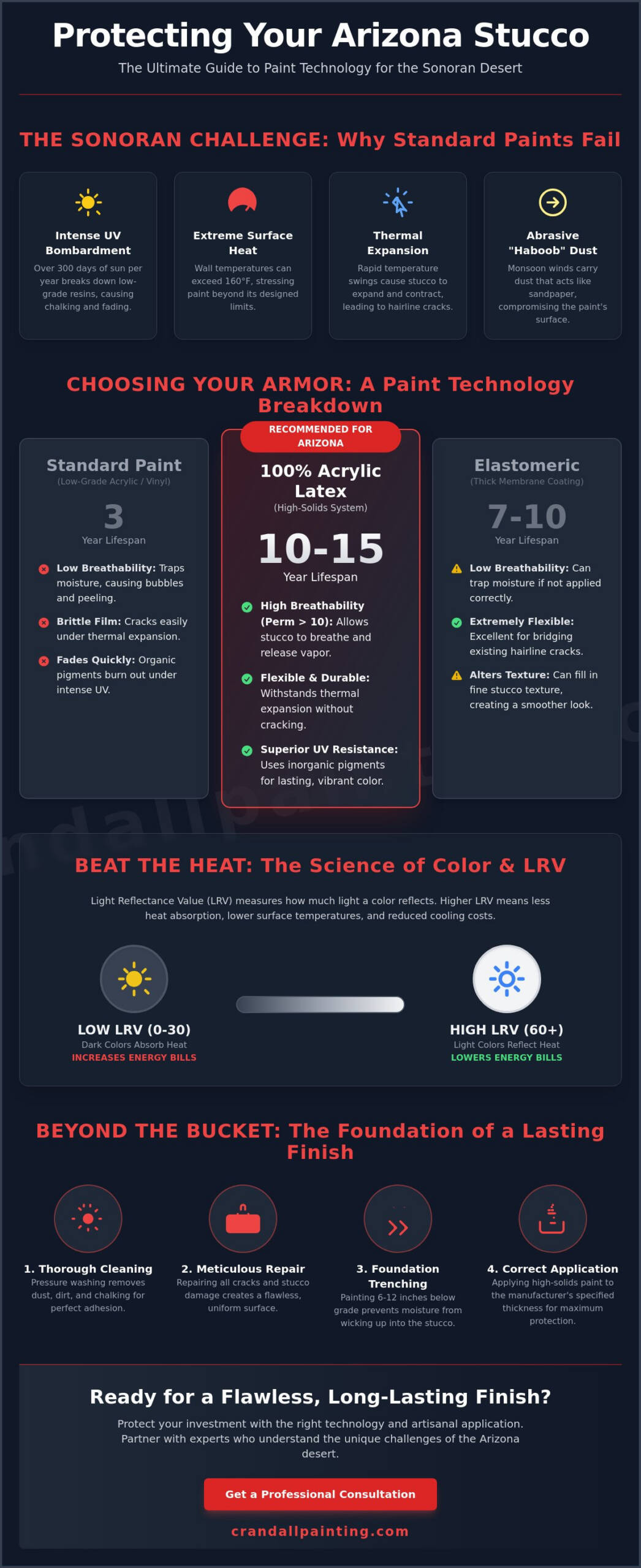
The Arizona sun is a relentless force. With over 300 days of intense UV bombardment annually, standard exterior paints simply aren’t engineered for long-term survival in the Sonoran Desert. Many homeowners assume that any premium label is sufficient; however, the desert environment demands a higher standard of chemistry. Identifying the best paint for stucco in Arizona desert requires looking beyond the marketing and focusing on how a coating responds to extreme solar radiation and mechanical wear.
Beyond the light itself, the desert heat creates a constant cycle of physical stress. During a typical summer afternoon, surface temperatures on a west-facing wall can exceed 160 degrees. As the sun sets, the temperature drops rapidly. This creates a phenomenon known as thermal expansion, where the stucco substrate physically expands and contracts. If a paint film is brittle or lacks high-performance elasticity, it will develop micro-fissures. These hairline cracks eventually lead to peeling and compromise the home’s structural integrity.
Regional geography also plays a significant role in your property’s maintenance needs. A residence in the higher, wind-swept elevations of Carefree faces different stressors than a property in the heat-trapping urban corridor of Phoenix. High-velocity winds during monsoon season carry abrasive “haboob” dust that acts like sandpaper on your home’s finish. When the rains finally arrive, moisture can penetrate these newly sanded surfaces if the coating isn’t perfectly intact. Professional exterior painting and stucco repair must account for these micro-climates to ensure a lasting finish.
UV Degradation and Pigment Burn
Intense solar radiation doesn’t just heat the wall; it attacks the paint at a molecular level. Low-grade resins lose their flexibility as UV rays break down their chemical bonds. This process is often visible as chalking, where the paint turns into a powdery residue that wipes away easily. Pigment stability is equally critical. Organic pigments, which are common in vibrant reds and deep blues, often vanish within two seasons. We prioritize inorganic, mineral-based pigments that reflect light rather than absorbing its destructive energy, ensuring your home’s color remains vibrant for years.
The Porosity of Stucco
Stucco is essentially a hard, breathable shell. To understand stucco composition and application, one must recognize it as a masonry product that requires gas exchange. If you seal your home with a non-permeable coating, you’re inviting disaster. Trapped moisture and heat behind the paint film create vapor pressure, leading to unsightly bubbling and delamination. The best paint for stucco in Arizona desert isn’t a plastic wrap. It’s a high-performance, breathable membrane that allows the structure to exhale while remaining entirely watertight.
Comparing Paint Technologies: Acrylic vs. Elastomeric vs. Silicate
Selecting the best paint for stucco in Arizona desert environments involves more than choosing a pleasing shade from a fan deck. It requires a technical evaluation of how different resin systems interact with the porous nature of masonry. While the market offers various coatings, three primary technologies dominate the landscape: 100% acrylic latex, elastomeric membranes, and mineral silicates. For the majority of high-end residential properties, a high-solids acrylic system represents the pinnacle of performance, balancing aesthetic refinement with the essential breathability your home requires.
The concept of “permeability” is central to this choice. In the desert, your walls must be able to “breathe” to prevent vapor pressure from building up behind the paint film. We look for a “Perm” rating of 10 or higher. This ensures that while liquid water is kept out, water vapor can escape. Research from the Building Science Corporation on paint durability in harsh climates highlights how critical these moisture-management properties are to preventing premature coating failure. Without this gas exchange, even the most expensive paint will eventually bubble and peel away from the stucco substrate.
The Case for 100% High-Solids Acrylic
High-solids acrylics are often considered the “sweet spot” for luxury Scottsdale estates. The term “solids by volume” refers to what remains on your wall after the water and solvents evaporate. A higher percentage of solids means a thicker, more durable protective film. These premium resins provide superior flexibility, allowing the paint to stretch slightly during those 40-degree temperature swings common in the desert. We typically recommend a meticulous two-coat system. This approach ensures maximum hide, consistent sheen, and a robust barrier against the sun’s abrasive energy. If you are evaluating your home’s current condition, exploring our comprehensive exterior painting services can help determine if a high-solids system is the right fit for your property.
When to Consider (and Avoid) Elastomeric
Elastomeric coatings are often marketed as a “thick armor” for your home. These coatings are ten times thicker than standard paint and can bridge significant hairline cracks. While this sounds appealing, it comes with a “Moisture Trap” risk. If the coating is applied over a substrate that already contains moisture, or if the application is uneven, it can seal the stucco so tightly that it creates pockets of trapped vapor. This leads to massive delamination. We generally reserve elastomeric upgrades for older homes with extensive “spider-web” cracking where a standard acrylic cannot provide sufficient coverage. For most modern desert homes, a premium acrylic provides better color longevity and safer moisture management than a heavy elastomeric membrane.
Achieving a flawless finish requires matching the coating technology to your home’s specific structural needs. You can learn more about our tailored approach at crandallpainting.com.
Color Selection and the Science of Light Reflectance Value (LRV)
In the high-desert landscapes of Paradise Valley and Scottsdale, color selection is often viewed through the lens of architectural harmony and HOA compliance. However, for the discerning homeowner, choosing a palette is a critical engineering decision that dictates the thermal load of the entire structure. Light Reflectance Value (LRV) is the professional metric used to measure the percentage of light a color reflects versus how much it absorbs. On a scale of 0 to 100, where 0 is absolute black and 100 is pure white, the LRV of your home’s exterior directly impacts its surface temperature and the longevity of the coating itself.
When specifying the best paint for stucco in Arizona desert climates, we prioritize pigments that resist “burn” while maintaining high reflectance. Many traditional “Desert Tones” approved by local associations—such as deep terracottas or heavy tans—actually have surprisingly low LRV numbers. These shades absorb significant infrared energy, which can lead to interior heat gain and higher utility bills. To combat this, modern coatings now utilize “Cool Wall” technology. These infrared-reflective pigments allow even mid-tone colors to stay cooler than their standard counterparts. This science mirrors the principles shared by the Department of Energy on Cool Roofs, which highlights how reflective surfaces extend the life of building materials by reducing thermal stress.
The High LRV Advantage
Selecting a paint with an LRV of 50 or higher is one of the most effective ways to protect your home. A high LRV finish can lower exterior wall temperatures by as much as 20 degrees during the peak of a July afternoon. This reduction in heat prevents the resin in the paint from becoming brittle, effectively extending the maintenance cycle of your exterior painting project. For 2026, we’re seeing a shift toward sophisticated, high-reflectance palettes in Scottsdale. Warm, creamy whites and muted “desert sages” are becoming the preferred choice for estates that seek to balance luxury aesthetics with maximum thermal performance.
Managing Darker Accents
While light colors are ideal for large expanses of stucco, many architectural styles require darker “coffee” or “charcoal” accents for visual depth. Using these tones safely in Arizona requires a master craftsman’s approach. We exclusively use high-grade inorganic pigments for these deep colors, as they’re far less prone to fading than organic alternatives. It’s also vital to recognize that south-facing walls with high-contrast finishes will naturally require more frequent inspections. Even the best paint for stucco in Arizona desert will face its toughest test on these exposed surfaces, making the choice of a high-solids, UV-resistant resin non-negotiable for dark accents.
The Crandall Standard: Preparation and Stucco Restoration
The most sophisticated chemical formulation won’t compensate for a surface that hasn’t been meticulously prepared. Identifying the best paint for stucco in Arizona desert environments is only the initial step; the true value lies in the restoration work performed before the first brush stroke. We view exterior painting not as a cosmetic application, but as a comprehensive structural renewal. Our methodology for stucco repair in Phoenix addresses the root causes of wear, ensuring that the final coating bonds perfectly to a stable, healthy substrate.
A defining element of our professional standard is the trenching process. Rather than stopping at the soil line, we excavate several inches around the perimeter of the home. This allows us to apply the protective coating below grade, preventing moisture from wicking up into the stucco and protecting the foundation from the “alkali burn” common in desert soils. We also pay close attention to efflorescence. These white, crystalline salt deposits can push a new paint film right off the wall if they aren’t neutralized and removed. By addressing these hidden vulnerabilities, we provide a foundation that allows the best paint for stucco in Arizona desert to perform for its full 15-year potential.
Structural Integrity and Crack Repair
We differentiate clearly between cosmetic hairline cracks and structural “stair-step” fissures that indicate settling. It’s a mistake to simply paint over these openings. We utilize masonry-compatible elastomeric caulks and high-performance patch compounds that mirror the expansion properties of the original stucco. This stabilization ensures that when the desert heat causes the home to move, the repair moves with it. We never apply a finish coat over “live” cracks until they’ve been properly stabilized and cured to prevent immediate re-cracking.
Texture Matching: The Mark of a Master
The visual success of a restoration depends entirely on the artisan’s ability to match the existing texture. Whether your home features a heavy Spanish Lace, a fine Sand finish, or a custom skip-trowel, our craftsmen replicate the original movement of the stucco. This prevents the unsightly “patched” look that often plagues lesser paint jobs. We also ensure a uniform absorption rate across the entire surface. By priming new patch work with specialized masonry sealers, we prevent “flashing,” where the new stucco absorbs the paint differently than the old, creating a blotchy appearance in the final sheen.
If your estate requires this level of disciplined craftsmanship, we invite you to view our professional exterior painting and restoration services.
Selecting the Right Partner for Your Desert Estate
The final stage of protecting your investment is selecting a partner who views your property with the same reverence you do. While identifying the best paint for stucco in Arizona desert environments provides the necessary chemical barrier, the longevity of that barrier depends entirely on the hands that apply it. For high-end estates in Scottsdale and Paradise Valley, a “white-glove” service model isn’t a luxury; it’s a requirement for preserving architectural detail. You should expect your contractor to provide transparent data on paint tiers and solids content. A true professional will explain why a high-solids acrylic is superior to a standard contractor-grade finish in the 115-degree heat.
Local expertise is equally vital when managing the specific environmental nuances of the Phoenix-Mesa area. This includes staying ahead of evolving VOC regulations and understanding how local micro-climates affect drying times and adhesion. We believe in a holistic approach to property care. This is why we integrate decorative restoration into every project, ensuring that every architectural element, from the primary stucco walls to the smallest ornamental detail, receives the same level of meticulous attention.
Beyond the Bucket: The Artisan’s Touch
A complete exterior transformation involves more than just a fresh coat on the masonry. The artisan’s touch extends to the wood staining and refinishing of your entry doors, vigas, and corbels. These elements are often the first to show signs of desert fatigue. Our master craftsmen take immense pride in protecting your home’s surrounding assets during this process. We employ rigorous shielding protocols for your professional landscaping, intricate stonework, and existing custom faux finishes. This disciplined approach ensures that the only evidence of our presence is the renewed beauty and increased value of your home. Using the best paint for stucco in Arizona desert is a waste of resources if the surrounding wood and stone are left to weather and degrade.
Schedule Your Professional Consultation
During a Crandall exterior evaluation, we conduct a thorough forensic analysis of your home’s current condition. We don’t just provide an estimate; we provide a roadmap for long-term protection. You can expect a detailed discussion on moisture management, crack stabilization, and the specific resin systems best suited for your home’s orientation to the sun. Our commitment to precision craftsmanship concludes with a final inspection that focuses on the invisible details, from the sharpness of the cut-lines to the consistency of the sheen. We treat every project as a significant investment in your lifestyle and property value.
Elevate your home’s exterior with Crandall Painting & Stucco to ensure your estate remains a beacon of desert elegance for years to come.
Securing the Future of Your Arizona Estate
Preserving the beauty of a high-end desert property requires more than a simple aesthetic refresh. It’s a disciplined process of choosing the best paint for stucco in Arizona desert climates and pairing it with meticulous restoration standards. You’ve learned that the secret to a 15-year lifespan lies in high-solids acrylic technology, strategic Light Reflectance Value selection, and a foundational commitment to surface preparation. Since 2004, we’ve dedicated our craft to protecting the most distinguished estates in Scottsdale and Paradise Valley through this exact blend of material science and artisanal mastery.
Your home is a significant asset that deserves a finish as resilient as it is refined. Whether you’re addressing hairline fractures or seeking a complete color transformation, the right expertise ensures your vision endures the Sonoran sun. We invite you to Schedule Your Master Craftsman Consultation to begin your home’s professional evaluation. Let’s work together to create a flawless, protective shield that enhances your property’s value for a decade to come.
Frequently Asked Questions
Is elastomeric paint better than acrylic for Arizona stucco?
High-performance 100% acrylic is generally superior for most Arizona stucco because it offers better breathability and color retention. Elastomeric coatings are significantly thicker and bridge cracks well, but they carry a higher risk of trapping moisture, which can lead to bubbling in our extreme heat. We typically reserve elastomeric for older homes with significant structural cracking that requires a heavy, flexible membrane.
How often should you repaint a stucco house in the desert?
You should plan to repaint your stucco home every 7 to 10 years to maintain its protective barrier. While some premium coatings applied with professional precision can last up to 15 years, the intense Sonoran UV exposure eventually breaks down even the most resilient resins. Regular inspections every five years help identify hairline cracks before they become costly structural issues.
What is the best month to paint the exterior of a house in Phoenix?
The ideal months for exterior painting in Phoenix are October through April, when temperatures are moderate and predictable. We avoid painting during the peak summer months when surface temperatures on stucco can exceed 160 degrees, as this causes the paint to dry too quickly and prevents proper bonding. Avoiding the monsoon season is also critical to ensure a dust-free, moisture-controlled application.
Can I paint my stucco a dark color in Scottsdale?
Yes, you can paint your stucco a dark color, but it requires a specialized approach using infrared-reflective pigments. Darker tones naturally absorb more heat, which can accelerate the degradation of the paint film and increase your cooling costs. If you choose a dark charcoal or deep coffee accent, we recommend high-solids formulations designed specifically to resist UV burn and maintain pigment stability.
Does painting stucco help with home insulation or cooling?
Painting your stucco with high-reflectance coatings significantly improves your home’s thermal performance by reflecting solar energy. While paint isn’t a substitute for traditional insulation, choosing the best paint for stucco in Arizona desert with a high Light Reflectance Value (LRV) can lower exterior wall temperatures by up to 20 degrees. This reduction in heat transfer helps your HVAC system run more efficiently during the summer.
What is LRV, and why does it matter for my Arizona home?
LRV stands for Light Reflectance Value, a scale from 0 to 100 that measures how much light a color reflects. In Arizona, LRV is a critical metric because it dictates how much heat your home absorbs from the sun. We typically recommend colors with an LRV of 50 or higher to ensure your home stays cooler and your paint resin remains flexible for a longer period of time.
How do I know if my stucco needs repair before it’s painted?
Your stucco requires professional repair if you notice “spider-web” cracking, bulging, or white crystalline deposits known as efflorescence. These signs indicate that moisture or structural movement is compromising the substrate. Painting over damaged stucco only masks the problem; we must stabilize the surface and match the existing texture before applying the final protective coating to ensure a seamless, durable result.
Why is Dunn-Edwards so popular for Arizona exterior painting?
Dunn-Edwards is a regional favorite because their products are specifically formulated and tested for the high heat and intense UV exposure of the Southwest. Their manufacturing facilities are located right here in the desert, allowing them to engineer the best paint for stucco in Arizona desert with superior color retention and chalk resistance. This localized chemistry provides a distinct advantage over national brands designed for milder climates.