
What if the visible streaks and peeling paint on your walls aren’t actually a failure of the product, but a deeper symptom of compromised surface preparation? It’s disheartening to witness unsightly roller marks, uneven flashing, or bubbling surfaces after expecting a pristine transformation. You deserve a home that reflects your high standards, yet these common imperfections often make a room feel unfinished or neglected. When you’re tasked with fixing bad paint job on interior walls, the instinct is often to simply apply another coat. However, this usually masks the underlying mechanical issues rather than solving them at the source.
We understand the frustration of living with subpar results, and we’re here to help you reclaim the beauty of your home. This guide provides a professional roadmap to identify these pitfalls and transform mediocre workmanship into a flawless, gallery-quality finish through master-level restoration techniques. You’ll gain a clear understanding of whether your walls require simple remediation or intensive drywall repair to achieve a smooth and uniform surface. We’ll also preview the essential steps for a successful restoration, including critical safety considerations for properties built before 1978. By the end, you’ll have the confidence to ensure your interior walls serve as a lasting investment in your property’s long-term value.
Key Takeaways
- Learn how to utilize “raking light” to accurately identify subtle defects like lap marks and flashing that disrupt the uniformity of your home’s interior.
- Understand why fixing bad paint job on interior walls often necessitates a “Sand and Skim” approach to restore a smooth, architectural-grade surface.
- Discover the scientific difference between mechanical and chemical bonds and why proper surface tension is vital for a flawless, long-lasting finish.
- Identify the specific scenarios where drywall restoration and professional skim coating are essential to correct deep-seated textural damage.
- Gain insight into the meticulous “white-glove” restoration process that transforms subpar workmanship into an asset that enhances your property’s overall value.
Identifying the Symptoms of a Subpar Interior Paint Job
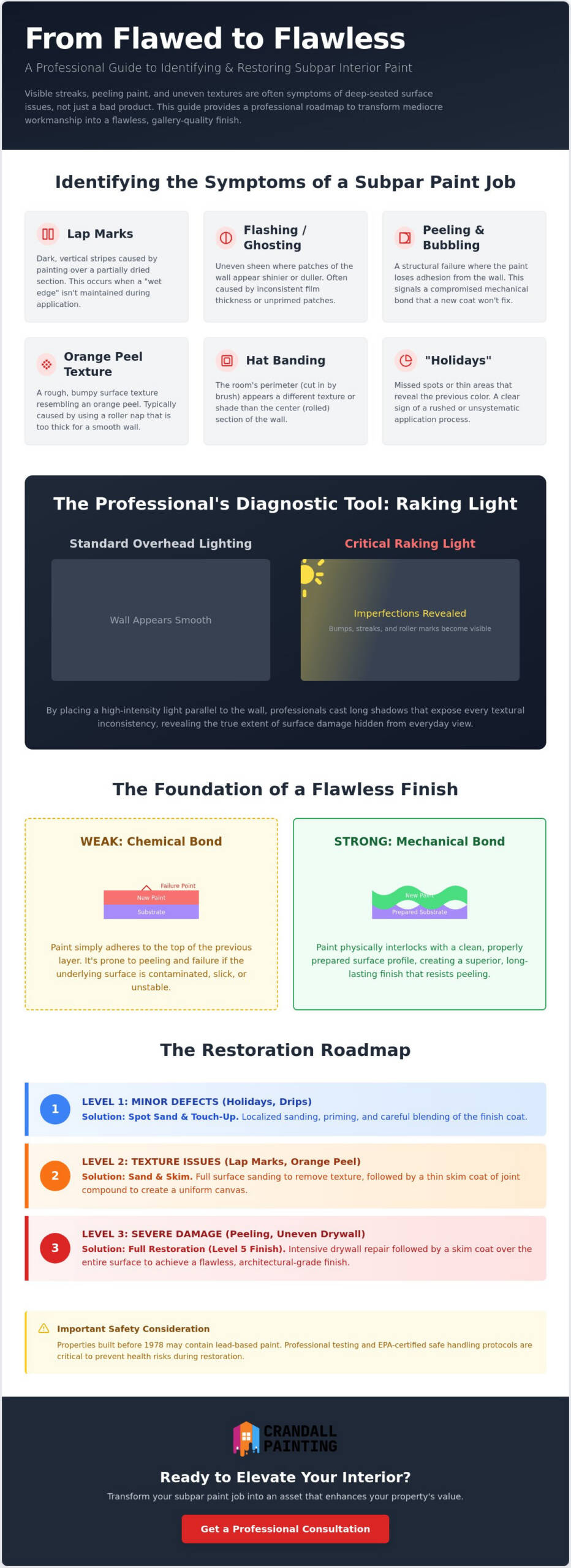
A professional restoration begins with a critical, clinical assessment of the current state of your surfaces. While some imperfections are obvious, others require a trained eye and specific lighting conditions to reveal the true extent of the damage. When homeowners consider fixing bad paint job on interior walls, they often start by identifying “holidays,” which are those frustratingly missed spots or thin areas that reveal the previous color beneath. These gaps aren’t just aesthetic oversights; they usually signal a lack of systematic preparation and a rushed application process that compromises the entire project’s integrity.
To truly evaluate the uniformity of your walls, professionals utilize “raking light.” This involves placing a high-intensity light source parallel to the wall surface to cast long shadows over any textural inconsistencies. This technique exposes common paint defects that remain hidden under standard overhead lighting. It’s vital to distinguish between simple aesthetic errors, such as a stray brush hair, and structural failures like peeling or bubbling. Structural issues often indicate a failure of the mechanical bond, meaning the paint is no longer adhering to the substrate, a problem that requires more than just a fresh coat of color to resolve.
Visual Indicators of Poor Technique
Visible lap marks are perhaps the most frequent sign of an amateur application. These occur when a painter fails to maintain a “wet edge,” allowing one section of paint to dry before the next is applied. This results in a literal overlap of dried film, creating dark, vertical stripes across the wall. You might also notice “hat banding,” a phenomenon where the perimeter of the room, cut in by brush, appears a different texture or shade than the rolled center. This often stems from improper roller sleeve selection. Using a nap that’s too thick for a smooth wall creates an “orange peel” texture that feels rough to the touch and looks inconsistent under the Scottsdale sun.
Sheen Variations and “Flashing”
Flashing is a sophisticated term for uneven sheen, where certain patches of the wall appear shinier or duller than the surrounding area. This “ghosting” effect is typically caused by inconsistent film thickness or failing to prime porous patches of drywall repair. In our local environment, the dry Arizona air significantly reduces the “open time” of the paint, meaning the product sets much faster than in humid climates. If a contractor isn’t experienced with these regional conditions, the paint may set before it has a chance to level out, leading to permanent streaks. Achieving a high-end, uniform finish requires a deep understanding of how these environmental factors impact our interior painting processes. Correcting these issues is the first step in fixing bad paint job on interior walls and restoring the sophisticated atmosphere your home deserves.
The Anatomy of a Flawless Wall: Why Most Efforts Fail
A truly flawless interior wall is the result of meticulous engineering rather than simple application. When homeowners struggle with fixing bad paint job on interior walls, the failure often lies in a misunderstanding of how paint interacts with the surface on a molecular level. High-end finishes rely on the delicate balance of surface tension and leveling. If the substrate is compromised, even the most expensive premium acrylic-latex hybrid won’t flow correctly, leading to permanent brush strokes and visible textures that disrupt the visual harmony of a room.
Central to this process is the distinction between a chemical bond and a mechanical bond. While modern paints are formulated to adhere chemically to previous layers, a long-lasting restoration requires a superior mechanical bond, where the coating physically interlocks with the microscopic profile of the wall. Subpar projects often ignore this necessity, resulting in finishes that are prone to peeling because the paint was applied over a surface that was either too slick or contaminated. Achieving an architectural-grade Level 5 finish, which involves a thin skim coat over the entire surface, is often the only way to ensure the edge-to-edge uniformity required in luxury interiors.
The Importance of Substrate Porosity
Porosity refers to the extent to which a surface contains minute spaces or holes that allow liquids to be absorbed into the substrate. In the context of interior walls, uneven porosity is a silent architect of failure. If one section of drywall absorbs the moisture from the paint faster than another, the sheen will appear blotchy and inconsistent. Professional sealing, which is the most frequently skipped step in budget-conscious projects, ensures a uniform rate of absorption across the entire surface. Without this foundational layer, the “hide” of the paint remains compromised regardless of how many coats are applied.
Environmental Factors in the Phoenix Metro Area
The unique climate of the Phoenix and Scottsdale region presents specific challenges for paint curing that many standard contractors overlook. With humidity levels frequently dropping below 10 percent, the “open time” of standard latex paints is dramatically shortened. This rapid evaporation prevents the paint film from properly leveling out, which is why many desert interiors suffer from excessive roller texture. Additionally, airborne dust can interfere with the mechanical bond if the walls aren’t meticulously cleaned immediately before application. Achieving a museum-quality result requires addressing these environmental variables through Expert Drywall Repair in Phoenix, AZ, which provides the perfectly smooth, sealed foundation necessary for a high-end transformation. For those seeking a truly bespoke result, a professional consultation can reveal if your home requires these advanced restoration techniques.
Strategic Remediation: Professional Methods for Correcting Defects
Restoring a surface to its intended elegance requires a disciplined approach that prioritizes structural integrity over cosmetic speed. When fixing bad paint job on interior walls, the most effective strategy is often the “Sand and Skim” method. This involves mechanically abrading the existing texture to create a level plane before applying a thin, architectural-grade layer of joint compound. This process is far superior to simply applying more paint, which often only serves to highlight previous errors. For large, open surfaces, we utilize pole-sanding to ensure edge-to-edge uniformity. Conversely, hand-sanding is reserved for intricate corners and trim interfaces where precision is paramount.
While localized spot patching might seem efficient, it frequently results in visible “halos” where the new paint fails to blend with the original sheen. Professional remediation typically favors full wall-to-wall repainting to ensure a seamless, light-reflective surface. When dealing with peeling or bubbling, we must choose between chemical stripping and mechanical abrasion. Mechanical methods are often preferred for interior residential settings to minimize odors and environmental impact, provided the substrate is stable and free of hazardous materials.
Correcting Texture and Roller Marks
Eliminating deep roller texture, often referred to as “orange peel,” requires the careful use of 220-grit abrasives. This specific grit is fine enough to level out high points without gouging the underlying drywall. A master craftsman understands the art of “feathering” the edges of a repair, gradually thinning the application so the transition becomes invisible to the naked eye. To prevent these issues from recurring, selecting the correct nap size is vital. A 3/8-inch nap is generally the standard for achieving a smooth, high-end residential finish on smooth-troweled walls, especially in the dry Scottsdale climate where paint sets quickly.
Addressing Drips and Runs
Hardened drips and runs are common hallmarks of an overloaded brush or roller. Rushing to sand these defects before they’ve fully cured will lead to “gumming” the sandpaper, which can tear the surrounding paint film and create more work. Once the paint is fully hardened, the “razor blade” technique allows us to carefully shave down the high point of the run before finishing with light sanding. Spot-priming the abraded area after sanding is vital for maintaining sheen consistency across the entire wall. This step prevents the repaired section from absorbing the topcoat differently than the rest of the surface, ensuring a flawless result that stands up to professional scrutiny.
Beyond the Brush: When Drywall Restoration is Non-Negotiable
Many homeowners mistakenly believe that a fresh coat of paint serves as a restorative mask for wall imperfections. In reality, high-quality architectural coatings actually highlight underlying flaws rather than concealing them. When fixing bad paint job on interior walls, we often discover that the visible defects aren’t failures of the paint itself, but rather a lack of proper drywall preparation. Significant textural damage, deep gouges, or uneven joints require a comprehensive skim coat to reset the surface to a neutral, uniform state. Without this intervention, even the most skillful application of premium paint will appear amateurish.
Our approach at Crandall involves ensuring a Level 5 finish before the first drop of color is ever applied. This standard represents the pinnacle of drywall finishing, where a thin film of joint compound is applied over the entire surface to eliminate suction variations and textural telegraphing. If your walls suffer from persistent bubbling or peeling, it’s essential to address the source, whether it’s localized moisture intrusion or a previous contractor’s failure to remove sanding dust. Without this foundational integrity, any subsequent paint application is destined to fail prematurely, regardless of the brand used.
Matching Texture in Scottsdale Homes
Achieving a seamless repair in many Scottsdale residences is complicated by specialized wall treatments like “knockdown” or “skip-trowel” finishes. These hand-applied textures require a master’s touch to replicate, as even a slight deviation in technique will be glaringly obvious once the light hits the finished surface. Professional drywall blending is required to ensure that repaired sections disappear into the existing architecture. If your interior features unique masonry elements or integrated plaster work, you may also benefit from our expertise in Mastering Stucco Repair in Phoenix to maintain a cohesive aesthetic throughout your home.
Evaluating Structural Integrity
Before proceeding with remediation, we must determine if the current failure is due to poor preparation or an environmental issue. Chalky residues or old, brittle layers of paint often require high-performance primers to “lock down” the substrate and provide a stable base for new coatings. If you notice that your architectural details are also showing signs of age, consulting a wood restoration specialist is a prudent step to ensure that your trim and molding match the renewed quality of your walls. Addressing these foundational elements is the only way to transform a failing interior into a lasting masterpiece. If you’re ready to elevate your home’s interior, explore our full range of Interior Painting and Drywall Repair services today.
Elevating Your Interior with Crandall’s Master Restoration
Discerning homeowners in Scottsdale and Paradise Valley understand that fixing bad paint job on interior walls requires an artisanal touch rather than a standard contractor’s speed. At Crandall Painting & Stucco, we view every project as a preservation of your home’s unique architectural character. This commitment to meticulousness transforms a source of daily frustration into a long-term asset that enhances your property’s overall market value. It’s about moving beyond simple remediation and into the realm of true atmospheric renewal. We focus on the outcomes of our technical mastery to ensure your peace of mind throughout the entire transformation.
Our “White Glove” process is defined by protection, preparation, and perfection. We begin by isolating the work area to safeguard your fine furnishings and flooring, creating a controlled environment for the restoration. By utilizing premium, low-VOC finishes, we provide a healthy luxury living environment that doesn’t sacrifice durability or depth of color. This methodical rhythm ensures that the final result is indistinguishable from the original high-end design. It’s a bespoke experience curated to meet the demands of the region’s most exclusive residences.
The Crandall Precision Touch-Up
For properties featuring specialized architectural details, our approach to Faux Finishing and Decorative Arts offers a level of customization that standard painting cannot achieve. We focus on expert color matching and precise sheen calibration to perform invisible repairs that respect your home’s existing architecture. This level of craftsmanship ensures that every touch-up blends seamlessly into the surrounding surfaces. We take immense pride in our ability to renew surfaces while protecting the significant investment you’ve made in your lifestyle.
Schedule Your Professional Consultation
We invite you to experience a higher standard of service by scheduling a comprehensive restoration assessment. Our experts will evaluate your unique paint failures and provide a tailored roadmap for fixing bad paint job on interior walls. Serving the Phoenix metro area for over 20 years, we remain dedicated to the highest standards of reliability and artisanal quality. Please view our full suite of services to see the breadth of what our master craftsmen can achieve for your home.
Reclaiming the Elegance of Your Interior Spaces
Achieving a flawless wall requires a disciplined approach that addresses the foundational bond between the substrate and the coating. We’ve explored how identifying technical defects and prioritizing mechanical adhesion are the first steps toward a museum-quality result. When you’re tasked with fixing bad paint job on interior walls, remember that the most enduring solutions often lie in professional-grade drywall restoration and meticulous surface leveling. By focusing on these architectural fundamentals, you ensure your home remains a sanctuary of refined beauty and long-term value.
As a family-owned business with over 20 years of Scottsdale expertise, we are specialists in high-end residential and decorative finishes. Our team possesses the unique expertise required for both structural drywall restoration and precision painting, ensuring your project receives the “White Glove” care it deserves. We invite you to restore your home’s beauty with a master consultation today. Your walls are the canvas of your life; let us help you make them perfect.
Frequently Asked Questions
Can I just paint over a bad paint job to fix it?
Simply applying more paint over a subpar finish rarely yields the desired result. In fact, adding layers usually accentuates existing imperfections like peeling, drips, or heavy roller texture. To achieve a high-end look, you must first address the mechanical bond and level the surface through sanding or skim coating. This foundational work ensures the new coat of paint adheres correctly and provides the uniform, light-reflective quality expected in luxury interiors.
How long should I wait before trying to fix a fresh paint mistake?
Patience is essential; you should wait at least 24 hours for the paint to harden before attempting a repair. If you try to sand or scrape a fresh mistake while the film is still soft, you risk “gumming” your sandpaper and tearing the surrounding paint. This creates a much larger defect that’s difficult to blend. Once the surface is fully cured, you can safely level the area and apply a precision touch-up that disappears into the wall.
Why do my walls look patchy even after two coats of paint?
Patchiness is typically the result of “flashing,” which occurs when the substrate absorbs the paint unevenly. This is common on walls where repairs weren’t properly sealed with a high-quality primer before the topcoat was applied. The porous drywall mud “sucks” the moisture out of the paint faster than the surrounding areas, leaving a dull, blotchy appearance. Achieving a uniform sheen requires a consistent film thickness and a properly prepared, non-porous foundation.
What is the best way to remove dried paint drips from walls?
The most effective method involves using a sharp razor blade to carefully shave the high point of the drip once it’s fully cured. By holding the blade at a shallow angle, you can remove the excess material without gouging the wall. After the run is leveled, lightly sand the area with fine-grit paper to smooth the edges. Finish by spot-priming the abraded spot to ensure the final coat of paint matches the surrounding sheen perfectly.
How do I fix roller marks that are already dry?
Correcting dry roller marks requires mechanical leveling through light sanding. This is a critical step in fixing bad paint job on interior walls when the previous application left behind heavy “orange peel” textures. We recommend using a 220-grit abrasive to gently smooth the ridges without damaging the underlying drywall. Once the surface is level and free of dust, applying a new coat with the correct roller nap will restore the intended smooth finish.
Is it worth hiring a professional to fix a bad DIY job?
Hiring a specialist is a prudent investment when you require a flawless, architectural-grade finish. Professionals utilize advanced tools like raking lights and high-performance sanders that aren’t typically available to homeowners. This ensures that the underlying drywall is perfectly level before the first drop of color is applied. Entrusting the remediation to an expert saves you from the cycle of repeated DIY attempts that often lead to excessive paint buildup and further textural issues.
What does “flashing” mean in interior painting?
Flashing refers to an inconsistent appearance in the paint’s sheen across a single surface. It manifests as shiny or dull patches that become particularly visible when light hits the wall at an angle. This defect is often caused by failing to maintain a “wet edge” during application or applying paint over unprimed drywall repairs. In high-end residential painting, avoiding flashing is a hallmark of professional mastery and meticulous attention to application speed.
Can humidity in Arizona cause my interior paint to fail?
The extreme low humidity in Arizona is a frequent cause of interior paint failure because it accelerates “open time.” When the paint dries too quickly, it prevents the film from leveling, making the process of fixing bad paint job on interior walls more complex than in more temperate climates. This rapid drying often leads to visible lap marks and heavy textures. Professionals adjust their techniques and use specific additives to counteract these desert conditions and ensure a flawless result.