
For an Arizona ranch, warm beige, tan, and taupe are reliable starting points: they complement the desert landscape and reflect sunlight. The best exterior color scheme advice for Phoenix desert homes pairs light, earthy walls with restrained accents such as terracotta, sage, or dusty blue. In Scottsdale, the palette should also suit the neighborhood’s established character.
Choosing a shade involves more than liking a paint chip. Arizona’s strong sun can change how a color looks across a large stucco exterior. This guide explains how Light Reflectance Value can help compare colors for sun-facing walls, how to build a cohesive scheme with desert-inspired accents, and what to consider about Scottsdale neighborhood preferences and HOA palettes. Use these criteria to narrow your options and choose colors that suit both the home and its setting.
Key Takeaways
- Choose warm desert neutrals as a starting point, then compare how shaded and sun-exposed elevations affect the color’s appearance.
- Use Light Reflectance Value to assess how much light a shade reflects, especially on walls that receive strong sun.
- Bring in terracotta, sage, or turquoise through restrained accents to add character without overwhelming the home’s palette.
- In Scottsdale, consider the neighborhood’s look and review HOA color preferences before settling on a final scheme.
1. What are the best exterior paint colors for a ranch house in Arizona?
Warm beige, tan, and taupe suit many Arizona ranch homes because their sandy undertones complement the desert landscape. Terracotta and soft brown offer richer options that can help disguise dust. To choose a palette for a Phoenix desert home, compare the closest homes and consider how your preferred colors fit the neighborhood.
Arizona’s summer heat, intense UV exposure, and daily temperature swings all affect exterior paint. Phoenix summer temperatures regularly exceed 115°F, and daily temperature swings can reach 40 degrees. For stucco, masonry, and block, 100% acrylic latex is a standard exterior paint choice. A quality acrylic paint job on stucco should last approximately seven years with proper maintenance. Darker, saturated colors can show fading more visibly under strong UV exposure.
Compare paint options by undertone and appearance on your home, not by name alone. Sherwin-Williams Accessible Beige and Universal Khaki, along with Dunn-Edwards Shady, are requested Phoenix-area choices. Benjamin Moore Edgecomb Gray and Pale Oak are warm-neutral alternatives. Sample your shortlisted colors directly on the walls, comparing shaded and sun-exposed elevations in natural light.
Coordinate the main wall color with the existing roof, stone, and masonry. Sandy beige walls can complement tan stone, while deeper brown trim adds contrast around windows and fascia. A neutral may look darker in shade and brighter in direct sun, so view samples on both exposures before choosing the final scheme.
Are there Phoenix or HOA rules restricting exterior paint colors? Review your HOA’s approved palette and obtain approval before buying paint. Requirements vary by community, so a color accepted nearby may not be allowed in yours.
What exterior colors help hide dust, fading, and water stains in Phoenix? Terracotta, soft brown, and warm neutrals with sandy undertones can help disguise dust between cleanings. For visible water marks, consider how runoff crosses the stucco and test a sample in that area before choosing the final shade.
2. Light Reflective Value and heat on sun-facing walls
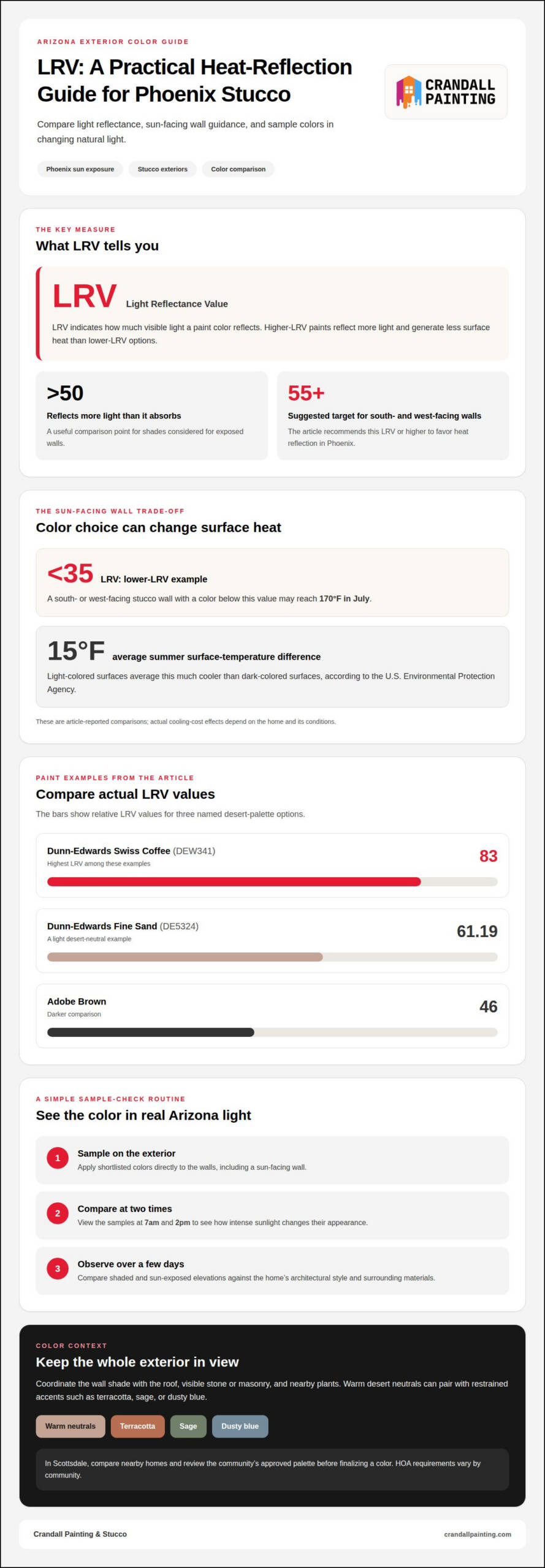
Light Reflectance Value, or LRV, indicates how much visible light a paint color reflects. Higher-LRV paints reflect more light and generate less surface heat than lower-LRV options. Colors above LRV 50 reflect more light than they absorb, making this measure useful when comparing shades for exposed walls.
For Phoenix’s south- and west-facing walls, target LRV 55 or higher to favor heat reflection. A color below LRV 35 can behave differently: a south- or west-facing stucco wall may reach 170°F in July. During summer, light-colored surfaces average 15°F cooler than dark-colored surfaces, according to the U.S. Environmental Protection Agency.
Compare actual LRV values, not just descriptions such as “light” or “cool.” Dunn-Edwards Fine Sand (DE5324) has an LRV of 61.19, while Dunn-Edwards Swiss Coffee (DEW341) has an LRV of 83. Adobe Brown, at LRV 46, offers a darker comparison. These examples show how neutrals can vary considerably in reflected light, even when each suits a desert palette.
Which exterior colors reflect heat and reduce cooling costs in Phoenix? Lighter colors with higher LRV, such as shades above 50, reflect more light and absorb less heat. They can reduce heat gained at the wall, though the resulting cooling-cost effect depends on the home and its conditions.
Test sample patches directly on the exterior, including a sun-facing wall. View them at 7am and 2pm, then observe them over a few days. This reveals how intense sunlight changes the color against different architectural styles and surrounding materials.
For a repaint, professional exterior painting can carry your chosen color scheme consistently across the home’s elevations.
3. Terracotta, sage, and turquoise accent colors
A three-color scheme gives Phoenix stucco homes definition without competing with the desert landscape. Choose a field color for the main walls, a trim color for edges and architectural details, and an accent for a smaller feature such as the front door. Warm sand walls, muted sage trim, and a terracotta door, for example, create a connected palette.
Terracotta and desert earth tones bring warmth to ranch and Southwestern architecture. Sage and deep moss green echo native plant colors, while dusty blue or turquoise adds a cooler counterpoint. For a named teal option, Benjamin Moore Aegean Teal can serve as a measured accent beside warm neutrals. Arizona palettes described for 2026 also favor creamy whites and deep moss greens.
Use contrast deliberately. A navy door can anchor pale stucco, while a bright turquoise would create a more vivid focal point. Keep trim visually quieter when the door or other accent carries stronger color. An accent door can account for 1 to 3 percent of the facade, so a concentrated shade can add character without dominating the walls.
What color palettes complement Sonoran Desert landscaping and Phoenix architecture? Warm desert neutrals, terracotta, sage, moss green, and dusty blue complement the region’s earth tones and stucco forms. Pair one expressive accent with restrained field and trim colors to keep the overall look cohesive.
Before repainting, identify three fixed references: the roof, visible stone or masonry, and nearby plants. Choose a field shade that works with those materials, then select trim to define windows and rooflines. Finally, test the accent against the actual stucco and front door. This sequence helps create a refined desert palette rather than a collection of unrelated colors, whether the home has traditional Southwestern details or a cleaner, contemporary style.
4. Scottsdale exterior color preferences
In Scottsdale, a successful exterior palette balances neighborhood character with the home’s architecture. Many Valley HOAs favor neutral earth tones and subtle accents that blend with Arizona’s surroundings. Compare nearby homes and note how their field colors, trim, and entry doors relate. These details provide a local reference when choosing shades for stucco, stone, and other visible surfaces.
HOA palettes can shape the available choices. Phoenix and Scottsdale homeowners should review their community’s approved colors before finalizing an exterior repaint. Kilim Beige SW 6106 is approved without modification by 90 percent of Scottsdale HOA committees, according to the cited market information. Treat that as a specific color example, not a guarantee of approval in every community; palettes and review practices can differ.
To make a scheme feel tailored, compare its undertones with the roof, masonry, and surrounding landscape. A subdued body shade can complement traditional Scottsdale architecture, while a restrained accent adds definition without overpowering the facade. Also consider UV exposure, climate, and temperatures: strong sun can make a color appear brighter on an exposed surface than beneath a shaded overhang. View samples on the actual exterior before deciding.
Follow a practical sequence: identify the HOA palette, choose a compatible field color, then coordinate trim and accents with fixed materials. Check the full combination from the street, where rooflines, garage doors, and entryways come together visually. If the approved colors feel limiting, adjust contrast through the trim and door instead of choosing an unapproved body shade. This keeps the design cohesive while respecting community guidelines.
For a Scottsdale repaint, plan the exterior color project around the home’s architecture and approved palette.
Crandall Painting & Stucco: Exterior Painting
Crandall Painting & Stucco brings Phoenix color schemes to life with exterior painting. Once you’ve narrowed your palette, the team can coordinate the walls, trim, and accents for a cohesive finish across the home.
If the stucco has damaged areas, Crandall Painting & Stucco provides stucco repair as part of preparing for a refreshed exterior. A sound, well-prepared surface helps the selected colors look consistent across the facade. The right scope depends on the home’s condition and the finish you want.
Whether you’re planning a full repaint or refining the home’s existing look, share your preferred colors and project goals with Crandall Painting & Stucco. Contact the team or visit crandallpainting.com to discuss your exterior painting project and request a free, no-obligation estimate.
Make Your Palette Feel Like Home
The final palette should look intentional from the street and welcoming at the entry. Before deciding, consider the impression you want: a home that blends quietly into its surroundings or one defined by a distinctive accent. Thoughtful exterior color scheme advice for Phoenix desert homes can help turn that preference into a palette suited to the property and its setting.
When you’re ready to move from choosing colors to refreshing your home, Crandall Painting & Stucco offers exterior painting and stucco repair. Interior painting can extend the refreshed feel indoors, creating a considered transition from the facade to the living spaces. Choose the service that matches your project’s priorities.
Contact Crandall Painting & Stucco to discuss your painting project and take the next step toward a home that feels distinctly yours.
Frequently Asked Questions
What are the best exterior paint colors for a ranch house in Arizona?
For an Arizona ranch, choose a warm, muted body color and let the roof and masonry guide its undertone. A sandy roof can pair naturally with creamy beige, while a gray-brown roof may suit a quieter taupe. Coordinate fascia, porch posts, and window trim to preserve the home’s low, horizontal profile, then consider a distinct entry color for a focused point of interest.
What exterior paint colors work best for homes in Phoenix’s desert climate?
Muted colors are a practical starting point for Phoenix homes because fading can be more noticeable on broad areas of deep, saturated color. Choose exterior paint suited to the home’s surface and consider its UV resistance. Dust and changing daylight can affect how a shade looks between cleanings, so assess it on the exterior rather than relying on a screen or indoor display.
What paint finishes and coatings withstand Phoenix sun, UV exposure, and dust?
Compare coatings by surface compatibility and stated UV resistance, rather than relying on the finish name alone. For stucco, masonry, and block, 100% acrylic latex is a standard exterior paint option. Sheen describes the look of the dried surface, while the coating formulation addresses other product characteristics. Consider how the selected sheen will appear across textured stucco before choosing.
How do stucco, brick, and other exterior materials affect color choice in Arizona?
Surface texture and existing materials affect how a color reads across a Phoenix facade. Stucco creates subtle variations of light and shadow, while brick and stone contribute their own fixed color patterns. Compare paint samples beside these materials and the roof and trim. On a mixed-material exterior, a restrained wall color can help the different surfaces feel connected rather than compete.
How should homeowners test exterior paint colors in intense Arizona sunlight?
Apply samples directly to the exterior and place them where they can be compared with the roof, trim, and masonry. A 4×4-inch paint chip may not show how a shade will read across a large stucco facade. Observe each test area as daylight changes, including on more exposed and shaded walls, before choosing the final color for a Phoenix home.