
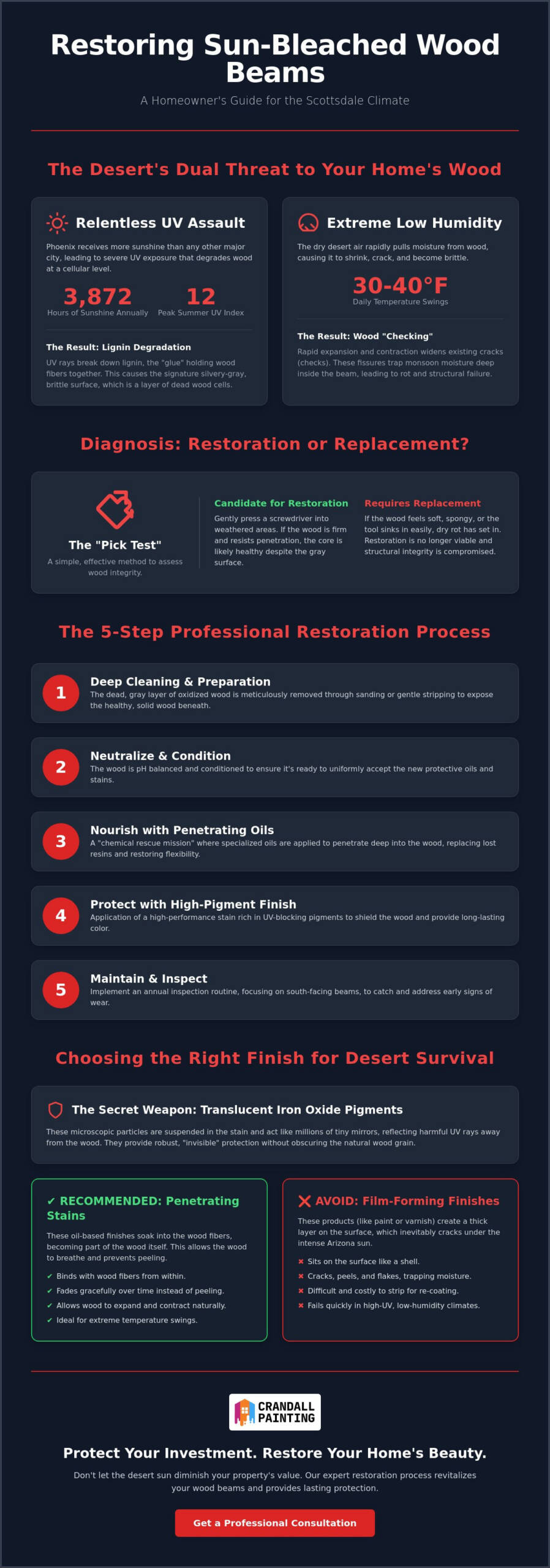
Did you know that the Phoenix metro area logs 3,872 hours of sunshine annually, more than any other major city on Earth? While this light defines our desert lifestyle, it also subjects your home to a relentless UV assault that can reach an extreme index of 12 during the peak summer months. You’ve likely noticed your architectural features losing their luster, replaced by an unsightly silvery gray and deep, worrying cracks. If you’re considering restoring sun-bleached wood beams in Scottsdale, you know that the desert’s low humidity and intense heat require a more sophisticated approach than standard hardware store solutions.
We understand that your home is a significant investment in your lifestyle, and seeing its character fade is disheartening. This restoration process is truly a chemical rescue mission designed to replace lost oils and prevent cellular collapse. By reading this guide, you’ll discover how to revive the rich, warm tones of your wood and ensure its structural integrity for years to come. We’ll walk through the essential role of high-pigment finishes and penetrating oils in creating a bespoke shield that enhances your estate’s curb appeal and long-term value.
Key Takeaways
- Learn how to distinguish between superficial silvering and structural decay using professional diagnostic methods like the “Pick Test.”
- Understand the meticulous five-step approach to restoring sun-bleached wood beams Scottsdale homeowners use to reclaim their property’s architectural beauty.
- Discover why translucent iron oxide pigments are the secret to providing “invisible” yet robust UV protection in extreme desert climates.
- Identify the critical differences between film-forming and penetrating stains to ensure your finish won’t peel or crack under the intense Arizona sun.
- Master the “South-Facing Rule” and annual inspection techniques to proactively maintain your wood’s luster and protect your long-term estate value.
The Science of Sun-Bleaching: Why Scottsdale Beams Fail
Scottsdale’s architectural charm often relies on the rustic elegance of exposed timber, yet our environment is uniquely hostile to natural materials. Understanding why wood fails in the Sonoran Desert is the first step toward restoring sun-bleached wood beams Scottsdale homeowners can take to protect their property’s value. The primary culprit is the relentless ultraviolet radiation that characterizes our region for over 330 days a year. This solar energy is so intense that it doesn’t just fade the color of your home; it fundamentally alters the wood’s biological structure.
Lignin Degradation and the Graying Process
At a cellular level, wood is held together by lignin, a complex organic polymer that acts as the “glue” for cellulose fibers. When UV-B rays strike an unprotected beam, they initiate a photochemical reaction that destroys this lignin. The Science of Sun-Bleaching reveals that once the lignin bond is broken, the wood’s natural pigments are bleached away, and the fibers lose their structural cohesion. This results in the characteristic “silvery-gray” patina, which is not merely a color change but a layer of dead, detached wood cells. You might notice the surface becoming “fuzzy” or brittle to the touch. This is a clear sign of cellular breakdown that standard hardware store stains, which often lack high-performance UV inhibitors, cannot adequately prevent or reverse.
The Role of Low Humidity in Wood Checking
While the sun attacks the surface, our desert’s extreme lack of humidity works from the inside out. Wood is a hygroscopic material, meaning it constantly gains and loses moisture to match its environment. In Scottsdale, the air is frequently so dry that moisture is wicked out of the timber at an accelerated rate, causing the wood to shrink rapidly. This leads to “checking,” which are longitudinal cracks that run parallel to the grain. While minor checks are often considered part of a beam’s rustic character, they can become structural risks if they penetrate deep enough to compromise the timber’s integrity.
The situation is further complicated by our dramatic diurnal temperature swings. It isn’t uncommon for Scottsdale to experience a 30 to 40-degree difference between midday heat and desert nights. This cycle causes constant expansion and contraction, widening existing checks and creating new ones. These deep fissures are particularly dangerous because they act as funnels. When our seasonal monsoons finally arrive, water bypasses the surface protection and travels deep into the core of the beam. This trapped moisture, combined with the heat, creates the perfect breeding ground for rot, turning a cosmetic issue into a costly structural failure. Truly restoring sun-bleached wood beams Scottsdale estates require involves addressing these deep-seated vulnerabilities before they compromise the home’s architecture.
Diagnostic Guide: Restoration vs. Replacement for Sun-Damaged Timber
Determining whether your timber is a candidate for restoring sun-bleached wood beams Scottsdale or if it requires full structural replacement is a critical first step for any homeowner. Many residents mistake the “silvery” appearance for terminal decay, but this is often just the “Silver Threshold.” This is a superficial layer of dead cells that, while unsightly, often protects the healthy wood grain beneath. If the wood remains firm despite the color change, restoration is not only possible but preferred to maintain the home’s original architectural character.
The “Pick Test” and Moisture Metering
To move beyond a visual assessment, we recommend the “Pick Test.” Take a small flat-head screwdriver and gently press the tip into the grayest, most weathered areas of the beam. Pay close attention to the beam ends, as end-grain exposure is where moisture and UV damage are most aggressive. If the wood resists and the screwdriver barely penetrates, the structural integrity is likely intact. However, if the wood feels spongy or the tool sinks in with little effort, you’ve likely reached the point of no return where dry rot has taken hold.
Professional restoration also relies on precision moisture metering. In our desert climate, wood that dries too rapidly becomes brittle, losing its ability to flex during Scottsdale’s intense temperature swings. A master craftsman uses these tools to ensure the wood’s internal moisture level is stable before applying any new treatments. If the moisture content is dangerously low or if “checking” (longitudinal cracks) exceeds one-third of the beam’s thickness, structural reinforcement or replacement by a master carpenter becomes necessary.
Cost-Benefit of Restoration for Luxury Estates
For owners of Scottsdale’s Mediterranean and Santa Barbara style estates, the architectural value of original hand-hewn beams is immense. Replacing these structural elements is often exponentially more expensive than a meticulous restoration, as it frequently requires building permits and structural engineering consultations. Choosing Restoring Natural Beauty: The 2026 Guide to Wood Restoration in Phoenix allows you to preserve that “aged” character while halting the UV-driven cellular breakdown.
Preserving Your Investment involves identifying which cracks are merely aesthetic checks and which are pathways for internal rot. By addressing surface damage early, you avoid the heavy costs of eventual structural failure. If you’re unsure about the current health of your timber, a professional wood restoration assessment can provide the clarity needed to protect your estate’s longevity and aesthetic appeal.
The Professional Restoration Process: A Five-Step Master Approach
Transforming weathered timber into an architectural centerpiece isn’t a matter of simply applying a new coat of paint. It’s a disciplined sequence of renewal. When restoring sun-bleached wood beams Scottsdale, we follow a rigorous five-step master approach designed to reverse years of environmental stress and restore the wood’s inherent vitality.
- Step 1: Precision Stripping. We safely remove failed, flaky coatings using methods that preserve the underlying wood grain and structural density.
- Step 2: Neutralizing and Cleaning. This essential phase opens the wood’s pores and ensures a neutral pH balance, which is vital for optimal product adhesion.
- Step 3: Multi-Stage Sanding. Using varying grits, we meticulously remove the dead, gray fiber layer to reveal the healthy, vibrant timber hidden beneath the surface.
- Step 4: Deep Conditioning. This is the “chemical rescue” phase where we replenish lost oils and restore the wood’s natural flexibility, preventing future brittleness.
- Step 5: High-Performance Shielding. We apply a high-solids, UV-resistant stain that acts as a robust barrier against the relentless Sonoran sun.
Advanced Stripping and Surface Preparation
While some homeowners might reach for a pressure washer, this is often a mistake for brittle, sun-damaged wood. High-pressure water can easily gouge weathered fibers, leading to a “fuzzy” texture that is nearly impossible to sand smooth. Instead, a professional approach utilizes targeted chemical strippers or controlled mechanical sanding. These methods safely dissolve old finishes without compromising the wood’s integrity. We prioritize ensuring the wood is properly neutralized after stripping. An improper pH can cause the new finish to fail prematurely, which is why we treat every beam with meticulous care before the first drop of stain is applied.
Conditioning the Wood for the Desert Climate
The “thirsty wood” phenomenon is a unique challenge in our dry climate. Because Scottsdale beams are often extremely dehydrated, they tend to soak up stains unevenly, resulting in a blotchy and amateur appearance. We utilize specialized wood conditioners to regulate absorption, ensuring the final finish is deep, rich, and uniform. This step also allows us to pre-treat existing checks and cracks. By saturating these fissures with protective conditioners, we help prevent further splitting during the next cycle of expansion and contraction. This level of professional wood restoration provides the “white-glove” results that protect both your home’s beauty and its market value.
Selecting Finishes for High-UV Desert Exposure
The final choice of finish is the most critical decision in restoring sun-bleached wood beams Scottsdale estates require for long-term preservation. This selection serves as the primary shield between your home’s architectural timber and the relentless Sonoran sun. A high-performance finish doesn’t just provide color; it acts as a sophisticated barrier that prevents the UV-driven cellular collapse we discussed in previous sections.
Film-Forming vs. Penetrating Stains
In the intense Arizona heat, film-forming finishes like varnishes or heavy lacquers often become a liability. These products create a rigid shell on the surface of the wood. Because timber expands and contracts rapidly during our 40-degree diurnal temperature swings, these rigid films eventually crack and peel. This leads to moisture traps and unsightly flaking that requires a full strip-and-sand to repair.
Penetrating oils are the preferred choice for discerning homeowners. These finishes soak deep into the wood fibers, remaining flexible and allowing the timber to breathe. They don’t peel because they don’t form a surface film, which makes future maintenance significantly simpler. Whether you are treating the tight grain of Douglas Fir or the porous nature of Western Red Cedar, penetrating oils provide a durable, “white-glove” result that is easier to refresh over time.
Pigmentation and UV Defense
Pigment is essentially sunscreen for your timber. Translucent iron oxide pigments are the master craftsman’s secret for achieving a natural, “invisible” look without sacrificing protection. These microscopic particles physically block the sun’s rays from reaching the lignin. Clear coats that lack pigment offer almost zero defense in Scottsdale; they allow UV rays to pass through, bleaching the wood fibers directly beneath the finish.
When selecting a tone, consider that darker stains typically contain higher concentrations of pigment. A rich walnut or deep chocolate tone often provides superior longevity compared to lighter honey shades. These deeper colors also beautifully complement the earthen stucco and desert landscape of local Mediterranean and Santa Barbara style estates. To ensure your home receives this level of protection, you can schedule a professional consultation for your wood restoration project and explore our curated palette of high-performance finishes.
Professional-grade desert sealants are distinguished by their “high-solids” content. This refers to the amount of actual protective resin and pigment left on the wood after the solvents evaporate. A high-solids product provides a denser, more resilient barrier against the environment. By combining these advanced formulations with the proper application techniques, we ensure your beams remain a vibrant and structurally sound investment for years to come.
Preserving Your Investment: Maintenance for Scottsdale Estates
Proactive care is the hallmark of a well-managed estate. Once the initial work of restoring sun-bleached wood beams Scottsdale is complete, the focus shifts to preservation. In our environment, maintenance isn’t a “one-and-done” task; it’s a strategic commitment to protecting your home’s architectural integrity. By understanding the specific needs of desert timber, you can avoid the heavy costs of future structural repairs and keep your home looking its absolute best.
The “South-Facing Rule” is perhaps the most critical concept for local homeowners to master. Because the sun tracks across the southern sky, beams on the south and west sides of your property endure significantly higher UV loads than those in the north-facing shade. These “high-exposure” areas often require maintenance twice as frequently. While a north-facing beam might look pristine for five years, a south-facing one may begin to show signs of thirst in as little as twenty-four months. Recognizing this imbalance allows you to target your maintenance efforts where they’re needed most.
The Scottsdale Maintenance Schedule
We recommend a professional inspection of all exterior timber every 18 to 24 months. During these checks, you can perform a simple “Water Bead Test” to evaluate your sealant’s performance. Gently sprinkle a few drops of water onto the beam’s surface. If the water beads up and rolls off, your protection is intact. However, if the water darkens the wood and soaks in, the cellular structure is once again vulnerable to the elements. This is especially important to check before the arrival of the monsoon season. The combination of abrasive desert dust and sudden, heavy downpours can quickly scour a weakened finish, leading to the rapid return of graying fibers.
Elevating Property Value through Meticulous Care
Exposed wood beams are more than just aesthetic features; they’re a primary indicator of a home’s overall health. When potential buyers or appraisers see perfectly maintained, rich wood tones, it sends a powerful psychological message that the entire estate has been managed with “Master Craftsman” levels of detail. Neglected, silvered wood often suggests deferred maintenance elsewhere, which can negatively impact your property’s market position.
By staying ahead of the bleaching process with periodic “refresh” coats, you save significant time and expense. A simple cleaning and a light application of a penetrating oil is far more cost-effective than a full restoration involving chemical stripping and deep sanding. This disciplined approach is a core component of Exterior Painting Scottsdale: The 2026 Guide to Luxury Home Restoration. To ensure your timber remains a source of pride rather than a point of concern, you should Contact Crandall Painting & Stucco for a professional wood restoration consultation. We provide the expertise and regional awareness necessary to keep your Scottsdale estate in peak condition for decades to come.
Revitalizing Your Home’s Architectural Legacy
Your home’s wood beams are more than just structural elements; they’re the soul of your estate’s architectural character. By understanding the cellular impact of our desert sun and implementing a disciplined maintenance schedule, you can ensure these features remain vibrant for decades. We’ve explored how identifying the “Silver Threshold” and choosing high-solids, penetrating finishes are vital steps in restoring sun-bleached wood beams Scottsdale homeowners can rely on for lasting beauty.
Crandall Painting & Stucco brings over 20 years of Scottsdale-specific restoration experience to every project. As a family-owned and operated business since 2004, we take immense pride in our specialized “Master Craftsman” approach to high-end finishes. We understand the unique environmental challenges of the Sonoran Desert and provide the meticulous care your luxury property deserves. You’re invited to Request a Professional Wood Restoration Consultation to begin your home’s transformation. We look forward to helping you protect your investment and rediscover the rich, warm beauty of your home’s natural timber.
Frequently Asked Questions
How long does wood beam restoration last in the Scottsdale sun?
Wood beam restoration typically lasts between three and five years depending on the orientation of your home. Beams on the south and west sides of an estate face the most intense UV radiation and may require a maintenance refresh every 24 months. By using high-solids, penetrating oils, we extend this lifespan significantly compared to standard retail products. Regular inspections ensure you catch minor fading before it requires a full restoration.
Can I just paint over sun-bleached wood beams?
You can paint over sun-bleached beams, but doing so permanently hides the natural grain and architectural character of the timber. Paint also creates a film that can peel or flake when the wood expands and contracts in the desert heat. For luxury Scottsdale homes, we generally recommend wood staining and refinishing. This process preserves the organic beauty of the wood while providing superior UV protection through specialized pigments.
What is the best time of year to restore wood beams in Arizona?
The ideal time for restoring sun-bleached wood beams Scottsdale homeowners choose is during the temperate months of late autumn or early spring. During these windows, the lower temperatures and stable humidity levels allow stains and conditioners to cure properly. We avoid the peak summer heat, which can cause products to dry too quickly and unevenly. Scheduling your restoration before the monsoon season arrives provides an essential shield against seasonal moisture.
Is it possible to lighten dark-stained beams that have been sun-damaged?
It is possible to lighten dark-stained beams by meticulously removing the existing finish and the upper layer of sun-damaged fibers. This process involves precision stripping followed by sanding with progressive grits to reveal the lighter, healthy wood beneath. Once we’ve reached a clean surface, we can apply a more translucent or lighter-toned stain. This transformation requires a master craftsman’s touch to ensure the color remains uniform across the entire beam.
Will restoring my beams fix the deep cracks or “checking” I see?
Restoration will stabilize existing checks and prevent them from widening, but it doesn’t make them disappear entirely. These cracks are a natural response to the desert’s low humidity. During the restoration process, we saturate these openings with deep conditioners and UV-resistant oils to prevent moisture from reaching the beam’s core. For exceptionally deep structural cracks, we may use specialized wood fillers or epoxy resins that blend seamlessly with the grain.
How do I know if my wood beams have dry rot or just sun damage?
You can distinguish between the two by performing a simple “Pick Test” with a small screwdriver. Sun damage is typically superficial, appearing as a silvery-gray patina on wood that remains firm to the touch. If the screwdriver sinks easily into the timber or the wood feels spongy and crumbles, you are likely dealing with dry rot. While sun damage is an aesthetic and protective issue, dry rot often requires structural intervention or replacement.
Why do professional restoration services cost more than standard house painting?
Professional wood restoration is a technical, labor-intensive process that goes far beyond simple painting. It requires specialized chemical strippers, multi-stage sanding, and deep conditioning treatments to reverse cellular damage. We use premium high-solids finishes that are specifically formulated for the Sonoran Desert’s extreme UV index. This “white-glove” service ensures the long-term health of your home’s architectural features, protecting your property value and preventing the need for costly structural replacements.