
The lowest quote isn’t always the wisest investment. When Phoenix homeowners begin researching the cost of interior painting phoenix professionals charge for luxury residences, they’re often confronted with a bewildering range of figures and very little explanation for the difference. One contractor promises a fresh coat over everything. Another speaks of surface restoration, drywall repair, and climate-specific prep work. The numbers rarely match, and the reasons why are seldom made clear.
That frustration is entirely valid. You’re not simply choosing a color; you’re making a decision about the long-term integrity of your home’s surfaces in one of the most demanding climates in the country. Intense desert heat, low humidity, and dramatic temperature swings between seasons all influence how paint adheres, cures, and endures over time. A finish that looks flawless in October can reveal every shortcut by the following summer.
This guide is designed to change that. You’ll find a precise breakdown of the factors that drive interior painting costs in the Phoenix metro area in 2026, from architectural complexity and surface preparation to premium finishes and integrated restoration work, so you can evaluate any proposal with genuine confidence.
Key Takeaways
- The true cost of interior painting phoenix luxury homes extends well beyond square footage — architectural features like vaulted ceilings, tray ceilings, and custom soffits each carry distinct labor and material premiums that significantly shape your final quote.
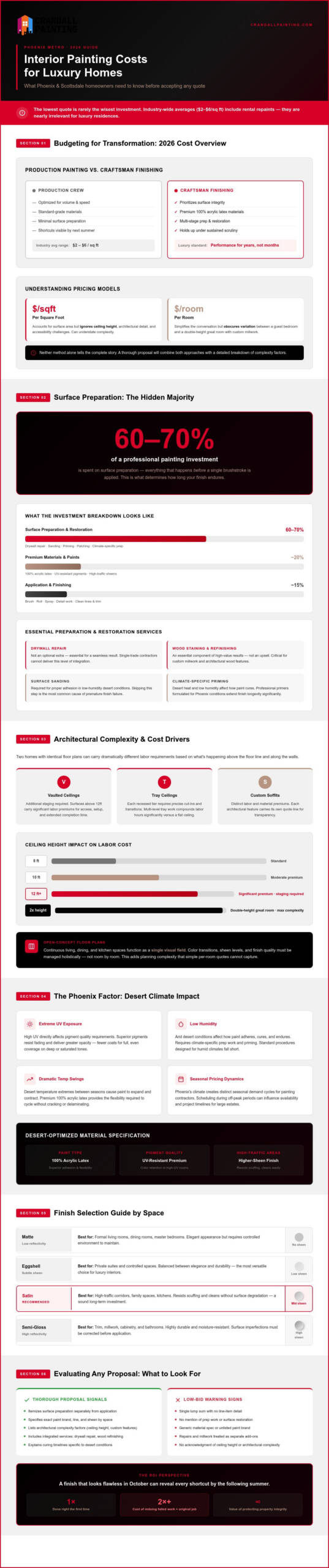
- Surface preparation typically accounts for 60–70% of a professional painting investment, meaning the quality of what happens before a single brushstroke is applied determines how long your finish will endure.
- Phoenix’s desert climate — including extreme UV exposure and low humidity — directly influences paint selection, curing timelines, and the long-term performance of interior finishes in sun-drenched rooms.
- Integrated services such as drywall repair and wood staining and refinishing are not optional extras; they are essential components of a seamless, high-value result that a single-trade contractor simply cannot deliver.
- Understanding what separates a thorough professional proposal from a low-bid estimate empowers you to protect your property’s value and avoid the compounding costs of work that must be redone.
Budgeting for Transformation: Average Costs of Interior Painting in Phoenix (2026)
Walk into any conversation about the cost of interior painting phoenix homeowners face, and you’ll quickly encounter a wide spectrum of numbers. Broad industry aggregators often cite figures in the range of two to six dollars per square foot, arriving at an average project cost that sounds reasonable on paper. The problem is that those averages are calculated across every tier of work, from quick production repaints on rental units to meticulous, multi-stage finishes in custom-built estates. For a luxury residence in the Phoenix metro, those benchmarks are largely irrelevant.
Understanding what actually drives your investment begins with recognizing a fundamental distinction: production painting versus craftsman finishing. A production crew moves fast, applies standard-grade materials, and optimizes for volume. A craftsman approach prioritizes surface integrity, material performance, and the kind of precision that holds up under sustained scrutiny. The visible difference between the two becomes apparent within a single desert summer.
Pricing models add another layer of complexity. Contractors typically quote either per square foot or per room, and neither method tells the complete story on its own. A per-square-foot figure accounts for surface area but ignores ceiling height, architectural detail, and accessibility. A per-room rate simplifies the conversation but can obscure significant variation between a modest guest bedroom and a double-height great room with custom millwork.
Square Footage vs. Room-by-Room Pricing
Open-concept floor plans, common throughout modern Scottsdale and Phoenix estates, complicate standard pricing formulas considerably. Continuous living, dining, and kitchen spaces function as a single visual field, meaning color transitions, sheen levels, and finish quality must be managed holistically rather than room by room. Ceiling height matters just as much as floor area; surfaces above twelve feet require additional staging, extended labor time, and greater physical complexity. Private suites, with their controlled scale and refined detail work, are often quoted differently than shared common areas for exactly this reason.
The Impact of Paint Quality on Long-Term Value
Material selection is where informed clients genuinely separate themselves from those who later face early repainting costs. Premium 100% acrylic latex formulations are the professional standard for desert interiors, offering superior adhesion and flexibility as temperatures cycle between extremes. For interior house painting in high-UV environments, pigment quality directly affects color retention; superior pigments also deliver greater opacity, which means fewer coats to achieve full, even coverage on deep or saturated tones. In high-traffic corridors and family spaces, a higher-sheen finish resists scuffing and cleans without surface degradation, making it a sound long-term investment rather than a cosmetic preference. Matte finishes, while elegant in formal rooms, require a more controlled environment to maintain their appearance over time.
Evaluating the true cost of interior painting phoenix luxury properties demands that you look beyond the per-gallon price on a material spec sheet and consider the compounding value of paint that performs well for years, not months. That perspective is what separates a well-constructed proposal from one that simply looks competitive at first glance. For a closer look at the full range of professional painting services that support this level of quality, the details matter from the first consultation forward.
Architectural Complexity: How Your Home Layout Influences the Quote
Square footage tells only part of the story. Two Phoenix homes with identical floor plans can carry dramatically different labor requirements based solely on what’s happening above the floor line and along the walls. Vaulted entries, recessed niches, tray ceilings, and elaborate millwork are defining characteristics of custom Scottsdale architecture, and each one introduces a distinct layer of complexity that a responsible contractor accounts for in detail. When evaluating the cost of interior painting phoenix luxury homes demand, architectural complexity is often the single largest variable separating one proposal from another.
Vaulted Ceilings and High-Reach Logistics
Ceilings that rise between twelve and twenty feet require more than a taller ladder. Professional crews working at those heights rely on scaffolding systems or articulating lifts, both of which take time to assemble, reposition, and dismantle safely. Floor and furniture protection becomes considerably more involved at elevation, since any drip or overspray travels farther and lands harder. Cutting in cleanly where a vaulted ceiling meets a painted wall requires a steady hand and deliberate pacing; speed at height is a liability, not an advantage. These logistics translate directly into extended labor hours, and a thorough proposal will reflect that honestly rather than absorbing the cost through thinner margins on materials.
Detailed Millwork and Custom Interior Trim
Crown molding, wainscoting, coffered ceilings, and built-in cabinetry are investments in their own right, and finishing them properly requires a fundamentally different approach than rolling out a flat wall surface. Hand-brushing intricate profiles demands patience and precision; spray-finishing built-ins requires careful masking of adjacent surfaces and controlled application to avoid texture inconsistency. The condition of existing trim matters significantly here. Trim that’s been painted over multiple times may need sanding, filling, or light restoration before a new coat can adhere cleanly and lie flat.
Multi-color schemes and deliberate accent walls add another dimension. Each color transition requires independent masking, independent drying time, and careful edge management to produce a crisp, intentional boundary rather than a blurred line. The labor-to-material ratio climbs sharply on these details because the hands-on time far outpaces the paint consumed.
- Tray ceilings and recessed niches: Multiple planes, interior corners, and shadow-line transitions each require individual attention and precise color placement.
- Custom soffits: Common in Scottsdale kitchens and great rooms, these architectural elements often involve both flat and curved surfaces within a single feature.
- Decorative painting elements: Faux finishing or accent treatments on architectural details require a specialist’s touch that production crews aren’t equipped to deliver.
Understanding how these features interact with your overall scope helps you read any proposal with clarity. A contractor who prices a home with extensive millwork the same way they’d price a builder-grade interior isn’t accounting for the real work involved. Reviewing the full range of professional interior painting services that address these architectural details is a practical first step toward building an accurate project budget.
Beyond the Brush: Factoring in Restoration and Surface Preparation
Paint doesn’t fix problems. It reveals them. A fresh coat applied over a stress crack, a water stain, or a poorly matched texture repair will make every flaw more visible, not less. This is why experienced contractors consistently allocate the majority of a professional painting investment to what happens before the first drop of color touches a wall. Surface preparation isn’t a preliminary step; it’s the foundation on which every subsequent decision rests.
For homeowners evaluating the cost of interior painting phoenix luxury properties require, understanding this proportion changes how you read a proposal. A quote that appears lean on labor almost certainly reflects a lean approach to preparation. The result follows accordingly.
Drywall Repair and Texture Matching Costs
Phoenix and Scottsdale homes settle differently than those in other climates. The combination of expansive soils, extreme temperature cycling, and low humidity creates conditions that produce fine stress cracks along corners, seams, and ceiling transitions with predictable regularity. Addressing these before painting isn’t optional; it’s essential. Drywall repair in Phoenix, AZ involves more than filling a crack with spackle. It requires feathering compound across a broad area, allowing proper cure time in low-humidity conditions, and then matching the surrounding texture with precision.
Texture matching is genuinely skilled work. Every wall carries its own profile, whether a light skip-trowel, a medium orange peel, or a hand-applied knockdown pattern. Replicating that profile over a repair so that it disappears under paint requires practiced technique and the right tools. A mismatched repair is immediately visible under raking light, particularly in sun-drenched rooms where Phoenix’s natural light is unforgiving.
For clients seeking the smoothest possible result, a level-5 finish represents the premium standard. This process involves skim-coating entire wall surfaces with a thin layer of joint compound, sanding to a perfectly flat plane, and priming before any color is applied. It eliminates surface variation entirely and is the appropriate foundation for high-sheen or deep-tone finishes where any imperfection would otherwise catch the light.
- Water damage remediation: Staining from past roof or plumbing issues requires sealing with appropriate primers before finish coats, or bleed-through will compromise the final color.
- Popcorn ceiling removal: Outdated acoustic textures add significant labor when removed, as the substrate beneath often requires skim-coating before it’s paint-ready.
- Heavy skip-trowel removal: Smoothing aggressive existing textures is a multi-stage process that adds both time and material cost to any scope.
Integrated Wood Refinishing and Cabinetry
An interior refresh that addresses walls and ceilings while leaving worn cabinetry or weathered wood trim untouched produces an incomplete result. The surfaces interact visually, and the contrast between a freshly painted room and tired wood finishes is difficult to overlook. This is where wood staining and refinishing becomes a meaningful component of a comprehensive interior project rather than a separate trade engagement.
The choice between painting and staining existing cabinetry carries both aesthetic and cost implications. Painting conceals the wood grain entirely and suits clients seeking a clean, contemporary look; it requires thorough deglossing, priming, and multiple finish coats to achieve a durable result. Staining preserves the natural character of the wood and is the appropriate choice for custom-built cabinetry where the material itself is part of the design intent. Wood restoration in Phoenix also addresses the cumulative effect of UV exposure and low humidity on interior wood elements, conditions that accelerate surface degradation in ways that paint alone cannot remedy.
For homes built with custom millwork and heritage-quality cabinetry, professional refinishing preserves that investment rather than replacing it. That distinction matters considerably when evaluating the true cost of interior painting phoenix projects at the luxury level, because the alternative, full cabinet replacement, represents a far greater expenditure than a skilled refinishing scope.
The Phoenix Factor: Local Climate and Seasonal Pricing Dynamics
Phoenix doesn’t behave like other markets, and any contractor who applies a one-size-fits-all approach to interior painting here is working against the environment rather than with it. The desert climate introduces variables that directly affect how paint is applied, how it cures, and ultimately how long it performs. For homeowners evaluating the cost of interior painting phoenix luxury residences require, understanding these local dynamics is as important as understanding square footage or material grades.
Seasonal demand shapes pricing in concrete ways. Winter and spring are the busiest periods for Phoenix painting professionals, as mild temperatures and lower humidity create favorable working conditions and homeowners prepare their properties before the summer heat intensifies. Booking during peak season often means longer lead times and less scheduling flexibility. Planning your project for late summer or early fall, once monsoon season subsides, can sometimes offer more scheduling availability, though the work itself requires careful humidity management during that window.
Interior Humidity and VOC Management
Phoenix’s average indoor humidity frequently drops below fifteen percent during dry months, which sounds ideal for fast drying but actually creates a distinct challenge. Paint that dries too rapidly on the surface can trap solvents beneath the film, compromising adhesion and long-term durability. Skilled applicators adjust their technique accordingly, working in smaller sections and timing each coat to allow proper open time before the surface skins over. Low-VOC formulations are the professional standard for modern, well-sealed homes, where air exchange is limited and off-gassing from conventional paints can linger far longer than it would in older, less airtight construction. Scheduling around the monsoon window, typically July through mid-September, also matters; elevated humidity during that period can extend cure times and affect how certain finishes settle.
UV exposure is another variable that receives far less attention than it deserves. Sun-drenched rooms with large south- or west-facing windows subject interior surfaces to sustained ultraviolet intensity that fades pigments and degrades binders over time. Premium paint formulations with high-quality pigments and UV-resistant chemistry address this directly, maintaining color integrity through years of intense desert light rather than months.
Dust Control and HVAC Protection
Desert dust is relentless. During sanding and surface preparation, fine particulate travels through a home’s air system with surprising efficiency, settling into return vents, filter media, and ductwork. Professional crews working in luxury interiors take deliberate steps to prevent this:
- HVAC isolation: Supply and return registers are sealed before any sanding begins, protecting your air filtration system from construction-grade particulate that standard filters aren’t designed to capture.
- Precision masking: High-value flooring, cabinetry, and fixed furnishings receive layered protection using professional-grade materials that won’t shift or allow bleed-through during extended work periods.
- Staged cleanup protocols: Dust is addressed incrementally throughout the project rather than consolidated at the end, reducing the risk of airborne particles settling onto freshly applied surfaces.
This level of site protection isn’t a courtesy; it’s a technical requirement for achieving a flawless finish in a desert environment. A crew that skips these steps will deliver results that show it. To understand how a professionally managed interior painting project accounts for Phoenix’s unique climate conditions from start to finish, reviewing the full scope of professional painting services is a practical starting point for any serious conversation about your home.
Investing in Excellence: Measuring ROI and Choosing a Partner
Every dollar spent on a well-executed interior finish is a dollar that works on your behalf long after the crew has packed up and left. Real estate professionals consistently identify interior painting as one of the highest-return improvements a homeowner can make before listing, and in the Phoenix luxury market, where buyers arrive with calibrated expectations, the condition and quality of interior finishes directly influence both perceived value and negotiating position. This isn’t a cosmetic consideration; it’s a financial one.
That context matters when you’re evaluating the cost of interior painting phoenix luxury properties require. The question isn’t simply what a project costs today. It’s what a substandard finish will cost you later, in early repainting, in buyer concessions, or in the quiet erosion of a home’s presentation over time.
Distinguishing Value from Price
Low-bid contractors rarely disclose where they compress their margins. The answer is almost always preparation and materials, the two variables that determine how long a finish actually holds. Thin coverage over unaddressed surface flaws, discount-grade paint applied without proper priming, and rushed timelines that ignore cure requirements in desert conditions all produce results that look acceptable for a season and begin failing shortly after. The cost of repainting a home two years ahead of schedule is invariably greater than the savings captured by the original low bid.
A master craftsman approach operates from a different set of priorities. Speed is never the objective; integrity is. When evaluating any proposal for custom painting Scottsdale projects at the luxury level, look for these indicators of genuine expertise:
- A detailed written scope: Every surface, every prep step, and every product specified by name and sheen level. Vague proposals protect the contractor, not the client.
- Surface preparation itemized separately: If prep isn’t called out as its own line item, it’s likely being minimized.
- Licensing, bonding, and insurance confirmed in writing: Verify these directly rather than accepting verbal assurance. A licensed and insured team protects your property and your liability exposure throughout the project.
- A warranty with defined terms: Understand exactly what’s covered, for how long, and what conditions apply. A contractor confident in their workmanship stands behind it explicitly.
- References from comparable properties: Ask for examples of work completed on homes with similar architectural complexity, not just satisfied clients in general.
The Final Walkthrough: Ensuring Your Investment Lasts
A professional project doesn’t end when the last coat dries. A thorough punch list review, conducted under natural light and at various angles, is where precision touch-ups are identified and completed before the team departs. This step separates a truly finished result from one that simply looks finished at a glance.
Maintaining that result in Arizona’s climate requires a few deliberate habits. Avoid cleaning painted surfaces with abrasive products; a soft cloth with mild soap is appropriate for most finishes. In rooms with intense western or southern sun exposure, UV-filtering window treatments extend color integrity considerably. Address any new stress cracks promptly rather than allowing them to widen, and keep touch-up paint stored in a climate-controlled space so it remains workable when you need it.
The relationship between a homeowner and a skilled painting partner doesn’t have to end at project completion. It’s a resource you can return to as your home evolves. Request a professional consultation from Crandall Painting to begin a conversation about what a meticulous, fully integrated interior finish can do for your Phoenix or Scottsdale residence.
Your Home Deserves a Finish That Lasts
Navigating the cost of interior painting phoenix luxury homes demand is ultimately about understanding what you’re protecting. Architectural complexity, meticulous surface preparation, climate-appropriate materials, and integrated wood refinishing aren’t line items to negotiate away; they’re the components that determine whether your investment holds its value through years of desert conditions or requires costly remediation ahead of schedule.
Choosing the right partner matters as much as choosing the right paint. Crandall Painting has been family-owned and operated since 2004, building a reputation across Scottsdale and Phoenix on the strength of high-end residential restorations, precision wood staining and faux finishing, and the kind of craftsmanship that holds up under sustained scrutiny. Every project reflects that commitment, from the first surface assessment to the final walkthrough.
Your home is one of your most significant assets. It deserves a finish applied with the care that reflects that. Request your custom interior painting estimate and take the first step toward a result you’ll appreciate for years to come.
Frequently Asked Questions About Interior Painting Costs in Phoenix
How much does it cost to paint a 2,500 sq. ft. house interior in Phoenix?
A 2,500 sq. ft. home in the Phoenix metro doesn’t carry a single fixed price because floor area is only one variable among several. Ceiling height, architectural detail, surface condition, and material grade all shape the final investment considerably. A production-level repaint and a meticulous craftsman finish on the same footprint can differ substantially in scope and outcome.
Rather than anchoring to a number that may not reflect your home’s specific conditions, the most reliable approach is a detailed on-site assessment. A thorough proposal will itemize preparation, materials, and labor separately so you can evaluate exactly what you’re receiving for each dollar spent.
Does the price of interior painting include drywall repairs?
Not automatically, and this distinction matters. Many contractors price painting and drywall repair as separate scopes, which means a quote that looks complete may not account for crack remediation, texture matching, or surface restoration. In Phoenix, where expansive soils and temperature cycling regularly produce stress fractures along seams and corners, some degree of drywall work is the norm rather than the exception.
When drywall repair is integrated into the same project rather than treated as a separate engagement, the result is a seamless finish that holds up under Phoenix’s unforgiving natural light. Confirm with any contractor exactly which prep and repair steps are included before accepting a proposal as complete.
How long does it take to paint the interior of a typical Scottsdale home?
A standard Scottsdale residence with moderate architectural detail typically requires several days to complete properly, though homes with extensive millwork, high ceilings, or integrated restoration work take longer. The preparation phase, including patching, sanding, priming, and masking, often accounts for more calendar time than the application of finish coats.
Rushing the timeline is where quality is most often compromised. In a low-humidity desert environment, open time between coats requires careful management, and a crew that prioritizes speed over integrity will produce results that reflect it within a single season.
Why is interior painting more expensive in homes with high ceilings?
Ceilings above twelve feet introduce logistical complexity that flat-rate pricing rarely captures honestly. Scaffolding or articulating lifts must be assembled, repositioned, and dismantled safely throughout the project. Cutting in cleanly at elevation demands deliberate pacing; the margin for error is greater and the consequences of a drip or overspray are more significant when surfaces are farther from the floor.
Floor and furniture protection also becomes considerably more involved at height. These factors translate directly into extended labor hours, and any contractor who prices a double-height great room the same as a standard bedroom isn’t accounting for the real work involved.
What is the best time of year to paint my home interior in Phoenix?
Winter and spring offer the most favorable conditions for interior painting in Phoenix, with mild temperatures and lower ambient humidity supporting proper adhesion and cure times. Demand from other homeowners is also highest during this window, so scheduling early is advisable if you’re planning a project for those months.
Late summer and early fall can offer more scheduling availability once monsoon season subsides, though crews must manage elevated humidity carefully during that period. The monsoon window, roughly July through mid-September, introduces moisture conditions that can affect how certain finishes settle and cure.
Can I stay in my home while the interior is being painted?
In most cases, yes, though the experience depends on the scope and sequencing of the work. A professional crew will isolate work areas, seal HVAC registers before sanding, and manage dust and odor incrementally rather than letting particulate migrate through the home. Low-VOC paint formulations, which are the professional standard for modern, well-sealed Phoenix residences, reduce off-gassing considerably compared to conventional products.
For projects involving extensive drywall restoration, cabinet refinishing, or multi-room sequencing, some homeowners find it more comfortable to vacate during the most intensive preparation phases. Your contractor should be able to advise on the most practical approach based on your specific project scope.
How much extra does it cost for custom faux finishes or decorative painting?
Decorative painting and faux finishing are specialist disciplines that command a meaningful premium over standard wall application, and appropriately so. These techniques require a different skill set, longer hands-on time per surface, and materials calibrated to the specific effect being achieved. The cost of interior painting phoenix luxury projects with decorative elements reflects that expertise directly.
The range varies considerably depending on the complexity of the technique, the size of the surface, and the number of layers or glazes involved. A subtle venetian plaster treatment in a formal dining room is a different undertaking than an elaborate multi-tone faux finish across an entire living space. A detailed consultation is the only reliable way to arrive at an accurate figure for your specific vision.
Does painting kitchen cabinets cost more than painting walls?
Yes, consistently. Cabinet painting involves thorough deglossing, priming with adhesion-promoting products, and multiple finish coats applied to surfaces that receive daily contact and cleaning. Every door, drawer front, and frame requires individual attention, careful masking of hardware cutouts, and sufficient dry time between coats to achieve a durable, even result.
For homeowners weighing cabinet painting against staining and refinishing, the choice carries both aesthetic and cost implications. Painting conceals the wood grain entirely and suits a clean, contemporary aesthetic; staining preserves the natural character of the material and is often the right choice for custom-built cabinetry where the wood itself is part of the design intent. Either approach, executed with precision, is a sound investment compared to full cabinet replacement.