
The most dramatic wall finish isn’t always the best choice for a living room. A custom faux finish for living room walls DC Ranch should respond to the room’s natural light, furnishings, stone or wood details, and focal points rather than compete with them. If you’re concerned that texture or color could feel overwhelming, start by deciding how much attention you want the walls to draw. The right effect can add depth while keeping the room cohesive.
Choosing a finish is easier when you compare subtle, layered treatments with more pronounced texture and contrast. This guide will help you assess options in your living room, understand how lighting and wall condition can affect the finished appearance, and prepare useful questions for a local decorative painting professional.
You’ll also learn what to discuss about samples, surface preparation, and project scope before making a commitment. Crandall Painting & Stucco is a family-owned and operated company serving DC Ranch and the Scottsdale and Phoenix metro areas since approximately 2004. Its services include decorative painting, custom faux finishing, interior painting, and drywall repair. Thoughtful planning can help you choose a finish that feels balanced and at home in your space.
Key Takeaways
- Let your living room’s light, furnishings, materials, and focal points guide the finish, so the walls complement rather than dominate the space.
- Compare options by visual effect and texture. Materials, application, wall surface, and lighting all shape the result.
- Adjust the scale and contrast of a custom faux finish for living room walls DC Ranch to suit the room.
- Review samples, wall condition, preparation, project scope, and care before committing.
- Evaluate a painter’s relevant decorative work, sample-review process, preparation plan, and communication to make an informed choice.
Custom Faux Finish for Living Room Walls in DC Ranch: Start With the Room
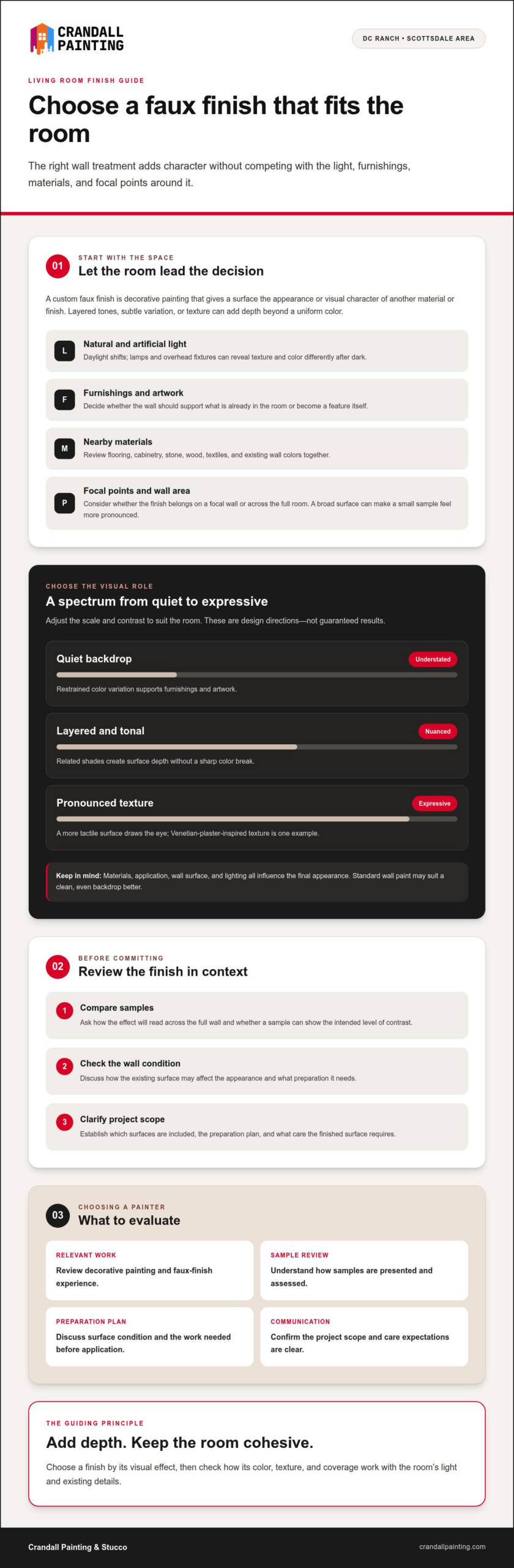
A distinctive living room finish should complement the home, not dominate it. The right custom faux finish for living room walls DC Ranch starts with the room’s architecture, light, and furnishings, then adds visual character at a scale that feels intentional. A subtle treatment can soften a broad wall, while a more expressive finish can give a focal area greater presence.
What does a custom faux finish add to a living room?
Faux finishing is decorative painting that gives a surface the appearance or visual character of another material or finish. Instead of a uniform field of color, it may use layered tones, subtle variation, or texture to bring depth to a wall. The effect depends on the technique and application. Standard wall paint may be a better fit when the goal is a clean, even backdrop. For an overview of decorative paint finishes, including approaches such as marbleizing and wood graining, see this reference.
Coverage also shapes the room’s impression. A focal wall can draw attention to a fireplace or seating area, while a full-room treatment creates a more enveloping atmosphere. A restrained accent, such as a softly varied finish in a related color, can add dimension without pulling focus from artwork, furnishings, or architectural details. The aim is to balance the finish with the rest of the room.
Which room details should guide the design?
Look at the living room as a whole before choosing a finish. Natural light changes throughout the day, and lamps or overhead fixtures can reveal texture and color differently after dark. Review flooring, cabinetry, stone, textiles, furnishings, and existing wall colors together. A finish that looks quiet on a small sample may feel more pronounced across a broad wall, so consider both its coverage and its contrast with nearby materials.
Start by deciding what role you want the walls to play:
- Quiet backdrop: Choose restrained color variation that supports furnishings and artwork.
- Focal point: Concentrate the decorative effect on a wall that already anchors the room.
- Expressive atmosphere: Consider a more visible treatment, then check how it works with the room’s existing materials.
Crandall Painting & Stucco serves DC Ranch with decorative painting and faux finishing services. A design discussion can connect the desired effect with the living room’s light, surfaces, and overall character before work begins.
Which Faux Finish Suits a DC Ranch Living Room’s Style and Light?
The best finish suits the home you have, not a style label attached to the neighborhood. DC Ranch living rooms vary in architecture, materials, furnishings, and daylight, so compare options against your own space and the effect you want. For a custom faux finish for living room walls DC Ranch, consider how much visual movement you prefer and how the wall will relate to the rest of the room.
How do subtle and more textured finishes differ?
Subtle color movement can give a wall depth without making it the room’s main attraction. A more pronounced texture, such as the look associated with Venetian plaster, draws the eye and may be easier to balance with simpler furnishings or a restrained palette. Neither direction is right for every room. Decide whether you want the wall to recede, complement the room, or become a defining feature.
Use this comparison to focus your discussion with a decorative painting professional. Each finish direction describes a visual goal, not a guaranteed result. Materials, application, wall surface, and lighting all influence the final appearance.
| Finish direction | Visual effect | Questions to discuss with the painter |
|---|---|---|
| Subtle color movement | Soft variation adds dimension while keeping the wall understated. | How will the variation read across the full wall? Can a sample show the intended level of contrast? |
| Layered, tonal treatment | Related shades create a nuanced surface without a sharp color break. | How will the chosen tones relate to nearby stone, wood, or textiles? |
| Pronounced texture | A tactile, more expressive surface becomes a stronger visual feature. | Will the texture suit the room’s furnishings and the wall’s condition? |
How do lighting and existing materials change the result?
A color or texture viewed on a screen can look different in your living room. Light direction and window exposure affect how shadows and tonal variation appear on the wall. Lamps can shift the impression after sunset. Nearby surfaces matter, too. Reflective stone or polished furnishings catch light differently from matte textiles and wood. A discussion of color theory in interior design can also help you think about how wall color relates to the room’s broader palette.
Ask to review sample panels in the actual room. Look at them at several times of day under natural and artificial light. This makes it easier to judge the finish’s movement, contrast, and texture before approving a direction. For a local conversation about decorative painting and faux finishing, explore Crandall’s painting services.
Will a Custom Faux Finish Feel Too Busy or Be Hard to Maintain?
It doesn’t have to. A decorative wall can feel composed when its texture, contrast, and coverage suit the room. First decide whether the finish should quietly enrich the space or serve as a prominent feature. Then consider how it will relate to existing focal points and furnishings.
A restrained treatment with gentle color variation can add depth while leaving artwork, a fireplace, or a statement sofa in the foreground. A more pronounced finish can give one wall a distinct presence, but strong texture or contrast across several walls may compete with other bold elements. Think about how you use the room and what you want to notice first.
How can homeowners keep a decorative wall visually balanced?
Start with the features that already command attention. If the living room has a prominent fireplace, large artwork, or richly patterned furnishings, consider limiting stronger texture or contrast to a purposeful area. If the walls are meant to be the focal point, discuss how the finish will relate to surrounding colors and materials instead of selecting it in isolation.
Review samples beside the room’s actual finishes, including flooring, stone, textiles, and wood. Look at them near the artwork or furniture they’ll share a view with. A sample can help you judge whether the treatment supports those elements or competes with them. This is useful before committing to a custom faux finish for living room walls DC Ranch, where the effect should feel at home in the specific space.
What should you ask about care and future touch-ups?
Care depends on the materials and application selected, so don’t assume every decorative finish can be cleaned or repaired in the same way. Before work begins, ask the painter to clarify:
- Which cleaning methods and products are appropriate for this finish?
- What should you avoid doing to prevent marks or changes in appearance?
- How might a small repair or touch-up look beside the surrounding finish?
- Will you receive written care instructions and details about the finish at completion?
It’s also sensible to discuss surface preparation and what to do if the wall is marked later. Depending on the finish, texture and layered color can make a localized repair more noticeable than a simple, uniform paint surface. Confirming care guidance and touch-up expectations for the proposed system helps you decide whether the effect suits your household and preferences.
How to Evaluate Samples, Wall Preparation, and Faux-Finish Proposals
A clear review process helps you compare proposals on more than a finish name or small color chip. For a custom faux finish for living room walls DC Ranch, consider how the sample, wall condition, preparation, and project scope fit together. Use these five steps to guide the conversation:
- Define the goal. Describe whether you want a quiet backdrop, a focal wall, or a more expressive treatment. Identify the surfaces and furnishings the finish should complement.
- Inspect samples in context. Review color, texture, sheen, and variation on a sample large enough to judge. Place it near adjoining materials and assess it under the room’s usual lighting.
- Assess the walls. Point out visible cracks, uneven areas, prior coatings, or existing texture. Defects may need attention before application to support a consistent decorative result.
- Confirm the scope. Clarify which walls or areas are included, what preparation and repairs are specified, and what finish and application are proposed. Ask how the work area will be protected and how the completed work will be reviewed.
- Clarify care. Ask which cleaning methods suit the selected finish, how touch-ups may appear, and what care instructions or finish details you’ll receive at completion.
What should a useful finish sample show?
A useful sample gives you more than a color impression. Check its texture, sheen, and tonal variation, then compare it with nearby flooring, stone, wood, textiles, and paint colors. Ask how the sample relates to the materials and application described in the proposal. If they differ, clarify what the finished wall is expected to look like and what could change across a larger surface.
Which preparation and scope details should be clarified?
Wall condition affects how a decorative finish reads, so discuss repairs before approving the work. Ask whether drywall repair or other surface preparation is included in the proposal or listed separately. Confirm which areas will be prepared and treated, how furnishings and nearby surfaces will be protected, and what the completion review will cover. Clear answers help prevent mismatched expectations about what the project includes.
Crandall Painting & Stucco offers decorative painting, custom faux finishing, and drywall repair in DC Ranch and the Scottsdale and Phoenix metro areas. Discuss your living-room finish and project requirements with the team as you evaluate samples, preparation, and scope.
Choosing a Faux-Finish Painter for Your DC Ranch Living Room
A successful faux-finish project depends on more than a striking sample. Look for a professional who can connect the requested effect to the wall condition, explain the proposed preparation, and communicate clearly as decisions are made. For a custom faux finish for living room walls DC Ranch, reviewing relevant work and discussing expectations can help you assess whether the approach suits your home.
What should you look for in a decorative painting professional?
Ask about experience with the type of finish you’re considering and with wall conditions similar to yours. Review completed projects for consistent application and a result that fits the intended effect, rather than relying on a single close-up image. Clarify who will review samples, confirm the project scope, and let you know if a wall condition or other detail affects the plan.
A practical selection checklist includes:
- Relevant decorative experience: Can the painter show work comparable to the finish and level of texture you want?
- Clear sample review: Will you be able to assess the proposed appearance in your room’s lighting?
- Defined preparation: Does the proposal explain which repairs and surface-preparation tasks are included?
- Project communication: Are application areas, finish expectations, and review steps stated clearly?
Discuss related surface needs, too. If walls need repair before decorative work, clarify whether drywall repair is included or separately scoped. Interior painting may also be relevant if adjoining areas need to coordinate with the finished wall.
What are the next steps for a DC Ranch homeowner?
Gather photographs of the living room, inspiration images, and notes about existing flooring, stone, textiles, furnishings, and light. These details make the conversation specific. Explain what you want the wall to contribute, whether that’s a quiet background, a focal feature, or a more expressive effect. Then ask how samples will be reviewed and what preparation the visible wall conditions may require.
Crandall Painting & Stucco is a family-owned and operated company serving DC Ranch and the Scottsdale and Phoenix metro areas since approximately 2004. Its services include custom faux finishing, decorative painting, interior painting, and drywall repair. To discuss the finish you have in mind and the project requirements, explore decorative painting and restoration services.
Bring Your Living Room Finish Into Focus
A well-chosen decorative finish begins with the room itself. Let its light, furnishings, and architectural details guide the level of texture and contrast, then review samples in the space before settling on a direction. Clear discussion of wall preparation, project scope, and care can help you make a considered decision.
If you’re considering a custom faux finish for living room walls DC Ranch, Crandall Painting & Stucco offers custom faux finishing for homeowners in the community. The company is family-owned and operated, with services that also include decorative painting, interior painting, and drywall repair.
For homeowners searching in Scottsdale, cottsdale, Paradise Valley, Carefree, DC Ranch, Desert Mountain, Scottsdale Mountain, and Phoenix, contact Crandall Painting & Stucco to discuss your living-room finish. Share the look you hope to achieve and ask about samples and preparation.
Frequently Asked Questions
Is a custom faux finish a good choice for living room walls?
A custom faux finish can suit living room walls when its visual effect complements the room’s light, furnishings, and materials. It can introduce layered color or texture where plain, uniform paint might feel too simple, but it isn’t right for every space. Consider whether you want a quiet backdrop or a distinctive feature, then review samples and discuss wall preparation with a decorative painting professional.
Which faux finish works best in a living room with strong natural light?
No single finish works best in every sunlit living room. Strong natural light can make surface texture, sheen, and color variation more noticeable, so assess the proposed finish in the actual space before deciding. Place a sample where the wall will be treated and observe it at different times of day. Consider window direction, lamps, and nearby reflective or matte materials as part of the review.
Can a faux finish be applied to just one living room wall?
Yes, a faux finish can be limited to one wall if it suits the design and the wall’s condition. A single treated surface can draw attention to a fireplace, artwork, or seating area without extending the effect around the room. Discuss how the chosen wall relates to adjacent surfaces, where the finish should begin and end, and whether the sample reflects the intended application across the full area.
How do I choose a faux finish that will not make my living room look too busy?
Choose a restrained level of texture and contrast, especially if the room already has prominent artwork, patterned textiles, or strong architectural details. A softly varied treatment can add depth without taking over, while a pronounced finish may work best on a purposeful focal wall. Compare samples beside your furnishings and existing colors, and ask the painter how the proposed coverage will affect the room’s visual balance.
How should I compare faux-finish samples in my DC Ranch home?
Review samples in the room rather than relying on a screen or small color chip. Choose a sample large enough to assess its color, texture, sheen, and variation, then place it near flooring, stone, textiles, or other adjoining surfaces. Look at it under natural and artificial light at different times of day. Ask how the sample relates to the proposed materials and application for your project.
Does a living room wall need repair before faux finishing?
It may need repair if the surface has cracks, uneven areas, damaged drywall, or existing textures that could affect the finish. The painter should assess the wall and explain the appropriate preparation before decorative work begins. Ask whether drywall repair and other surface preparation are included in the proposal or scoped separately. A sound surface provides a more consistent base for the selected treatment.
How much does a custom faux finish for living room walls cost in DC Ranch?
The cost depends on the selected finish, the size and condition of the walls, the preparation required, and the scope of application. Request a detailed proposal that identifies the areas included, surface work, materials, and finish expectations. Crandall Painting & Stucco offers custom faux finishing in DC Ranch and serves Scottsdale, Paradise Valley, Carefree, Desert Mountain, Scottsdale Mountain, and Phoenix.