
In the Sonoran Desert, an exterior crack is rarely just a cosmetic blemish; it is an active reaction to relentless sun exposure and daily temperature swings of up to 40 degrees. When rigid masonry begins to yield under these severe thermal stresses, executing durable stucco crack repair Scottsdale estates require demands far more than a hurried surface patch.
Few things are more frustrating for a homeowner than watching an uneven, mismatched repair ruin an otherwise pristine architectural facade, especially with heavy monsoon rains threatening moisture damage behind compromised walls. You deserve the quiet confidence that comes with flawless visual harmony and lasting structural protection. In this guide, you’ll discover how to identify the root causes of stucco failure, master the art of an invisible texture match, and shield your home against ongoing desert movement. Here is your roadmap to preserving both the beauty and value of your property through genuine master-level restoration.
Key Takeaways
- Understand how dramatic Sonoran Desert temperature shifts cause thermal stress, helping you differentiate harmless surface hairline cracks from signs of deeper structural compromise.
- Discover why standard patching falls short on luxury estates, and how master-level stucco crack repair Scottsdale specialists achieve truly invisible texture and color matching.
- Learn the vital diagnostic differences between minor 1/16-inch fissures and active 1/4-inch fractures that threaten your home’s moisture barrier ahead of monsoon season.
- Explore the multi-step mechanical preparation and bonding techniques engineered to prevent recurrent thermal cracking in extreme heat environments.
- See how proactive exterior masonry restoration protects structural integrity and preserves the enduring architectural value of your property.
Understanding Stucco Cracks in the Scottsdale Desert Environment
Stucco serves as the quintessential protective envelope for Southwestern architecture, valued for its natural fire resistance and thermal mass. At its core, traditional stucco composition consists of Portland cement, sand, lime, and water. This creates an exceptionally hard, stone-like shell over a structure. Yet, the very rigidity that makes cement plaster durable also makes it unforgiving when confronted with the extreme environmental realities of the Sonoran Desert.
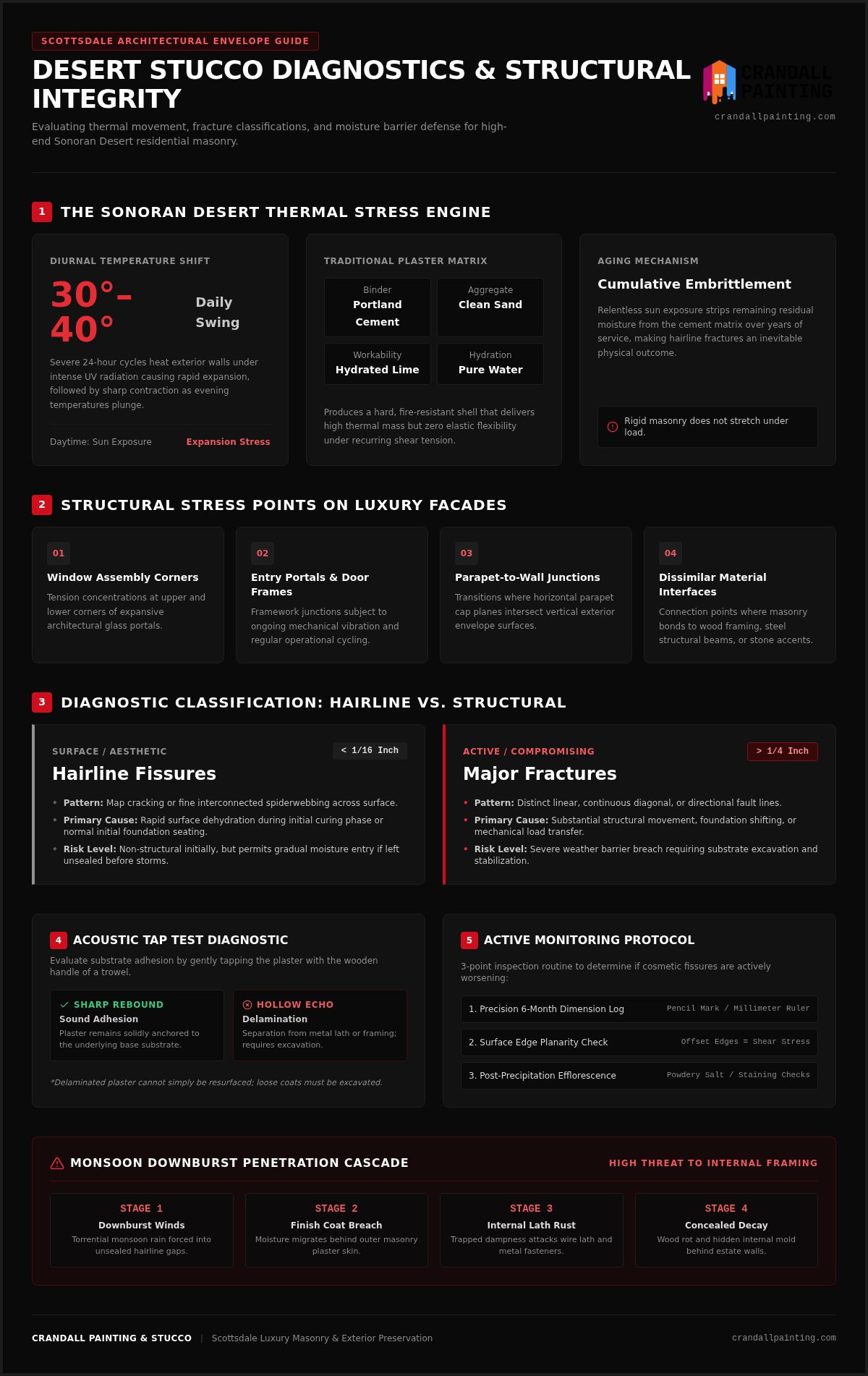
Scottsdale’s climate exerts punishing physical stress on residential exteriors. The primary culprit is the dramatic diurnal shift; local temperatures routinely swing by 30 to 40 degrees within a single twenty-four-hour cycle. As surfaces heat up under intense ultraviolet radiation, exterior walls expand. When the sun dips behind the McDowell Mountains and the desert cools, the plaster rapidly contracts. Over years of unyielding sun exposure, the material loses its residual moisture, growing increasingly brittle. Because masonry does not stretch, minor hairline fissures become an inevitable physical outcome on virtually every local property, regardless of architectural caliber.
The Science of Thermal Expansion and Contraction
Continuous thermal movement generates massive stress concentrations across an estate’s exterior envelope. Plaster shifts against rigid framing members, with tension inevitably concentrating around natural structural weak points:
- Upper and lower corners of expansive window assemblies
- Door frames and entry portals subject to operational vibration
- Junctions between horizontal parapets and vertical exterior walls
- Transitions where masonry joins dissimilar architectural materials
Even premier custom estates in communities like DC Ranch or Desert Mountain experience these dynamics. Settling and thermal strain naturally manifest along these predictable fracture lines.
Monsoon Season: When Hairline Cracks Become a Risk
While an isolated surface fracture might seem harmless during dry spring months, summer monsoon storms completely change the equation. Driven by powerful downburst winds, torrential monsoon rain easily infiltrates unsealed hairline gaps. Once moisture breaches the finish coat, it migrates toward internal wire lath, metal fasteners, and wood framing members. Trapped dampness causes structural rust, wood rot, and internal mold growth that remains completely concealed until catastrophic failure occurs. Enlisting dedicated stucco crack repair scottsdale specialists before the summer storm season arrives is an essential protective measure to secure your home against severe internal water intrusion.
Identifying the Severity: Hairline Cracks vs. Structural Failure
Accurate diagnosis dictates whether an exterior flaw requires targeted aesthetic refinement or comprehensive stabilization. Surface fractures generally fall into two distinct classifications: minor hairline fissures measuring under 1/16 of an inch, and major fractures exceeding 1/4 of an inch. Fine, interconnected webs across a wall surface, often referred to as map cracking or spiderwebbing, typically point to rapid dehydration during the original curing phase. In contrast, linear or directional cracks stem from structural movement or mechanical load transfer.
A reliable diagnostic method is the tap test. By gently tapping the plaster surface with the wooden handle of a trowel, you can evaluate the bond beneath. A sharp, solid rebound indicates sound adhesion to the substrate. A dull, hollow echo reveals delamination, meaning the plaster has physically separated from the metal lath or framing. Delaminated sections must be excavated and replaced rather than simply filled.
When a Crack is “Just Cosmetic”
Fine hairline fissures often surface within the first few seasons of a home’s construction as the foundation establishes its initial footing. While these narrow gaps rarely indicate structural peril, ignoring them invites gradual moisture penetration that degrades underlying building materials over time. To track whether an aesthetic flaw is evolving into a more serious vulnerability, maintain an active monitoring protocol:
- Measure crack width precisely using a pencil mark or millimeter ruler at established six-month intervals.
- Check whether edges remain flush; elevated or offset edges signify shearing stresses underneath.
- Inspect for staining, efflorescence, or powdery salt deposits along the fracture line after precipitation.
Warning Signs of Serious Structural Issues
Wider fractures demand immediate, elevated intervention. Diagonal cracks radiating outward from window headers or continuous stair-step patterns following mortar joints in masonry block indicate genuine foundation movement or structural subsidence. Gaps wider than a standard pencil signal that the exterior plane is moving actively. In these scenarios, consulting an independent structural engineer before beginning physical surface work confirms that foundational settling has ceased.
Adhering to recognized industry standards, such as those established for professional stucco restoration, ensures that cosmetic work never masks deeper architectural liabilities. Once structural stability is verified, partnering with dedicated craftsmen for your stucco crack repair scottsdale project will permanently seal the envelope and return the exterior finish to an unblemished state.
The Art of Seamless Stucco Restoration and Texture Matching
Patching a wall merely seals an opening; genuine restoration renders the intervention invisible. Many property owners discover too late that standard handymen approach exterior masonry like indoor drywall, wiping premixed compound across the surface and calling it complete. This careless technique produces an unsightly visual scar that catches harsh desert sunlight from every angle. Delivering refined stucco crack repair scottsdale estates require calls for replicating the original plasterer’s hand pressure, aggregate size, and trowel motion.
Every historic period and custom builder in the Valley leaves a distinct textural signature behind. Flawless repair demands an artisanal touch capable of reading those subtle variations across the facade. When repairs fail to mirror the surrounding wall density, light breaks unevenly across the plane, exposing the patch immediately.
Matching Common Scottsdale Stucco Finishes
Mastering custom finishes requires tailored application techniques suited to Scottsdale’s distinctive architectural styles:
- Skip Trowel: This classic Spanish and Mediterranean finish demands an irregular, rhythmic touch. The craftsman holds the trowel at a shallow angle, skipping compound across the surface to produce raised flat plateaus separated by exposed base texture.
- Sand (Float) Finish: Common in contemporary and Santa Fe builds, this uniform style relies on precise aggregate grading. A sponge or wood float is worked in continuous circular motions to draw fine silica grains evenly to the face.
- Lace and Smear: Prevalent throughout mature neighborhoods in Paradise Valley and Gainey Ranch, this method involves spraying or spattering a rough base coat, then lightly flattening the high spots with a broad trowel.
Color Blending and the Role of Elastomeric Coatings
Applying standard latex paint over a fresh cement patch almost always reveals a distinct color halo. Fresh plaster absorbs pigment differently than decades-old masonry that has endured years of desert ultraviolet exposure. Specialized masonry sealers must balance the surface suction before any finish coat touches the wall.
High-build elastomeric coatings provide an ideal finish for desert properties. Formulated with flexible acrylic polymers, elastomeric membranes bridge microscopic fractures while flexing alongside the wall’s continuous expansion and contraction cycles. Because these coatings maintain elasticity across extreme thermal shifts, they prevent cured repairs from re-fracturing. Completing the project with high-grade exterior painting locks in the moisture barrier and delivers an enduring, perfectly integrated architectural facade.
Professional Repair Methodology for High-End Estates
Executing enduring stucco crack repair Scottsdale estates require demands a disciplined, multi-phase technical protocol. Quick cosmetic surface fills fail because they skip essential mechanical bonding. A master restoration sequence follows five exacting phases:
- Substrate Decontamination: Eliminating chalking paint, oxidized plaster, and desert dust from within the void.
- Mechanical Keying: Precision routing along the fracture line to generate an inverted channel that mechanically locks the new compound in place.
- Chemical Interlocking: Saturating exposed edges with an acrylic-polymer bonding liquid to stop dry masonry from drawing essential moisture out of the patch.
- Structural Bridging: Embedding alkali-resistant fiberglass mesh across wider fissures to distribute shifting stresses across a broader surface area.
- Artisanal Profiling: Hand-tooling custom aggregates to mirror adjacent wall topography before initiating a controlled hydration schedule.
Why Surface Preparation is 90% of the Work
Subsurface cleanliness governs whether a repair endures or delaminates. Residual desert dust, sun-baked oils, and aging elastomeric films prevent fresh compounds from fusing with the underlying wall. Mechanically opening a narrow crack into a balanced V-profile provides the physical depth needed to seat structural material. In the context of desert climate coatings, adhesion represents the chemical and mechanical interlocking of fresh cementitious compounds to weathered masonry without premature moisture depletion. Without this thorough preparation, patch edges lift within months.
The Curing Process: Patience for Permanence
Plaster gains its strength through chemical hydration rather than simple drying. Newly placed Portland cement remains highly caustic, often carrying a pH level above 12. Applying exterior coatings over uncured stucco chemically burns the paint, resulting in chalking, blistering, and severe discoloration. Lightly misting the repair over several days allows the crystalline structure to densify properly and the pH to neutralize. This disciplined waiting period ensures a flawless paint bond.
To preserve your home’s exterior with meticulous craftsmanship, review our comprehensive suite of stucco crack repair scottsdale restoration services to schedule your professional property assessment.
Investing in Longevity: Why Master Craftsmanship Matters
Preserving the architectural envelope of a luxury property is an active investment in capital asset protection. While temporary fills may conceal blemishes for a single season, settling for cosmetic shortcuts invites systemic failures beneath the surface. Engaging a true restoration specialist for stucco crack repair scottsdale homeowners rely on shields framing from water intrusion and arrests recurring degradation before interior finishes suffer.
Master-level restoration yields substantial financial returns over time. Addressing foundational masonry integrity early prevents cascading remediation costs associated with framing replacement, re-lathing, and full substrate rebuilds. Discerning estate owners recognize that true value lies in the precision of the process:
- Meticulous Property Protection: Complete containment of stone pavers, custom bronze fixtures, and delicate desert landscaping from mechanical abrasion and overspray.
- Architectural Continuity: Achieving indistinguishable transitions between historical lime-wash finishes, aged float coats, and fresh patches.
- Clear Operational Transparency: Reliable schedules, precise progress updates, and a respectful on-site presence suitable for private communities.
Curb Appeal and Property Value in Paradise Valley
In luxury markets like Paradise Valley, DC Ranch, and Scottsdale Mountain, exterior perfection is an unspoken standard. Prominent fractures or poorly matched textures stand out immediately under harsh desert daylight, signaling delayed maintenance during inspections and appraisal reviews. Architectural Review Boards enforce stringent guidelines regarding exterior uniformity, making visible patch work an immediate compliance liability. A pristine facade assures appraisers and prospective purchasers that the home has received uncompromising stewardship.
The Crandall Difference: A Legacy of Excellence
Since 2004, Crandall Painting & Stucco has delivered refined craftsmanship tailored specifically to the Sonoran Desert’s severe conditions. Our approach treats exterior surfaces as an integrated whole. By coordinating masonry restoration alongside wood refinishing, we ensure that exposed architectural beams, decorative entries, and plaster walls age gracefully together.
Elevate and protect your estate’s architectural heritage. To restore your home’s exterior to flawless condition, contact Crandall Painting for a professional consultation with our master restoration team.
Restoring Your Desert Estate with Lasting Confidence
Preserving an architectural masterpiece against the harsh Sonoran climate requires precision, patience, and true artisan skill. Recognizing early environmental stress before it invites monsoon water intrusion protects your home’s framing from costly structural deterioration. True restoration isn’t about hiding a crack; it’s about matching original aggregates and trowel work so thoroughly that the repair disappears entirely into the surrounding plane.
Serving Scottsdale and Paradise Valley since 2004, our craftsmen specialize in invisible texture matching and comprehensive exterior protection. When you demand uncompromising excellence for your stucco crack repair scottsdale project, invest in solutions engineered to withstand extreme desert heat. Request a professional stucco restoration consultation today, and ensure your private sanctuary remains as enduring as it is beautiful.
Frequently Asked Questions
Is it normal for stucco to have hairline cracks in Scottsdale?
Yes, minor hairline fissures are completely normal in the Sonoran Desert due to constant thermal expansion and contraction. Daily temperature swings of 30 to 40 degrees cause continuous movement against rigid building materials. While these superficial cracks don’t necessarily indicate structural failure, you shouldn’t ignore them. Sealing them promptly prevents wind-driven moisture from reaching your home’s underlying lath and framing during summer storms.
How much does it cost to repair stucco cracks in Arizona?
Repair costs vary widely depending on the damage scope, crack width, accessibility, and the complexity of the architectural texture. Minor surface hairline sealing requires significantly less labor than deep structural excavation, lath re-securing, and multi-layered finish replication. Factors such as custom paint blending, elastomeric coating application, and HOA color matching also shape the overall investment. A professional on-site evaluation provides an accurate assessment tailored to your estate’s specific architectural requirements.
Can I just use caulk to fix stucco cracks?
Standard silicone or painter’s caulk should never be used on exterior stucco. Smooth caulking cannot mimic mineral aggregate textures, leaving glossy, smooth bands across textured walls that stand out starkly under Arizona sunlight. Cheap sealants also degrade and pull away under relentless ultraviolet exposure. Proper restoration demands specialized acrylic-modified patching compounds and textured masonry sealers engineered to flex with masonry walls while replicating surrounding trowel profiles.
Will the stucco repair match my existing wall color and texture?
With expert stucco crack repair Scottsdale specialists provide, a restored area blends invisibly into the surrounding wall. Achieving this requires matching aggregate grain sizes and duplicating the original trowel technique, whether skip trowel, sand float, or lace. Because sun exposure weathers existing exterior paint over time, precision touch-ups require custom tint matching or applying premium elastomeric coatings across architectural break lines to ensure complete visual uniformity.
How long does a professional stucco repair take to complete?
Most residential repairs require two to four days of work, spaced out to respect necessary curing intervals. Preparing the substrate, routing cracks, applying bonding agents, and hand-troweling the finish often takes one to two days. However, fresh Portland cement plaster requires adequate hydration and curing time before applying coatings. Rushing this process traps alkalinity behind the paint, so scheduling sufficient curing time guarantees long-term durability and flawless finish adhesion.
Does a crack in my stucco mean I have a foundation problem?
Most hairline stucco cracks stem from natural thermal movement or minor initial settling rather than foundation failure. However, diagonal cracks extending outward from door headers, horizontal fractures near ground level, or continuous stair-step separations along concrete blocks warrant closer attention. If fractures measure wider than 1/4 inch or display offset edges, arrange an assessment with a structural engineer before proceeding with aesthetic masonry restoration. For property owners seeking deeper insight into how slab settling and masonry movement occur, read more about professional concrete repair and stabilization techniques.
Late autumn through early spring provides the ideal climate for exterior masonry work, as moderate temperatures allow patching compounds to cure gradually without rapid moisture evaporation. Completing stucco crack repair Scottsdale estates require before the summer monsoon season arrives is critical. Sealing vulnerable fissures in spring ensures wind-driven rains cannot penetrate your exterior walls, protecting internal wire lath and wood framing from concealed water damage.
How often should I inspect my stucco for damage?
Inspect your home’s exterior envelope at least twice a year, ideally in spring before high summer temperatures arrive and in late autumn after the monsoon season concludes. Focus your inspection on parapet caps, window corners, patio transitions, and areas where exterior masonry contacts soil or hardscape pavers. Catching narrow fractures early simplifies restoration and protects the long-term architectural integrity of your property.