
You notice a faint, amber-colored ring blooming across your pristine tray ceiling, right where the custom skip-trowel texture should be flawless. It isn’t just a cosmetic blemish. It’s a signal that the structural integrity of your home is under threat from hidden moisture. In the Valley’s unique climate, where monsoon rains or failing AC units often cause internal havoc, a prompt response is essential to prevent mold and permanent damage.
We understand the anxiety that comes with these discoveries. You’re likely worried about whether the repair will ever truly match your high-end finishes or if toxic spores are already colonizing behind the paper. This guide provides a master craftsman’s perspective on drywall water damage repair phoenix, offering clarity on when to patch and when to replace. You’ll discover how to identify the source, assess the scope of work, and achieve a seamless restoration that preserves your property’s value. From infrared detection to meticulous texture matching, we’ll show you how a professional approach ensures your walls remain both healthy and beautiful. Peace of mind begins with understanding the restoration process from the inside out.
Key Takeaways
- Identify how the unique Phoenix environment, from monsoon rain to attic-mounted AC units, specifically impacts your home’s interior integrity.
- Learn why a meticulous assessment within the first 48 hours is vital for preventing mold and preserving your high-end wall finishes.
- Discover the professional criteria for determining whether to repair or replace saturated panels to maintain a flawless, structurally sound result.
- Understand the artisanal techniques required for drywall water damage repair phoenix to ensure an invisible blend with custom textures like skip-trowel or knockdown.
- Gain insights into restoring complex decorative surfaces, including Venetian plaster and faux finishes, to their original aesthetic brilliance.
Understanding the Causes of Drywall Water Damage in the Phoenix Desert
The arid beauty of the Sonoran Desert often masks the hidden environmental stressors that compromise high-end residential interiors. While we think of the Valley as a dry environment, the specific composition of drywall makes it highly susceptible to even minor moisture intrusion. When water enters the home, the gypsum core acts like a professional-grade sponge. It draws liquid deep into the material, which eventually compromises the structural bond of the paper facing and leads to visible degradation. Understanding these specific local causes is the first step toward a successful project involving drywall water damage repair phoenix.
Many homeowners are surprised to find that external forces are often the primary culprit. Beyond direct storm damage, the relentless desert sun causes building materials to expand and contract at different rates. This thermal movement creates hairline fractures in the building envelope. Additionally, the mineral-heavy hard water common in the Phoenix metro area puts significant stress on internal plumbing systems. This often leads to pinhole leaks that remain undetected until a wall surface begins to soften or discolor.
The Stucco-Drywall Connection
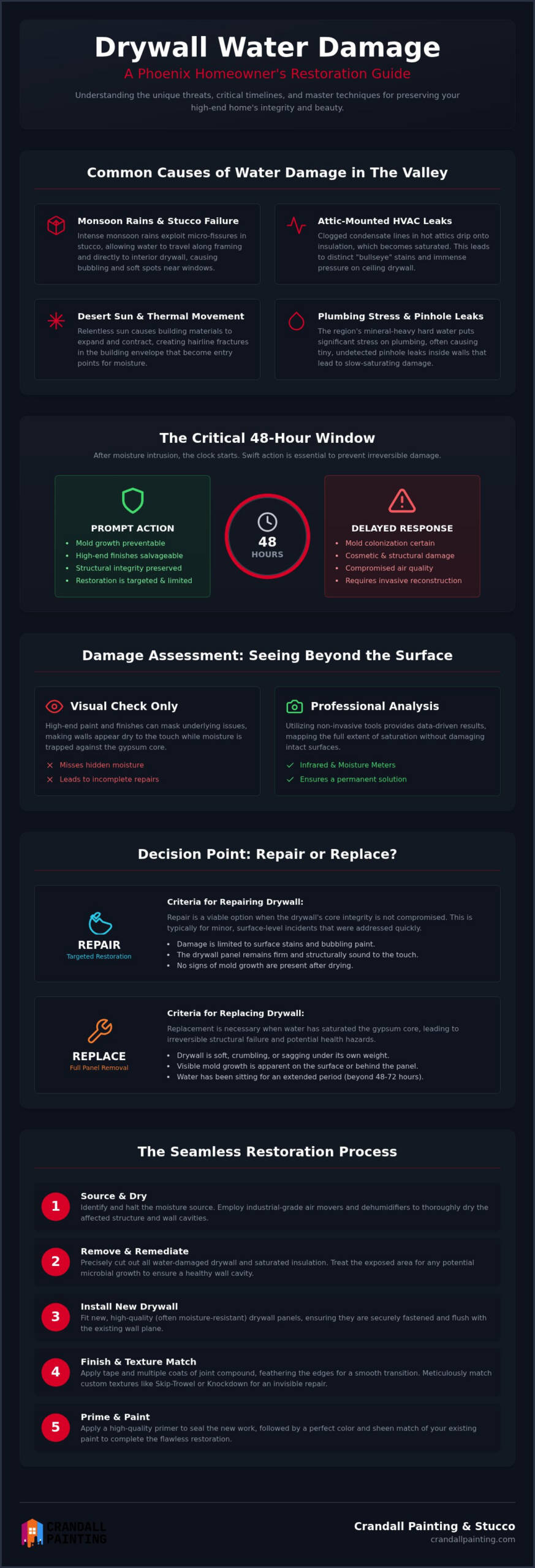
In many Scottsdale and Paradise Valley estates, the exterior stucco and interior drywall function as a single, integrated system. When driving monsoon rains exploit micro-fissures in the facade, water travels along the framing members directly to the interior surfaces. You might notice bubbling paint or a soft spot near a window frame. This is a clear signal that the exterior barrier has failed. Simply patching the interior is a temporary fix; true restoration requires addressing stucco cracks to ensure moisture cannot return. We also frequently observe wicking damage, where poor exterior drainage allows groundwater to soak into the base of the drywall, causing baseboards to warp and plaster to crumble.
HVAC and Attic Leak Indicators
Because many Phoenix homes utilize attic-mounted HVAC systems, the ceiling is often the first place damage appears. A slow drip from a clogged condensate line typically creates a distinct, circular bullseye stain. These leaks are particularly deceptive because the attic insulation absorbs the water first. By the time the stain appears on your ceiling, the insulation is often heavy and saturated, which puts immense pressure on the drywall screws. The extreme heat of a Phoenix attic combined with this trapped moisture creates a localized greenhouse effect. This environment significantly accelerates the risk of mold growth within the wall cavity. Professional drywall water damage repair phoenix must account for these hidden attic variables to ensure a permanent, healthy result.
The 48-Hour Window: Why Immediate Assessment is Critical
In the restoration world, the first 48 hours are often referred to as the “golden window.” After this point, the risk of microbial growth escalates from a possibility to a certainty. While the Phoenix heat might suggest that walls dry quickly on their own, the reality is that trapped moisture within the wall cavity creates a stagnant, humid micro-environment. This is the primary reason that professional drywall water damage repair phoenix begins with an urgent, data-driven assessment rather than a simple visual check. Delaying action doesn’t just lead to cosmetic issues; it compromises the structural integrity of the gypsum board itself.
When drywall becomes saturated, the gypsum core loses its crystalline bond. This softening means the material can no longer effectively hold the screws or nails that secure it to the wall studs. In high-end Scottsdale homes, ignoring a “musty” smell can lead to degraded air quality and the eventual need for much more invasive reconstruction. Acting quickly allows for targeted drying, which can often save custom architectural features that would otherwise require a full replacement.
Identifying Hidden Moisture
Surface appearances are frequently deceptive. High-end wall finishes, particularly those with multiple layers of paint or specialized coatings, can trap moisture against the gypsum core while appearing dry to the touch. We utilize non-invasive moisture meters to penetrate these layers electronically and provide an accurate saturation reading without damaging your walls. Infrared technology detects subtle temperature variances caused by moisture evaporation, allowing us to see through the surface and map the exact boundaries of the damage. For discerning homeowners, this level of precision prevents the need for unnecessary demolition while ensuring no damp pockets are left behind to foster mold.
The Progression of Water Damage
Understanding the stages of degradation helps in deciding the level of intervention required to restore your home to its original state.
- Stage 1: Discoloration and Staining. This early warning often manifests as amber or yellow rings on the surface. At this point, the damage is primarily aesthetic, but it indicates an active or recent leak.
- Stage 2: Physical Deformation. The wall begins to swell, paint starts to bubble or peel, and the drywall becomes noticeably soft to the touch. The structural bond of the paper facing is now compromised.
- Stage 3: Structural Failure and Colonization. At this point, the material may sag or crumble entirely. This stage is often accompanied by visible mold growth and requires immediate removal of the affected sections.
According to the EPA guide on mold and moisture, preventing mold requires drying these materials within 24 to 48 hours. If you detect a persistent odor or notice a changing texture on your walls, it’s likely that moisture is already affecting your property’s health. Addressing these issues early preserves both the well-being of your family and the value of your estate. If you’re concerned about a recent leak, a professional consultation can provide the clarity needed to protect your home’s interior.
Repair vs. Replacement: Evaluating Drywall Saturation
Determining whether to preserve existing material or perform a full-scale extraction is a decision that defines the longevity of your restoration. For a master craftsman, this isn’t a matter of convenience, but a rigorous evaluation of structural integrity. We utilize the “1% Rule” as a technical benchmark. When moisture meters indicate that the gypsum core retains levels significantly above its dry equilibrium of 1% after professional mitigation, the material’s internal bond has likely dissolved. In the context of drywall water damage repair phoenix, attempting to patch over-saturated boards often leads to “joint telegraphing,” where the outlines of the repair become visible over time as the materials settle at different rates.
Ceiling damage requires an even more conservative approach due to the relentless pull of gravity. A saturated ceiling panel can weigh several times its original mass, placing dangerous stress on the fasteners. We also carefully inspect the underlying insulation and wooden framing. If the insulation has compressed into a damp mat, it acts as a permanent moisture reservoir that will eventually rot the new drywall from the inside out. Ensuring these hidden elements are completely dry is the only way to protect your investment.
When to Choose Professional Patching
Minor “Category 1” leaks, such as a clean water line break that was caught immediately, often qualify for surgical patching. This is only viable when the spread is limited and the gypsum remains firm to the touch. Our process involves “cutting back” the damaged area to the center of the nearest dry studs, providing a solid anchor point for the new material. We don’t just bridge the gap; we structurally reinforce the perimeter with specialized backing to prevent the hairline cracks that commonly plague amateur repairs. This meticulous approach ensures the patch becomes a permanent, invisible part of the wall’s structure.
When Full Replacement is Mandatory
Certain scenarios leave no room for compromise. If your home has suffered a “Category 3” intrusion, such as groundwater or sewage backup, the drywall must be replaced entirely to eliminate health risks. Similarly, when large-scale saturation occurs in rooms with complex architectural details, replacing the entire panel is often the most cost-effective path to an aesthetically perfect result. It’s far better to start with a flawless foundation than to struggle with blending a large patch into a high-end finish. This ensures the final surface is indistinguishable from the surrounding walls, maintaining the bespoke quality of your Scottsdale or Paradise Valley estate.
The Restoration Process: Achieving a Seamless Finish
Restoring a wall after water intrusion is an exercise in surgical precision. It begins with precision extraction, where we remove compromised material without disturbing the surrounding architectural details. This careful approach is essential for drywall water damage repair phoenix, especially in residences where custom crown molding or integrated lighting systems are present. By isolating the affected area and using specialized dust containment, we preserve the pristine condition of your home while preparing the site for a structural renewal.
The hallmark of a master craftsman is the ability to make the repair disappear. We don’t simply fill a hole; we engineer a transition that accounts for the subtle ways light interacts with a surface. This involves a methodical layering of joint compound, followed by extensive feathering that extends far beyond the physical patch. This technique ensures there are no abrupt changes in the wall’s plane, creating a foundation that is ready for the most demanding finishes.
Mastering the Texture Match
Phoenix architecture is renowned for its diverse interior surfaces, ranging from heavy knockdown to delicate orange peel and perfectly smooth Level 5 finishes. Replicating the “loft” and “density” of an existing spray pattern requires a deep understanding of air pressure and material viscosity. We meticulously hand-tool each patch with artisanal knives to replicate the subtle irregularities of aged drywall surfaces, ensuring the new material mimics the original’s character. This artisanal attention to detail prevents the “patchy” look that often results from generic repair methods.
Priming and Surface Preparation
Water stains are notoriously persistent and will often migrate through standard latex paint if not properly sealed. We utilize high-solids, oil-based primers to lock in residual tannins and mineral deposits, providing a chemical barrier against “stain bleed-through.” Once the patch is sealed, we often perform a wide-area skim coat to ensure light-reflective consistency across the entire wall section. This uniform substrate is a non-negotiable requirement for high-end interior painting, as any variation in texture or porosity will be amplified by modern lighting. To ensure your home’s surfaces are restored to their original elegance, we invite you to explore our full range of drywall repair and restoration services.
Beyond the Patch: Restoring Decorative and Faux Finishes
True restoration extends far beyond the structural layer. In the Valley’s most prestigious homes, walls are rarely just painted; they are curated with layers of depth and history. When moisture compromises these surfaces, the task of drywall water damage repair phoenix evolves into a delicate artistic endeavor. We approach every project with a white-glove philosophy, ensuring that adjacent custom cabinetry and hand-carved wood trim are meticulously protected before a single tool is lifted. This commitment to detail ensures that the restoration process remains as refined as the property itself. For luxury interiors, “close enough” is never acceptable. We understand that a successful repair must be indistinguishable from the original work, even under the most scrutinizing light.
Artisanal Wall Texture Restoration
The technical demands of drywall water damage repair phoenix reach their peak when dealing with artisanal layers. Rooms featuring custom faux finishing, decorative glazing, or metallic leaf require a master’s touch to replicate. We don’t just apply a single color; we recreate the aged, multi-tonal depth through a methodical process of color layering and manipulation. Venetian plaster presents its own unique challenges. As a specialized lime-based finish, it cannot be patched with standard compounds. We utilize authentic materials and traditional troweling techniques to fuse the new section with the old, eliminating visible seams and preserving the stone-like luster that defines these high-end surfaces.
The Final Transformation
Achieving a perfect finish requires a holistic view of the room’s aesthetics. Once the structural and decorative repairs are complete, we coordinate with our interior painting services to provide a seamless room refresh. This final step is critical for sheen matching. The intense, direct sunlight common in Phoenix will ruthlessly highlight any discrepancy in paint finish or texture. We meticulously adjust the sheen to ensure the light reflects uniformly across the entire wall. This level of craftsmanship is the foundation of the Crandall promise. Our goal is a restoration so precise and thorough that the memory of the original damage is completely forgotten, leaving behind only the beauty and value of your home.
Restoring Your Home’s Structural and Aesthetic Integrity
Protecting a luxury residence requires a blend of technical vigilance and artistic mastery. As we’ve explored, addressing the root causes of moisture intrusion and acting within the critical 48-hour window are the most effective ways to preserve your property’s long-term value. Whether you’re managing the aftermath of a monsoon or a subtle HVAC leak, the goal is a restoration that leaves no trace of the incident behind. A precise assessment ensures that every layer, from the interior gypsum to the exterior stucco, is perfectly sound.
With over 20 years of expertise in Phoenix and Scottsdale restoration, Crandall Painting & Stucco provides the meticulous, white-glove care your home deserves. We specialize in seamless texture matching and the complex restoration of high-end decorative finishes, ensuring that every repair meets our uncompromising standards for excellence. Selecting a specialist for drywall water damage repair phoenix is an investment in your home’s future beauty and structural health. We invite you to Request a Professional Restoration Consultation today. Let us transform your walls back into the flawless canvases they were meant to be, providing you with total peace of mind and a home that feels entirely renewed.
Frequently Asked Questions
How can I tell if my drywall has water damage before a stain appears?
You can detect moisture before a visible stain by feeling for changes in the wall’s texture or firmness. Saturated gypsum becomes soft or spongy to the touch, and you might notice the paint beginning to lose its adhesion, resulting in subtle bubbling. A persistent musty odor in specific rooms often indicates moisture trapped within the wall cavity. For a definitive assessment, we use non-invasive moisture meters to identify hidden dampness behind high-end finishes.
Is it safe to just paint over a small water stain on the ceiling?
Painting over a water stain without addressing the underlying cause is never recommended for long-term property protection. Standard latex paint cannot block the tannins and minerals found in water stains, meaning the discoloration will eventually bleed back through the new finish. More importantly, simply covering the mark ignores potential mold growth or structural weakening of the ceiling panel. A professional approach involves sealing the leak, drying the substrate, and using specialized primers.
How long does the drywall water damage repair process typically take?
Most projects involving drywall water damage repair phoenix require between three and five days to complete properly. This timeline accounts for the essential drying phase, which must be verified with moisture meters before any new material is installed. Once the area is dry, our craftsmen spend time on precision patching and texture matching. We then allow for proper cure times between coats of compound and primer to ensure a seamless, high-end result.
Does homeowners insurance in Phoenix usually cover drywall water damage?
Homeowners insurance in the Valley typically covers drywall damage caused by sudden and accidental events, such as a burst pipe or a failing water heater. However, damage resulting from long-term maintenance issues, like unresolved hairline stucco cracks or gradual AC condensation leaks, may be excluded. We recommend reviewing your specific policy or consulting with your adjuster to determine coverage eligibility for the reconstruction phase of your interior wall restoration and protection.
Can mold grow inside my walls even if the surface looks dry?
Mold can certainly thrive inside your wall cavity even if the exterior surface feels dry to the touch. High-end wall coatings and multiple layers of paint often act as a vapor barrier, trapping moisture against the wooden studs and the back of the drywall. This creates a humid micro-environment where mold spores can colonize within 48 hours. Professional detection tools are necessary to ensure the interior space is completely dry and safe.
What is the average cost of drywall water damage repair in Scottsdale?
The investment for drywall water damage repair phoenix varies significantly based on the complexity of your home’s architectural finishes. Factors that influence the final cost include the extent of the saturation, the height of the ceilings, and the type of custom texture required for an invisible blend. Intricate finishes like Venetian plaster or multi-tonal faux glazes require more intensive labor than standard textures. We provide detailed consultations to assess these unique variables.
How do you match the specific texture of my existing walls?
Matching a custom texture is an artisanal process that requires adjusting air pressure, nozzle settings, and material viscosity. Our master craftsmen analyze the loft and density of your existing wall pattern to replicate it exactly. Whether your home features a skip-trowel, knockdown, or a perfectly smooth Level 5 finish, we use hand-tooling techniques to ensure the patch is indistinguishable. This meticulous attention to detail is what defines our white-glove restoration service.
What should I do immediately after discovering a leak in my wall?
Your first priority should be identifying and stopping the source of the water to prevent further saturation. Once the leak is contained, clear the area of furniture and valuables to protect them from secondary damage. Avoid cutting into the wall yourself, as this can disturb electrical lines or spread mold spores if they are present. Contacting a specialist for a professional assessment will ensure that the drying and restoration process begins correctly and safely.